


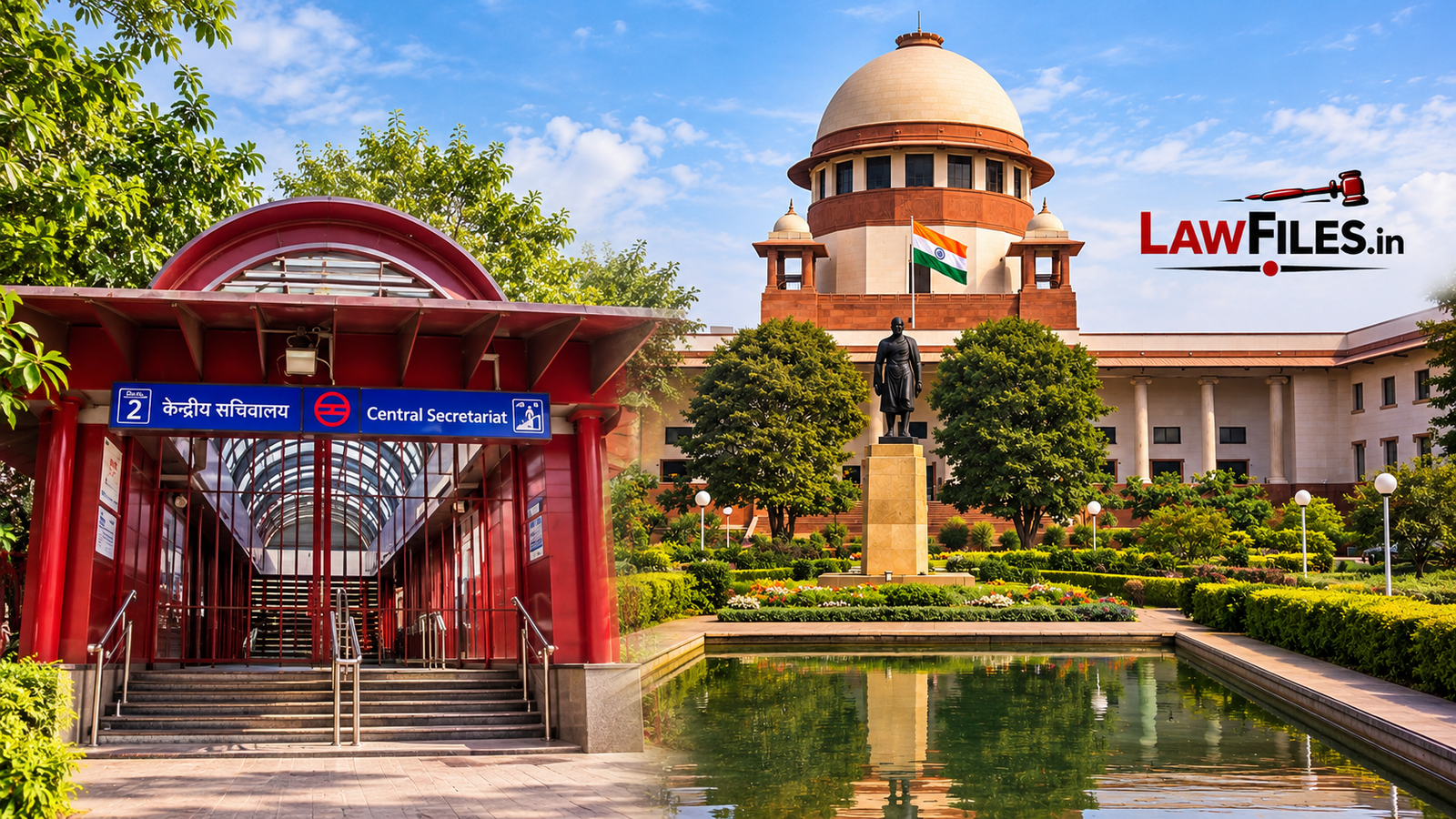
A contempt petition has been filed before the Supreme Court alleging that senior government and transport officials failed to comply with the Court’s October 9 directions concerning the operation of Delhi Metro and railway services ahead of the proposed October 10 demonstrations against Chief Election Commissioner Gyanesh Kumar. Advocate Shailendra Mani Tripathi has sought contempt action against Union Home Secretary Govind Mohan, Delhi Police Commissioner Anurag Kumar and Delhi Metro Rail Corporation Chairperson D. Thara. The petition alleges that station closures and train cancellations continued despite the Court’s direction that public transport should not be completely prohibited and must instead be regulated in a manner that minimises inconvenience to the public. These assertions are allegations in a pending contempt plea; they have not yet been judicially established.
The controversy emerged after authorities announced extensive transport restrictions in anticipation of demonstrations called by the Cockroach Janata Party and other groups seeking the resignation of the Chief Election Commissioner. The protest was linked to wider political objections concerning the revision of electoral rolls and the functioning of the Election Commission. Delhi Police had communicated a direction to close entry and exit gates at 57 Metro stations, while railway services scheduled to arrive at New Delhi and Hazrat Nizamuddin stations during a specified period were also to be cancelled. The scale of the proposed restrictions prompted an urgent approach to the Supreme Court by CPI(M) General Secretary M.A. Baby and other petitioners, who argued that the arrangements risked immobilising ordinary residents under the guise of maintaining public order.
On October 9, a Bench comprising Chief Justice of India Surya Kant and Justices Joymalya Bagchi and V. Mohana expressed serious concern about the breadth of the restrictions. The Bench distinguished between regulating public transport and bringing it to a complete halt. The Solicitor General, Tushar Mehta, assured the Court that he would impress upon the authorities the need to reassess the restrictions and allow Metro and railway services to operate in a suitable, regulated manner. The Court recorded that assurance and clarified that there should be no outright prohibition on the movement of Metro trains, while permitting the authorities to adopt proportionate operational measures and requiring the revised decision to be widely publicised. The Court was concerned not only with those intending to protest but also with students, employees, senior citizens and other residents who depend on public transport for their daily lives.
The contempt petition alleges that the subsequent arrangements did not give meaningful effect to that judicial direction. Tripathi claims that he visited GTB Nagar and Vishwavidyalaya Metro stations at around 9:30 p.m. on October 9 and found entry gates closed, with access being managed principally to permit passengers to exit. He has reportedly stated that Gate No. 2 at GTB Nagar was locked and that other gates were similarly closed or restricted. The petitioner says he recorded a video of the situation and can furnish it along with real-time location details. He also relies on a DMRC announcement stating that entry and exit at the affected stations would remain closed from 9 p.m. on October 9 until 6 p.m. on October 10, subject to review by security agencies. Although the number of stations identified for closure was subsequently reduced from 57 to 45, the petitioner contends that the essential restriction remained in force and was inconsistent with the Court’s direction.
The petition further alleges that the continued curbs were disproportionate to the circumstances on the ground. Tripathi states that he visited Jantar Mantar and adjoining areas on the evening of October 9 and found police and paramilitary personnel present, but no gathering of protesters at the time of his visit. He questions whether the continuation of extensive transport restrictions could be justified when the immediate surroundings did not appear to reflect the scale of threat assumed by the authorities. The petition seeks revocation of blanket restrictions affecting Metro and railway operations and directions for regulated services accompanied by immediate and transparent public advisories. The factual account of the visits, the justification for the security decisions and the precise scope of compliance will, however, require examination by the Court rather than acceptance solely on the petitioner’s assertion.
The legal threshold for contempt is materially higher than showing that an administrative decision caused hardship or differed from what a litigant considers appropriate. Under Article 129 of the Constitution, the Supreme Court is a court of record with the power to punish for contempt of itself. The Contempt of Courts Act, 1971, defines civil contempt to include wilful disobedience of a judgment, decree, direction, order, writ or other process of a court, or wilful breach of an undertaking given to a court. The decisive question will therefore be whether the authorities knowingly and deliberately failed to comply with a clear judicial command, rather than whether their decisions were merely inconvenient, excessive or open to challenge on other legal grounds.
The word “wilful” is central to that inquiry. A contempt court ordinarily examines the terms of the original order, the obligations it imposed, the knowledge of the persons against whom action is sought and the conduct said to constitute disobedience. An official’s disagreement with the wisdom of a judicial direction is not a lawful basis for ignoring it. Equally, contempt jurisdiction is not intended to become an automatic enforcement mechanism for every disputed interpretation of an order. If the direction leaves room for operational judgment, or if the authorities have taken steps they genuinely considered consistent with the order, the Court must examine the actual language of the direction and the surrounding circumstances before concluding that disobedience was deliberate. The legal assessment must distinguish between an imperfect implementation, a mistaken interpretation and conscious defiance.
That distinction is especially important here because the Supreme Court did not order that every Metro station remain fully accessible under all circumstances, nor did it remove the authorities’ power to take security measures. The Court expressly accepted that transport operations could be regulated. The central limitation was that regulation should not become a complete prohibition and should remain proportionate to the public-safety objective. The contempt court may therefore have to consider whether closure of selected station entrances, restrictions on interchange facilities, altered service patterns or cancellations of particular trains were compatible with the order, or whether their cumulative effect recreated the very blanket shutdown the Bench had cautioned against. The authorities’ reasons, the operational alternatives considered and the information available to them at the relevant time may all be material.
The issue also illustrates the constitutional principle of proportionality. Article 19(1)(d) protects citizens’ freedom to move freely throughout the territory of India, subject to constitutionally permissible restrictions, while Article 21 protects life and personal liberty. The right to move through a city is not absolute, and the State has a legitimate responsibility to prevent violence, protect public infrastructure and ensure the safety of protesters, police personnel and the wider public. But restrictions must have a rational connection to a legitimate objective and must not extend further than reasonably necessary to achieve it. Where a less restrictive measure—such as regulating entry, increasing security deployment, limiting access to specific sensitive locations or adjusting service frequency—could address the identified risk, a sweeping shutdown requires a particularly convincing justification.
The proportionality principle is not a demand that authorities wait for violence to occur before acting. Preventive policing is often necessary, and officials must be permitted to respond to credible intelligence and prior incidents. The legal difficulty arises when precaution becomes indiscriminate. A restriction that affects a large population, including people with no connection to the proposed demonstration, must be supported by reasons proportionate to its reach. The Court’s October 9 intervention reflected precisely this concern: public order is a legitimate state responsibility, but the means chosen to secure it cannot be assessed solely from the perspective of law enforcement while ignoring the burden placed on ordinary residents.
The public transport dimension makes the dispute more consequential than a disagreement over the management of one demonstration. Metro services are essential urban infrastructure for workers, students, patients, caregivers and people travelling to railway stations, workplaces and public institutions. Train cancellations can have effects well beyond Delhi, disrupting journeys that began in other parts of the country and leaving passengers with limited alternatives. Where a security measure affects an entire transport network, the State must consider not only whether it makes policing easier but also whether it transfers the cost of maintaining order onto citizens who are not involved in the event. Public inconvenience is not automatically unconstitutional, but widespread disruption demands a reasoned, carefully tailored response.
The matter also raises an institutional question concerning the binding character of judicial directions. When the Supreme Court records an assurance by the law officer appearing for the Union and issues directions on that basis, compliance cannot be treated as an optional administrative preference. The executive retains discretion in implementing the order only within the boundaries the Court has prescribed. If the authorities believe that circumstances require a measure apparently inconsistent with a judicial direction, the legally sound course is to seek clarification or appropriate modification rather than unilaterally proceed on a conflicting interpretation. Judicial review would lose practical force if the administration could accept a direction in court and then implement substantially the same measure without a transparent explanation.
At the same time, contempt proceedings must not be used to substitute judicial supervision for every operational decision taken during a security-sensitive event. The authorities may possess information about threats, crowd movement and potential violence that is not fully reflected in a brief public advisory. The Court must be able to examine such material without presuming either that the State’s security assessment is conclusive or that any restrictive measure is inherently unlawful. A balanced inquiry would test the restrictions against the terms of the order, the reasons documented by the authorities, the availability of less restrictive alternatives and the steps taken to inform the public. This would allow accountability without undermining legitimate preventive policing.
The alleged failure to issue or publicise clear advisories is independently significant. The Supreme Court had expressly stressed the need for wide publicity so that commuters would not be taken by surprise. Timely and accurate information is not a mere administrative courtesy when a public service is being restricted on a large scale; it is part of the practical protection against avoidable hardship. Passengers need to know which stations are affected, whether entry and exit are restricted, what alternative routes are available and whether the arrangements have changed. If public notices are unclear, late or inconsistent with actual operations, commuters may suffer even where a restriction has a legitimate security purpose. Whether the publicity requirement was adequately met is therefore a relevant question in assessing compliance with the Court’s order.
The case must also be understood in the context of the right to peaceful protest. Article 19(1)(a) protects freedom of speech and expression, while Article 19(1)(b) protects the right to assemble peaceably and without arms, subject to reasonable restrictions in the interests specified by the Constitution. These rights do not confer an unrestricted entitlement to occupy any location, block highways or disregard lawful conditions imposed for public safety. Authorities may regulate demonstrations and prevent violence. But a restriction on a proposed protest should not automatically be translated into a restriction on the movement of the wider public. The constitutional balance requires the State to address the specific risk posed by the gathering without treating the entire city as though every resident were a potential participant.
The Supreme Court has not, merely by entertaining the original transport challenge or by the filing of the present contempt petition, granted blanket permission for the October 10 protest. Nor has it declared the authorities guilty of contempt. The immediate issue is narrower: whether the directions concerning regulated transport services and public advisories were complied with, and whether any failure was wilful. That distinction must be maintained because the legality of the protest arrangements, the proportionality of particular restrictions and the personal responsibility of individual officials are related but separate questions.
The outcome of the contempt plea will therefore turn on evidence and the precise wording of the October 9 order, not simply on the scale of commuter inconvenience. If the Court finds that officials deliberately preserved a blanket shutdown despite a clear direction against complete prohibition, it may consider the remedies available under its contempt jurisdiction. If, on the other hand, the authorities demonstrate that the revised arrangements were genuinely designed to comply with the order and were supported by proportionate security considerations, the allegation of wilful disobedience would require a different assessment, even if aspects of the implementation remain open to criticism.
The broader lesson is that public order and constitutional liberty are not competing objectives in which one must be sacrificed entirely for the other. A democratic administration must protect public safety while preserving ordinary civic life as far as reasonably possible. The Supreme Court’s October 9 directions placed that obligation in concrete terms by distinguishing regulation from prohibition; the contempt petition now asks whether that distinction was respected in practice. The Court’s eventual consideration may clarify not only the limits of executive discretion during demonstrations, but also the standard of accountability that applies when a judicial direction leaves room for administrative judgment while prohibiting an excessive or blanket restriction.
