


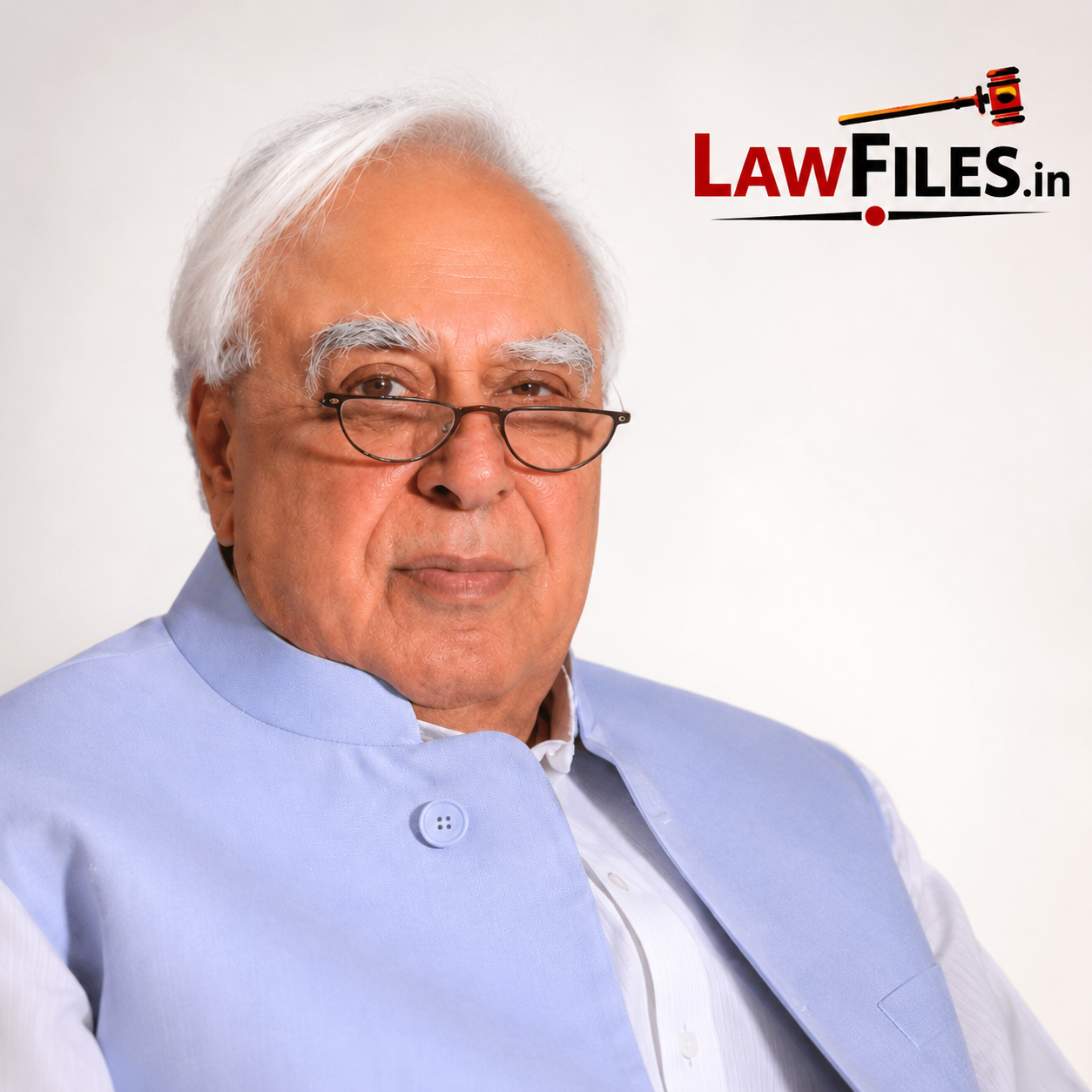
Senior Advocate and Rajya Sabha MP Kapil Sibal has raised a pointed concern over the functioning of two institutions that occupy an indispensable position in a constitutional democracy the judiciary and the press. Speaking in the context of the larger debate surrounding constitutional governance, institutional accountability and the erosion of public confidence, Sibal questioned whether both the judicial system and the media have adequately discharged their responsibilities as democratic checks on power. His remarks are significant not merely as political criticism but because they raise a deeper constitutional question: what happens to democracy when institutions constitutionally expected to scrutinise power themselves begin to lose public credibility?
The concern expressed by Sibal is not that either the judiciary or the press has ceased to exist as an institution. The concern is more fundamental—that institutions may formally continue to perform their functions while gradually losing the public confidence upon which their effectiveness ultimately depends. A court may continue to pronounce judgments, and newspapers and television channels may continue to publish reports, but constitutional democracy requires something more than institutional activity. It requires independence, credibility, fairness and the public perception that these institutions are willing and able to question power without fear or favour.
Sibal’s criticism therefore needs to be understood within the constitutional architecture rather than merely as an indictment of individual judges or journalists. The Indian Constitution deliberately distributes power between institutions and creates multiple mechanisms of accountability. The legislature makes laws, the executive implements them and the judiciary reviews executive and legislative action within constitutional limits. The press, though not expressly created by the Constitution as a separate constitutional organ, performs an equally important democratic function by informing citizens and scrutinising those exercising public power. When either of these institutions becomes ineffective, the consequences are not confined to the institution itself. They affect the citizen’s ability to understand, question and ultimately control the exercise of governmental power.
The judiciary occupies a particularly sensitive position in this structure because it is expected to protect constitutional rights even when those rights come into conflict with the interests of the State. Judicial independence is therefore not an institutional privilege. It is a constitutional mechanism designed to ensure that an individual citizen can challenge the State before a forum that is capable of deciding the dispute independently. The Supreme Court’s jurisprudence on judicial review, fundamental rights and the basic structure doctrine has repeatedly treated an independent judiciary as an essential feature of constitutional democracy. The problem arises when independence exists formally but the public begins to question whether judicial institutions are functioning consistently with the constitutional expectations placed upon them.
This question of public confidence has become increasingly relevant in recent years. Delays in adjudication, inconsistent approaches in politically sensitive cases, questions concerning judicial appointments, case allocation, transfers, transparency and the perception of unequal access to justice have contributed to a continuing public debate about the judiciary. Sibal has previously criticised the functioning of the collegium and argued that the system of judicial appointments lacks sufficient transparency and does not always ensure that the most meritorious candidates reach the Bench. He has also criticised delays and administrative functioning within courts, arguing that institutional reform cannot be confined to the process of deciding cases.
There is an important legal distinction here between judicial independence and judicial accountability. These concepts are sometimes presented as opposites, although constitutionally they are not. Judicial independence protects judges from external pressure, particularly executive or political interference. Judicial accountability, on the other hand, ensures that judicial power is exercised responsibly, transparently and according to law. A judiciary without independence can become vulnerable to political control; a judiciary without meaningful accountability can become vulnerable to institutional insularity. A constitutional democracy requires both.
The debate surrounding judicial appointments illustrates this tension particularly well. The collegium system emerged from the Supreme Court’s interpretation of Articles 124 and 217 of the Constitution and was designed principally to preserve judicial independence from executive dominance. Yet the system has repeatedly faced criticism for opacity, limited public reasoning and the absence of a transparent institutional mechanism through which the public can understand how candidates are assessed. The Supreme Court’s rejection of the National Judicial Appointments Commission also demonstrated the constitutional difficulty of introducing executive influence into judicial appointments. The challenge, therefore, is not simply to replace one system with another but to construct an appointments process that preserves independence while improving transparency and institutional accountability.
Sibal’s remarks also acquire significance because he has himself occupied different positions within India’s legal and political establishment. As a senior advocate, former Union Minister and parliamentarian, he has been both a participant in governance and a member of the Bar that regularly appears before the judiciary. His criticism consequently comes from someone who has experienced the functioning of constitutional institutions from several perspectives. That does not make his assessment immune from criticism, but it does make the underlying institutional questions worthy of serious consideration rather than dismissal as political rhetoric.
The second institution identified by Sibal the press presents a different but equally important constitutional problem. Freedom of the press is generally understood as flowing from Article 19(1)(a), which protects freedom of speech and expression. Although the Constitution does not separately mention a “freedom of the press”, the Supreme Court has consistently recognised that press freedom forms an essential part of the broader guarantee of freedom of expression. The reason is obvious: a democracy in which citizens are formally free to speak but cannot access reliable information about public affairs would possess only a limited form of democratic participation.
The press therefore performs a function that goes beyond reporting events. It creates an information environment within which citizens form opinions, evaluate governments and understand institutional decisions. If journalism becomes excessively dependent upon political, commercial or corporate interests, the resulting problem is not merely one of media ethics. It can become a democratic problem because citizens may no longer receive the information necessary to hold power accountable.
This is why Sibal’s criticism of the press cannot be reduced to a complaint about biased reporting. The deeper concern is whether the media retains sufficient independence to investigate uncomfortable questions, challenge powerful institutions and provide citizens with information that those in power may prefer to keep outside public scrutiny. The concern is particularly acute in an era where traditional journalism competes with television debates, digital platforms, social-media influencers and algorithmically distributed information.
The media environment has fundamentally changed. Information now travels faster than institutions can verify it. A claim can reach millions of people before a journalist has an opportunity to establish whether it is accurate. At the same time, the economic model supporting traditional journalism has become increasingly fragile. News organisations compete for attention, advertising and digital engagement, creating incentives for sensationalism and polarisation. The constitutional importance of free expression therefore coexists with an equally serious question concerning the quality and reliability of the information being disseminated.
A free press does not mean a press free from professional responsibility. Freedom of expression protects journalism even when it is critical of the government, judiciary or other powerful institutions, but responsible journalism requires verification, fairness and distinction between fact, allegation and opinion. The constitutional value of press freedom is weakened when sensationalism becomes more important than accuracy. Conversely, press freedom is equally threatened when governments, regulators or powerful institutions attempt to suppress legitimate criticism by characterising uncomfortable reporting as misinformation.
The problem therefore cannot be solved by simply demanding greater control over the media. Any regulatory response must itself be examined through the constitutional guarantee of free expression. The history of democratic societies demonstrates that governmental control over information can be far more damaging than irresponsible journalism. The constitutional objective should instead be to preserve a media environment in which independent journalism can flourish while mechanisms of professional accountability remain available for genuine violations.
The relationship between the judiciary and the press makes this issue even more complicated. Courts increasingly rely upon the media to communicate judicial proceedings to the public, while journalists rely upon courts as sources of authoritative information concerning disputes of public importance. Live-streaming of constitutional proceedings has further transformed the relationship between courts and citizens by allowing members of the public to witness proceedings directly rather than relying entirely upon subsequent reporting.
This development has considerable democratic value, but it also creates new responsibilities. Once courtroom remarks become instantly available to millions, an oral observation made during a hearing can acquire a public life even if it does not ultimately form part of the judgment. This makes restraint important on both sides. Judges must recognise the consequences of public remarks, while journalists must distinguish between an observation during arguments and the legal holding contained in the final decision.
The issue becomes even more sensitive when lawyers themselves participate in public discussions concerning cases in which they appear. Recent proceedings before the Supreme Court have witnessed a debate over whether advocates should publicly discuss cases they are handling. Senior Advocate Kapil Sibal had defended the proposition that judgments, once delivered, are matters of public discussion, while objections were raised concerning lawyers using public platforms to shape narratives around pending litigation. (Live Law)
This debate reflects a larger transformation in the legal profession. Lawyers are no longer communicating exclusively through court pleadings and oral arguments. Senior advocates, judges, academics and litigants increasingly participate in podcasts, interviews, televised discussions and social-media conversations. This can improve public understanding of the law, but it can also create the possibility that litigation becomes part of a parallel public-relations contest.
The constitutional challenge is therefore to preserve open justice without allowing public discourse to become an alternative form of adjudication.
Sibal’s broader concern about institutional failure must also be viewed against the principle of checks and balances. The Indian Constitution does not establish a rigid separation of powers in the classical sense. Instead, it creates overlapping institutional powers accompanied by mechanisms of restraint. Parliament can legislate, but courts can examine constitutional validity. The executive administers the country, but legislative and judicial oversight remain available. The media informs citizens, while citizens themselves ultimately exercise democratic control through elections and public participation.
When one institution fails, the others are expected to provide a degree of correction. But when several accountability mechanisms weaken simultaneously, the citizen is left in a more vulnerable position.
This is perhaps the most serious implication of Sibal’s criticism.
If the media fails to investigate governmental power, citizens may depend upon courts to expose illegality. If courts fail to provide timely remedies, citizens may depend upon the media to bring institutional failures to public attention. If both mechanisms become ineffective, the ordinary citizen has considerably fewer avenues through which to challenge arbitrary power.
The constitutional system therefore depends not merely upon the existence of institutions but upon their functional independence.
The Supreme Court’s own jurisprudence on access to justice recognises that a right without an effective remedy can become largely theoretical. Article 32 has historically been described as a fundamental constitutional remedy, while High Courts exercise broad jurisdiction under Article 226. But if cases involving fundamental rights remain pending for years, the passage of time can itself defeat the remedy. A delayed decision may formally resolve the legal question while failing to repair the damage caused during the period of inaction.
This is why judicial delay is not merely an administrative inconvenience. In certain cases, delay can become a substantive justice problem.
At the same time, criticism of the judiciary must remain institutionally responsible. Courts are not political bodies, and disagreement with a judgment does not by itself establish judicial failure. Judges necessarily make difficult decisions involving competing rights, incomplete information and complex statutory frameworks. Public criticism is legitimate, but it should distinguish between disagreement with the outcome of a particular case and evidence of structural institutional malfunction.
The same principle applies to the media. Not every unfavourable report is evidence of media capture, just as not every critical judicial decision is evidence of judicial decline. Serious institutional criticism requires evidence, patterns and reasoned analysis rather than isolated examples.
This distinction is essential because public trust cannot be manufactured by institutional self-defence, but neither can it be restored through indiscriminate institutional condemnation.
The most constructive response to concerns about both institutions would therefore be reform rather than rhetoric.
For the judiciary, this could include greater transparency in administrative decision-making, clearer mechanisms for case allocation, more predictable listing practices, stronger systems for reducing adjournments, improvements in judicial infrastructure and greater institutional attention to the reasons behind long-pending constitutional matters. Judicial appointments could also benefit from greater transparency while preserving the constitutional requirement of independence from executive domination.
The challenge is delicate. Any mechanism that gives the executive excessive control over appointments risks compromising judicial independence. But a system that provides almost no meaningful public explanation for appointments can create perceptions of arbitrariness. The answer lies in designing a process in which independence and transparency reinforce rather than undermine each other.
For the media, reform requires a different set of measures. Professional journalism needs stronger internal standards for verification, correction and disclosure of conflicts of interest. Media ownership concentration and commercial pressures deserve sustained scrutiny. Digital journalism requires particular attention because the speed of dissemination can amplify errors before corrective reporting has any opportunity to catch up.
But the ultimate safeguard remains a pluralistic information environment. Citizens should have access to multiple independent sources so that no single institution can monopolise the narrative.
This is where the relationship between press freedom and democratic literacy becomes important. A free press is meaningful only when citizens possess the ability to evaluate competing claims. The rise of social media has made this increasingly difficult. False information can be designed to look indistinguishable from professional journalism, while genuine investigative reporting may be dismissed simply because it challenges an established political narrative.
The answer cannot be to give the State the power to decide which information citizens should believe. That would create an even greater threat to democratic freedom. Instead, institutions of education, journalism and civil society must strengthen citizens’ ability to distinguish evidence from assertion.
Sibal’s criticism therefore raises a question larger than whether the press or judiciary has “failed”. It asks whether constitutional democracy is still capable of correcting institutional failures from within itself.
That question is particularly relevant because no democratic institution is designed to be infallible. Judges can err. Journalists can publish inaccurate reports. Governments can abuse power. Legislatures can enact constitutionally questionable laws. The genius of constitutional democracy lies not in eliminating institutional failure but in creating mechanisms through which failure can be identified and corrected.
The judiciary can correct the executive. Parliament can respond to judicial interpretations through constitutionally permissible legislation. The press can expose governmental and institutional wrongdoing. Citizens can challenge unlawful State action in court and ultimately exercise electoral power.
The system becomes fragile when criticism itself is treated as disloyalty. A healthy constitutional culture must therefore tolerate criticism of judges, governments, journalists and political leaders alike. Judicial independence cannot mean judicial immunity from public discussion. Press freedom cannot mean immunity from professional scrutiny. Political authority cannot mean freedom from accountability.
The constitutional principle underlying all three is the same: power must remain answerable to reason, law and the public interest. This is also why institutional criticism from members of the legal profession should not automatically be treated as an attack upon the judiciary. The Bar has historically played an important role in defending judicial independence while simultaneously demanding judicial accountability. Lawyers appear before judges but are also citizens entitled to participate in public constitutional debate. The relationship between Bench and Bar is therefore one of professional interdependence, not unquestioning deference.
At the same time, lawyers occupy a special position as officers of the court. Public criticism should therefore be informed by accuracy and responsibility. The objective should be to improve institutions rather than delegitimise the very system through which constitutional rights are protected. The distinction between institutional criticism and institutional destruction is consequently crucial.
A democracy needs citizens who can say that a judgment is wrong, that a judicial process is opaque, that a media organisation has failed to investigate an important story, or that a government has violated constitutional principles. It does not follow that citizens should conclude that courts or journalism as institutions are inherently illegitimate.
Indeed, the fact that such criticism can be publicly expressed is itself evidence of constitutional freedom. Sibal’s remarks can therefore be read as a warning against complacency. Institutions that occupy a privileged position within a democracy cannot assume that constitutional legitimacy is permanent. Public confidence must be continually earned through performance, transparency and accountability. The judiciary cannot rely indefinitely upon its historical reputation for independence if contemporary citizens perceive delay or inconsistency. The media cannot rely indefinitely upon constitutional protection if audiences perceive that journalism has become indistinguishable from political advocacy or commercial promotion. The deeper challenge is to restore institutional credibility without weakening institutional independence.
That requires introspection. Courts must examine their administrative functioning. Journalists must examine their professional standards. Lawyers must examine their own role in public discourse. Political institutions must resist the temptation to control either the media or the judiciary. And citizens must remain willing to scrutinise all of them.
The constitutional promise of democracy does not guarantee perfect institutions. It creates a framework through which imperfect institutions can be challenged and corrected.
In that sense, the significance of Sibal’s remarks lies less in the severity of the phrase “failed us” and more in the question that follows it: what must institutions do to regain the trust of the people they are constitutionally meant to serve?
For the judiciary, the answer lies in timely, transparent and fearless adjudication, together with administrative reforms that make access to justice more meaningful. For the press, it lies in independent journalism that values verification over sensationalism and public interest over proximity to power. For both, the ultimate test is whether they remain willing to scrutinise authority including their own.
India’s constitutional structure does not depend upon the assumption that judges will always be right or journalists will always be responsible. It depends upon the existence of institutions capable of correcting one another and upon citizens capable of demanding that correction. That is why institutional criticism, when evidence-based and responsibly expressed, should not be feared. It should be treated as part of the democratic conversation.
The real danger would not be that someone says the judiciary or the press has failed. The greater danger would be a society in which such criticism can no longer be expressed, investigated or debated.
Sibal’s intervention thus opens a wider constitutional conversation about public trust, institutional independence and democratic accountability. The judiciary and the press perform fundamentally different functions, but both ultimately depend upon credibility. Courts derive their authority not merely from constitutional text but from the confidence that their decisions are reached according to law. The press derives its democratic value not merely from the formal freedom to publish but from the public’s confidence that what it publishes is independently investigated and responsibly presented.
When that confidence begins to erode, institutional reform becomes unavoidable. The constitutional task, however, is not to weaken these institutions because they have shortcomings. It is to make them stronger precisely by confronting those shortcomings. A democracy cannot afford a judiciary that fears scrutiny, just as it cannot afford a press that fears power.
Ultimately, the health of constitutional democracy depends upon a simple but demanding principle: those entrusted with the power to inform, adjudicate or govern must themselves remain answerable to constitutional values. Institutional independence is necessary, but independence without accountability can become insulation; accountability without independence can become control. The difficult task before India’s constitutional institutions is to preserve the former while strengthening the latter.
That, more than the rhetoric surrounding any single statement, is the substantive issue raised by Kapil Sibal’s criticism. The question is not whether the press or judiciary has “failed” in an absolute sense. Both institutions continue to perform indispensable functions. The question is whether they are responding adequately to the changing expectations of a constitutional democracy and whether they are prepared to reform themselves before declining public confidence becomes a deeper institutional crisis. Recent public discussions involving Sibal and other senior legal voices have similarly focused on judicial appointments, delays, judicial independence and the relationship between institutions and public trust, demonstrating that these concerns are now part of a continuing constitutional debate rather than an isolated criticism.
