

Close Menu
LawFilesLawFiles

    Subscribe to Updates

    Get the latest creative news from FooBar about art, design and business.

    What's Hot

    Supreme Court Declines To Extend Pawan Khera’s Transit Anticipatory Bail: Reasserting Jurisdictional Discipline in Bail Law

    April 17, 2026

    Dowry Law and Victim Protection: Supreme Court Clarifies Immunity for Wife and Her Family

    April 17, 2026

    Women’s Reservation Law Notified: Reform Realised or Deferred Constitutional Promise?

    April 17, 2026
    Facebook X (Twitter) Instagram Threads
    Friday, April 17
    LawFilesLawFiles
    Facebook X (Twitter)
    • Home
      • Who We Are
      • Our Mission
      • Advisory board
      • Contact US
    • Supreme Court
    • High Courts
      • Gujarat High Court
      • Jharkhand High Court
      • Rajasthan High Court
      • Karnataka High Court
      • Andhra Pradesh High Court
      • Allahabad High Court
      • Himachal Pradesh High Court
      • Chhattisgarh High Court
      • Jammu & Kashmir and Ladakh High Court
      • Kerala High Court
      • Punjab and Haryana High Court
      • Patna High Court
      • Madhya Pradesh High Court
      • Madras High Court
      • Bombay High Court
      • Orissa High Court
      • Calcutta High Court
      • Meghalaya High Court
      • Delhi High Court
      • Manipur High Court
      • Gauhati High Court
    • Corporate
    • Taxation Laws
      • Income Tax
      • GST
      • Customs & Excise
    • Global Affairs
    • Articles
      • Former Judge’s’ Views
      • Senior Advocate
      • Policy Analysis
      • Tax Expert
    • PILS
      • Free/Affordable Legal Aid
      • PIL Cell
      • Law student Volunteer Cell (research & Drafting)
      • NGO & Legal services Authority Tie-ups
      • Online Legal Formats
      • Online Legal Help Form
    Subscribe Premium
    LawFilesLawFiles
    Home»High Courts»Allahabad High Court: Authorities Cannot Limit Namaz Gatherings on Law-and-Order Grounds
    High Courts

    Allahabad High Court: Authorities Cannot Limit Namaz Gatherings on Law-and-Order Grounds

    Anvita DwivediBy Anvita DwivediMarch 14, 2026No Comments3 Mins Read
    WhatsApp Facebook Twitter Copy Link
    Share
    Facebook Twitter Pinterest Copy Link WhatsApp

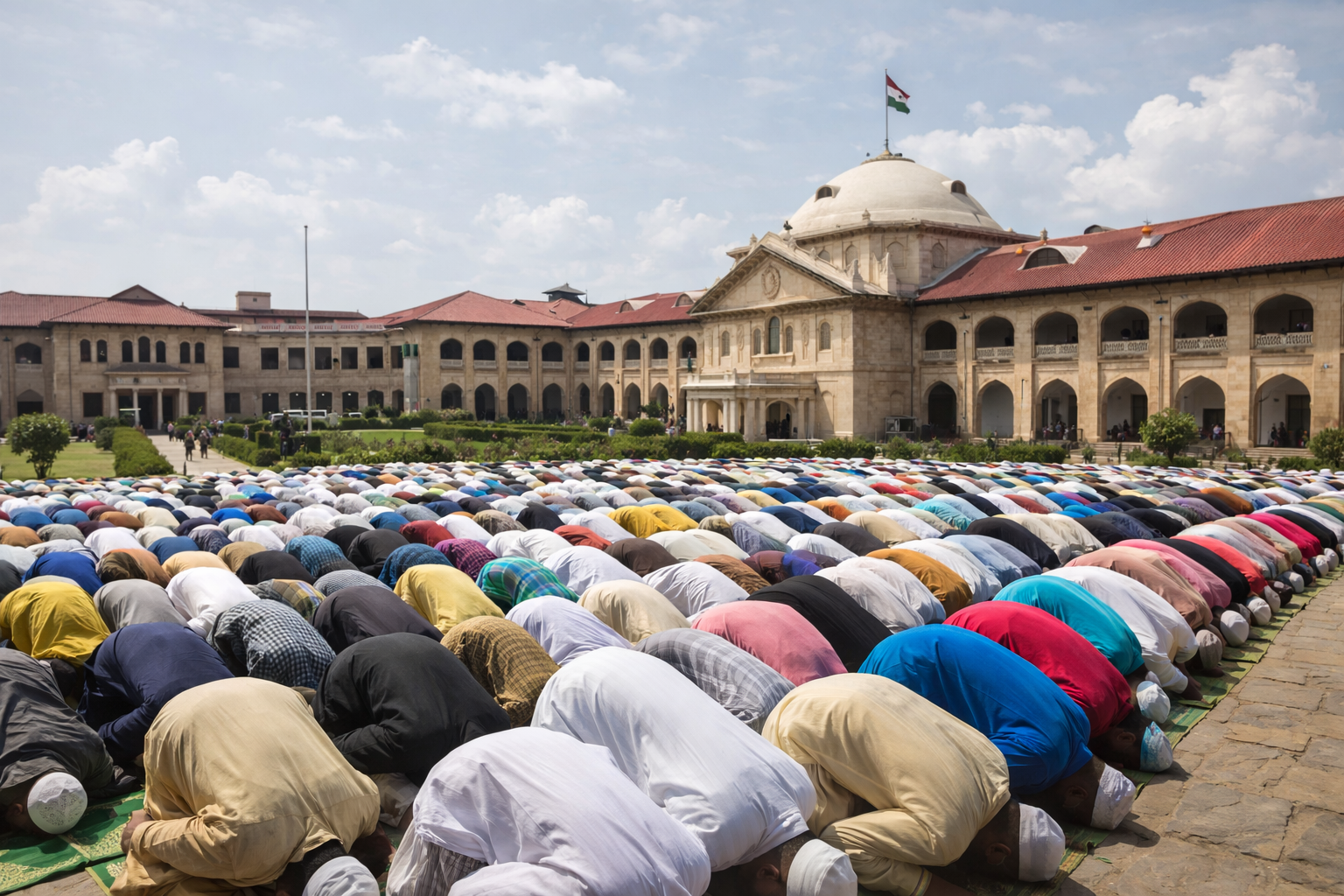
    In a significant observation reaffirming the protection of religious freedoms, the Allahabad High Court has held that administrative authorities cannot restrict the number of persons offering Namaz merely on the apprehension of law-and-order issues. The Court emphasized that maintaining public order is the responsibility of the State, and such concerns cannot be used to curtail the exercise of religious practices.

    The remarks were made by a division bench comprising Justice Atul Sreedharan and Justice Siddharth Nandan while hearing a writ petition filed by Munazir Khan, who alleged that authorities in Sambhal district had prevented worshippers from offering Namaz at a mosque during the month of Ramzan.

    According to the petition, local authorities had permitted only around twenty individuals to offer prayers at the premises, despite the expectation that a larger number of worshippers would gather during Ramzan. The restriction was reportedly imposed by the district administration citing concerns about potential disturbances to law and order.

    Rejecting the State’s justification, the High Court observed that such restrictions cannot be justified merely on the basis of perceived security concerns. The bench underscored that it is the duty of the administration to ensure that the rule of law prevails and that citizens are able to practice their faith peacefully at designated places of worship.

    In strong remarks directed at the local administration, the Court stated that if the Superintendent of Police and the District Collector believe that they cannot maintain law and order without restricting religious gatherings, they should consider stepping down from their posts or seek a transfer from the district.

    The bench noted that public authorities cannot shift the burden of maintaining law and order onto citizens by imposing arbitrary restrictions on their constitutional rights.

    The Court further reiterated that the State has a constitutional obligation to ensure that every community is able to perform religious practices peacefully at their respective places of worship. Where the place of worship is situated on private property, the Court observed that individuals may conduct prayers without requiring prior permission from the State.

    This observation aligns with earlier judicial pronouncements emphasising that the freedom of religion guaranteed under Article 25 of the Constitution of India protects the right to practice and propagate faith, subject only to reasonable restrictions relating to public order, morality, and health.

    The controversy arose from the district administration’s decision to limit the number of worshippers at a mosque located on land identified as Gata No. 291 in Sambhal district during Ramzan. The petitioner contended that the site had long been used as a place of worship and that the restriction imposed by the authorities effectively interfered with the community’s ability to offer congregational prayers.

    While defending its action, the State argued that the limitation was imposed purely as a preventive measure to avert possible disturbances. However, the Court was not persuaded by this justification and reiterated that maintaining public order is the primary responsibility of the administration.

    The High Court’s observations highlight the judiciary’s continuing emphasis on safeguarding fundamental rights against administrative overreach. The ruling also reinforces the principle that executive authorities cannot impose blanket restrictions on religious practices simply because of anticipated law-and-order challenges.

    Legal observers note that the judgment may serve as an important precedent in disputes involving restrictions on religious gatherings, particularly where such measures are justified solely on speculative security concerns rather than concrete evidence of imminent threats.

    The matter is expected to proceed further as the Court continues to examine the issues raised in the petition, including the legality of the administrative order restricting congregational prayers.


    Allahabad High Court Authorities Cannot Limit Namaz Gatherings on Law-and-Order Grounds
    Share. WhatsApp Facebook Twitter Pinterest Email
    Anvita Dwivedi

    Related Posts

    Supreme Court Declines To Extend Pawan Khera’s Transit Anticipatory Bail: Reasserting Jurisdictional Discipline in Bail Law

    April 17, 2026

    Dowry Law and Victim Protection: Supreme Court Clarifies Immunity for Wife and Her Family

    April 17, 2026

    Women’s Reservation Law Notified: Reform Realised or Deferred Constitutional Promise?

    April 17, 2026
    Add A Comment
    Leave A Reply Cancel Reply

    Demo
    Top Posts

    Wrongful Claim Rejection Amounts to Deficiency in Service: Delhi Consumer Commission Holds Star Health Liable

    March 16, 202655 Views

    Bombay High Court Quashes POCSO Case, Directs Accused to Fund MacBook for Victim’s Education

    February 28, 202648 Views

    Siyahat Meri Syahi Se: A Journey That Transforms Travel into Thought and Entrepreneurship

    March 18, 202636 Views

    Welfare or Electoral Strategy? Supreme Court’s Sharp Take on Pre-Poll Cash Schemes

    February 20, 202624 Views
    Don't Miss

    Supreme Court Declines To Extend Pawan Khera’s Transit Anticipatory Bail: Reasserting Jurisdictional Discipline in Bail Law

    By Anvita DwivediApril 17, 2026

    In a fresh setback to Congress leader Pawan Khera, the Supreme Court has declined to…

    Dowry Law and Victim Protection: Supreme Court Clarifies Immunity for Wife and Her Family

    April 17, 2026

    Women’s Reservation Law Notified: Reform Realised or Deferred Constitutional Promise?

    April 17, 2026

    Supreme Court Notice on Muslim Personal Law: Reopening the Constitutional Debate on Gender Equality and Faith

    April 16, 2026
    Stay In Touch
    • Facebook
    • Twitter

    Subscribe to Updates

    Get the latest creative news from SmartMag about art & design.

    Top Posts

    Wrongful Claim Rejection Amounts to Deficiency in Service: Delhi Consumer Commission Holds Star Health Liable

    March 16, 202655 Views

    Bombay High Court Quashes POCSO Case, Directs Accused to Fund MacBook for Victim’s Education

    February 28, 202648 Views

    Siyahat Meri Syahi Se: A Journey That Transforms Travel into Thought and Entrepreneurship

    March 18, 202636 Views
    Don't Miss

    Supreme Court Declines To Extend Pawan Khera’s Transit Anticipatory Bail: Reasserting Jurisdictional Discipline in Bail Law

    By Anvita DwivediApril 17, 2026

    In a fresh setback to Congress leader Pawan Khera, the Supreme Court has declined to…

    Dowry Law and Victim Protection: Supreme Court Clarifies Immunity for Wife and Her Family

    April 17, 2026

    Women’s Reservation Law Notified: Reform Realised or Deferred Constitutional Promise?

    April 17, 2026

    Supreme Court Notice on Muslim Personal Law: Reopening the Constitutional Debate on Gender Equality and Faith

    April 16, 2026
    Stay In Touch
    • Facebook
    • YouTube
    • TikTok
    • Instagram
    Top Trending
    About Us
    About Us

    LawFiles.in is a comprehensive legal news platform delivering real-time updates from the Supreme Court, High Courts, Tribunals, Corporate and Tax law, Regulators, Politics, Crime, Consumer cases, and Global Affairs.

    Email Us: lawfilesoffical@gmail.com
    Contact: +91 8800026066

    Contact Us:
    India International Centre
    40, Max Mueller Marg
    Lodhi Estate, New Delhi-110003

    Facebook X (Twitter)
    Our Picks

    Supreme Court Declines To Extend Pawan Khera’s Transit Anticipatory Bail: Reasserting Jurisdictional Discipline in Bail Law

    April 17, 2026

    Dowry Law and Victim Protection: Supreme Court Clarifies Immunity for Wife and Her Family

    April 17, 2026

    Women’s Reservation Law Notified: Reform Realised or Deferred Constitutional Promise?

    April 17, 2026

    Supreme Court Notice on Muslim Personal Law: Reopening the Constitutional Debate on Gender Equality and Faith

    April 16, 2026

    Free Speech or Incitement? Calcutta High Court Plea Against Suvendu Adhikari Rekindles Debate on Political Speech Limits

    April 16, 2026
    Most Popular

    ED Can Arrest Even If FIRs Are Added to ECIR Later: Punjab & Haryana High Court

    January 30, 20260 Views

    Non-Disclosure Of QCBS Criteria In Tender Alone Not Enough To Allege Malafides: Gauhati High Court

    January 31, 20260 Views

    Anticipatory Bail For Proclaimed Offenders: Evolution Of Law

    January 31, 20260 Views

    January 2026 Monthly Digest: Important Rulings of the Jammu & Kashmir and Ladakh High Court

    February 2, 20260 Views

    Custodial Death and State Liability : A Critical Analysis of the Allahabad High Court’s ₹10 Lakh Compensation Judgment

    February 22, 20260 Views
    © 2026 LawFiles. Owned by Varta24 Media.
    • Articles
    • Careers
    • Corporate
    • Global Affairs
    • Law Firms & Lawyers
    • PILS
    • Regulatory

    Type above and press Enter to search. Press Esc to cancel.