


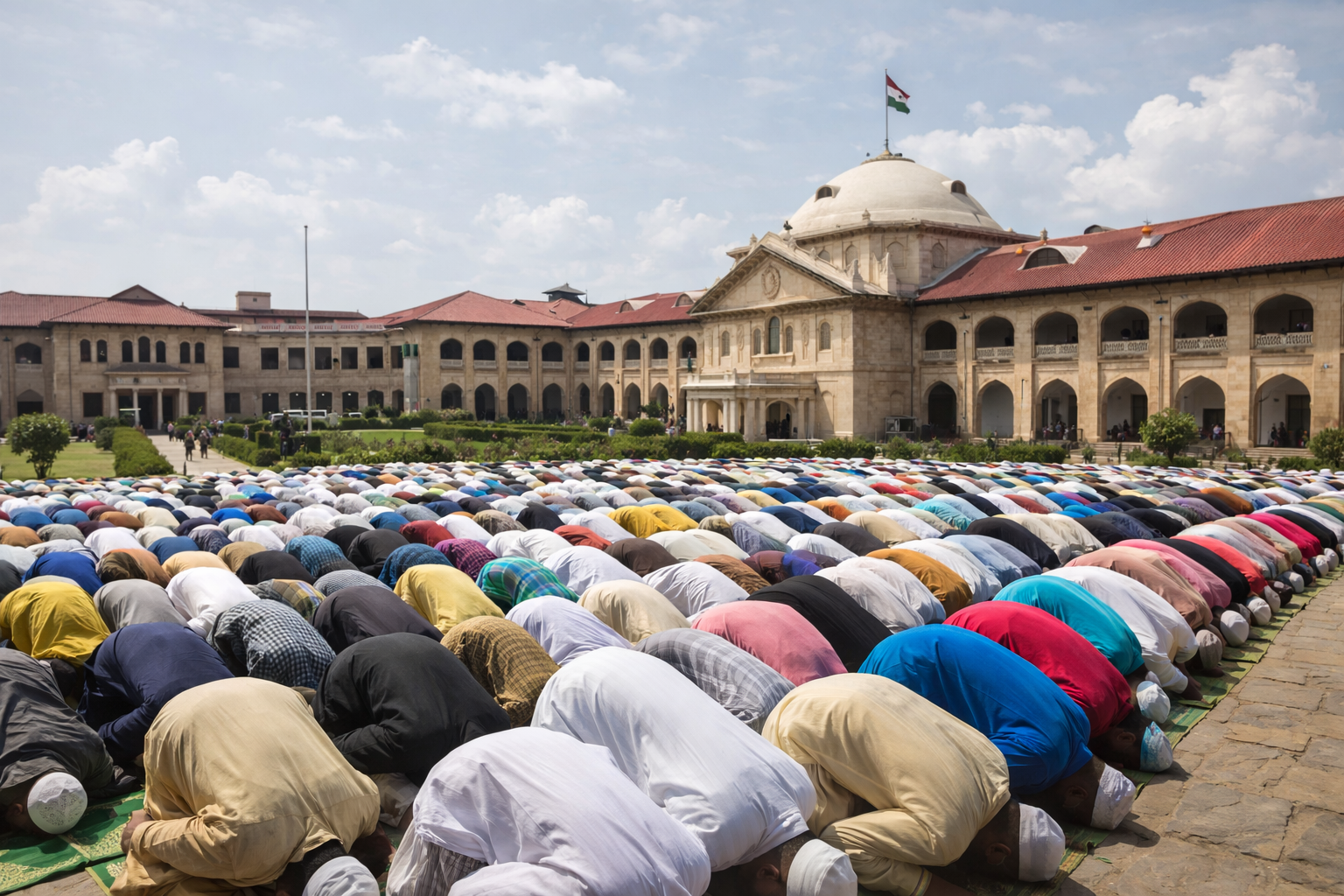
In a significant observation reaffirming the protection of religious freedoms, the Allahabad High Court has held that administrative authorities cannot restrict the number of persons offering Namaz merely on the apprehension of law-and-order issues. The Court emphasized that maintaining public order is the responsibility of the State, and such concerns cannot be used to curtail the exercise of religious practices.
The remarks were made by a division bench comprising Justice Atul Sreedharan and Justice Siddharth Nandan while hearing a writ petition filed by Munazir Khan, who alleged that authorities in Sambhal district had prevented worshippers from offering Namaz at a mosque during the month of Ramzan.
According to the petition, local authorities had permitted only around twenty individuals to offer prayers at the premises, despite the expectation that a larger number of worshippers would gather during Ramzan. The restriction was reportedly imposed by the district administration citing concerns about potential disturbances to law and order.
Rejecting the State’s justification, the High Court observed that such restrictions cannot be justified merely on the basis of perceived security concerns. The bench underscored that it is the duty of the administration to ensure that the rule of law prevails and that citizens are able to practice their faith peacefully at designated places of worship.
In strong remarks directed at the local administration, the Court stated that if the Superintendent of Police and the District Collector believe that they cannot maintain law and order without restricting religious gatherings, they should consider stepping down from their posts or seek a transfer from the district.
The bench noted that public authorities cannot shift the burden of maintaining law and order onto citizens by imposing arbitrary restrictions on their constitutional rights.
The Court further reiterated that the State has a constitutional obligation to ensure that every community is able to perform religious practices peacefully at their respective places of worship. Where the place of worship is situated on private property, the Court observed that individuals may conduct prayers without requiring prior permission from the State.
This observation aligns with earlier judicial pronouncements emphasising that the freedom of religion guaranteed under Article 25 of the Constitution of India protects the right to practice and propagate faith, subject only to reasonable restrictions relating to public order, morality, and health.
The controversy arose from the district administration’s decision to limit the number of worshippers at a mosque located on land identified as Gata No. 291 in Sambhal district during Ramzan. The petitioner contended that the site had long been used as a place of worship and that the restriction imposed by the authorities effectively interfered with the community’s ability to offer congregational prayers.
While defending its action, the State argued that the limitation was imposed purely as a preventive measure to avert possible disturbances. However, the Court was not persuaded by this justification and reiterated that maintaining public order is the primary responsibility of the administration.
The High Court’s observations highlight the judiciary’s continuing emphasis on safeguarding fundamental rights against administrative overreach. The ruling also reinforces the principle that executive authorities cannot impose blanket restrictions on religious practices simply because of anticipated law-and-order challenges.
Legal observers note that the judgment may serve as an important precedent in disputes involving restrictions on religious gatherings, particularly where such measures are justified solely on speculative security concerns rather than concrete evidence of imminent threats.
The matter is expected to proceed further as the Court continues to examine the issues raised in the petition, including the legality of the administrative order restricting congregational prayers.
