


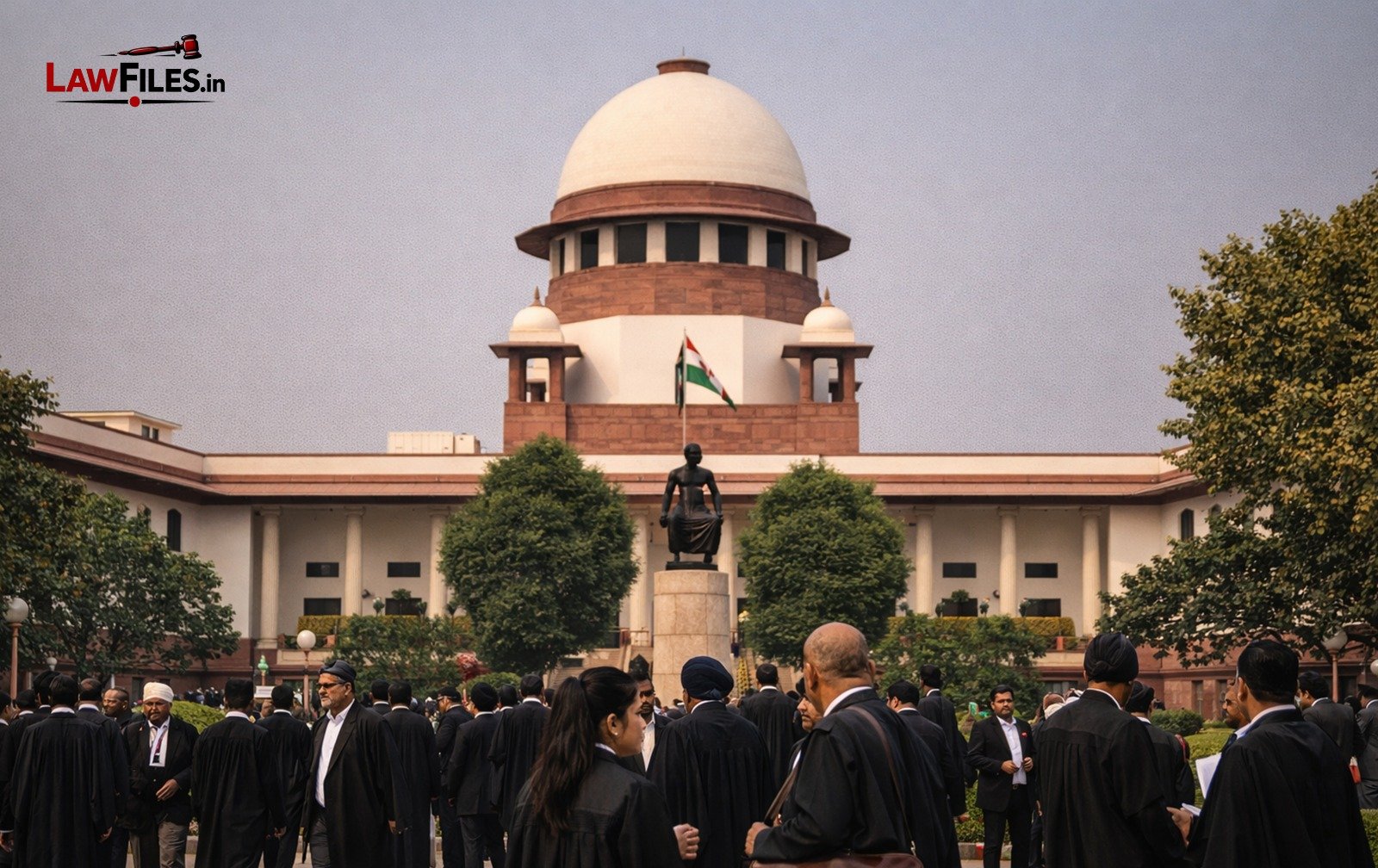
The constitutional debate over the rendition of Vande Mataram has acquired a fresh legal dimension with a petition before the Supreme Court challenging the Union Government’s decision to prescribe the complete six-stanza version of the National Song for specified official and ceremonial occasions. The petition, filed by Nagpur-based Buddhist activist and Ambedkarite scholar B.D. Borkar under Article 32, does not merely question the manner in which the song is to be performed. It raises a broader constitutional issue: can the executive prescribe, and potentially enforce through penal law, a particular textual version of a national symbol when that version contains religious imagery capable of engaging questions of conscience, equality and secularism?
The challenge is directed against the Ministry of Home Affairs orders dated January 28 and July 9, 2026. According to the petition, these directions have effectively moved the official practice from the traditionally rendered first two stanzas to the complete six-stanza composition. The petitioner contends that such a change cannot be achieved merely through executive instructions because the constitutional and historical status of the National Song does not, according to him, confer an unrestricted power upon the Ministry to redefine its content or impose a particular form of rendition. The petition consequently seeks quashing of the two orders and a declaration that citizens cannot be compelled to sing or play Vande Mataram or subjected to civil, administrative or criminal consequences merely for declining to participate.
The controversy becomes legally complex because Vande Mataram occupies a distinctive position in India’s constitutional history. On January 24, 1950, while the Constituent Assembly was dealing with the question of the National Anthem, President of the Assembly Dr. Rajendra Prasad stated that Jana Gana Mana would be the National Anthem and that Vande Mataram, which had played a historic role in the freedom struggle, would be honoured equally with it. The Constituent Assembly statement did not, however, prescribe a particular number of stanzas or reproduce a detailed performance protocol. That historical formulation is now relevant because the present dispute asks whether subsequent executive practice can determine the precise version that citizens are expected to treat as the National Song.
The distinction between the status of a national symbol and the manner in which the State regulates its performance is likely to be central to the litigation. The petitioner is not disputing the historic significance of Vande Mataram. Instead, his case is that the Union cannot transform a historically evolved practice into a compulsory six-stanza rendition without identifying a constitutionally or statutorily sufficient source of authority. This makes the challenge partly one of fundamental rights and partly one of administrative competence.
The Union Government’s January 2026 guidelines had prescribed the six-stanza version for specified State occasions, including formal functions involving the President and Governor, civil investitures and certain national ceremonies. Where the National Song and National Anthem are performed together, the guidelines provide for the National Song to be rendered first. The subsequent government initiative also resulted in All India Radio beginning broadcasts of the complete six-stanza version from March 26, 2026, replacing its long-standing practice of beginning broadcasts with the two-stanza version.
The July 9 directions, according to the petition, expanded the occasions on which the National Song would be played or sung, including educational settings, and further specified the order in which the National Song and National Anthem would be rendered. The petitioner’s objection therefore concerns not merely ceremonial protocol but what he describes as a substantive change in the State’s treatment of the National Song.
The two-stanza versus six-stanza question
A major component of the petition rests on the historical distinction between the first two stanzas and the complete composition appearing in Bankim Chandra Chattopadhyay’s Anandamath. The first two stanzas predominantly describe the motherland through imagery of natural beauty, while later portions contain references to Hindu deities including Durga, Lakshmi and Saraswati. The petitioner argues that the later stanzas therefore possess a distinctly religious character which cannot simply be made compulsory for citizens of different faiths or philosophical convictions under the constitutional framework of a secular republic.
The historical question is not entirely new. In 1937, the Congress Working Committee had recommended that only the first two stanzas be sung at national gatherings. The resolution recorded the view that the first two stanzas had become closely associated with the national movement and contained nothing objectionable to different religious communities, whereas the later portions contained religious allusions that might not accord with the beliefs of other groups. The present petition relies upon this history to argue that the two-stanza rendition was not an arbitrary truncation but a conscious accommodation that developed during the freedom movement.
At the same time, the existence of this historical practice does not by itself answer the constitutional question. A convention followed for decades may have considerable institutional significance, but the Court would still have to determine whether it has acquired a legal character that restricts the executive’s authority to prescribe a different protocol. Conversely, the fact that the State has historically honoured the first two stanzas does not automatically establish that the remaining portions are constitutionally prohibited.
That distinction is important. The Court may ultimately have to separate three questions which are often merged in public discourse: what constitutes the National Song; which version the State may prescribe for official functions; and whether an individual citizen can constitutionally be compelled to sing it. Each question involves a different legal inquiry.
Secularism and freedom of conscience
The petition invokes Articles 14, 15, 19(1)(a), 21, 23(1), 25(1) and 29(2), besides placing substantial reliance upon the constitutional commitment to secularism and fraternity. The petitioner characterises the compulsory six-stanza rendition as potentially imposing religious imagery associated with one faith upon citizens who may not accept those beliefs.
The constitutional issue here is more nuanced than whether the State is permitted to recognise a cultural or historical symbol containing religious imagery. Indian constitutional jurisprudence has never treated every reference to religion in public life as automatically unconstitutional. The more precise question is whether the State can compel an individual to participate in an act carrying religious or ideological meaning contrary to that person’s conscience.
That brings the litigation directly into the territory of Bijoe Emmanuel v. State of Kerala, the Supreme Court’s important 1986 decision concerning three schoolchildren who declined to sing the National Anthem because of their religious beliefs but stood respectfully while it was sung. The Court protected the children, holding in substance that respect for a national symbol could not automatically be converted into an obligation to vocalise words contrary to genuine conscientious belief.
The precedent does not necessarily mean that Vande Mataram and the National Anthem occupy identical constitutional positions, nor does it decide the present challenge. Its significance lies in the principle concerning compelled expression and conscientious objection.
Indeed, during the recent hearing in a separate challenge brought by Carnatic musician T.M. Krishna, a Bench comprising Chief Justice Surya Kant, Justice Joymalya Bagchi and Justice V. Mohana sought the Union Government’s response and orally indicated that a person who refrains from singing the National Song for religious or conscientious reasons should not face criminal consequences. The Court also observed that it was not, at that stage, determining what the National Song is; rather, it was examining whether the constitutional protection recognised in Bijoe Emmanuel could protect a conscientious objector. No final ruling on the constitutional validity of the 2026 measures has yet been delivered in that proceeding.
That distinction becomes particularly important in the present petition. The Court is not being asked simply to decide whether Vande Mataram is a national symbol. That status is not seriously disputed. The harder constitutional question is whether national honour can constitutionally be expressed through compelled speech.
The 2026 penal amendment changes the legal landscape
The controversy has acquired greater significance because Parliament amended the Prevention of Insults to National Honour Act, 1971 in 2026. The amendment extends the statutory protection previously applicable to the National Anthem to the National Song. Section 3, as substituted, provides punishment for intentionally preventing the singing of the National Anthem or National Song, or causing disturbance to an assembly engaged in such singing. The punishment may extend to three years’ imprisonment, fine, or both.
The amendment therefore needs to be distinguished carefully from the MHA’s performance guidelines.
The executive directions prescribe protocol—when the National Song is to be played, which version is to be rendered and the manner of its rendition at specified functions. The statute creates a criminal prohibition against intentional prevention or disturbance of a singing assembly. Whether the penal provision can legitimately be interpreted to punish mere non-participation is a separate question of statutory construction and constitutional validity.
The language of the amended Section 3 is significant because it speaks of intentionally preventing singing or causing disturbance to an assembly. It does not, on its face, say that every individual must sing. This textual distinction may become important if a future prosecution attempts to equate silence or non-participation with intentional prevention or disturbance.
The Supreme Court’s recent observations in the T.M. Krishna proceedings make that issue particularly relevant. The Court indicated that non-singing for religious reasons should not, merely by itself, result in criminal consequences. But until a final judgment is delivered, that remains an oral judicial observation rather than a binding declaration striking down the amended provision.
Can an executive order determine the content of a national symbol?
Another substantial issue raised by Borkar concerns the source of executive power.
The petition argues that the MHA’s orders effectively replaced the established two-stanza rendition with the six-stanza version without any statutory or constitutional provision expressly authorising the Ministry to make such a substantive alteration. The challenge therefore raises a classic public-law question: where does the executive derive the power to prescribe the content of a national symbol, and what are the constitutional limits of that power?
Executive instructions can ordinarily regulate governmental administration where there is a source of executive competence and no statutory prohibition. But an executive instruction cannot override legislation, constitutional guarantees or an existing statutory framework. Nor can an office memorandum create a criminal prohibition where Parliament has not enacted one.
The Court may therefore be required to examine the legal character of the MHA documents. Are they merely internal ceremonial protocols governing State functions? Do they purport to impose obligations upon ordinary citizens? Or, when read alongside the amended National Honour Act, do they acquire a wider coercive effect?
That distinction could determine the constitutional outcome of significant portions of the challenge.
If the directions are confined to regulating how government functions are conducted, the State’s argument may be materially different from a situation where the same directions are treated as creating a legal obligation upon every person present at a function to sing the prescribed version.
National symbols and compelled expression
Indian constitutional law has historically maintained a careful distinction between respect and compelled participation.
The National Flag, National Anthem and National Song may occupy positions of extraordinary symbolic importance, but constitutional patriotism does not necessarily require the State to prescribe a single form of verbal or expressive participation for every citizen.
The Bijoe Emmanuel principle is important precisely because it recognised that respect can sometimes be demonstrated through conduct other than vocal participation. The children in that case did not disrupt the anthem or prevent others from singing it. Their objection was one of conscience. The Supreme Court therefore refused to equate silence with disrespect.
The same analytical distinction may become relevant here. A person who obstructs an assembly singing the National Song is conceptually different from a person who remains respectfully silent. The amended Section 3 itself uses the language of intentional prevention and disturbance, suggesting that Parliament has criminalised conduct directed against the performance rather than simply legislating a universal duty to sing.
Whether the executive protocol can nevertheless require active participation in particular State or educational settings remains a separate constitutional question.
Article 25 and the limits of secular State action
Article 25 protects freedom of conscience and the right freely to profess, practise and propagate religion, subject to the limitations specified by the Constitution. The petitioner relies on this provision to argue that compulsory participation in religiously inflected portions of the song may burden individual conscience.
But the Court would also have to examine whether the performance of Vande Mataram in a national or civic context should necessarily be characterised as a religious practice. A State may contend that the song’s historical meaning in contemporary public life is national rather than devotional, and that the presence of religious imagery in a literary composition does not automatically convert every official rendition into an act of religious worship.
This is likely to be one of the more intellectually difficult aspects of the litigation. The constitutional question cannot be answered merely by identifying religious words in a composition. The Court may have to examine the legal purpose for which the State is prescribing the song, the manner in which participation is required, the actual coercive consequence of refusal, and whether the individual is being asked to express a religious belief or merely participate in a civic ceremony.
The petitioner’s reliance on Article 25 therefore raises a genuine constitutional inquiry, but the eventual answer will depend upon how the Court characterises the State’s action.
Fraternity and the constitutional management of difference
The invocation of fraternity adds another dimension to the case.
The Constitution does not treat secularism merely as institutional separation between government and religion. It also contemplates a social order in which citizens possessing different faiths, beliefs and identities participate in a common constitutional community. The petition argues that compelling religiously specific imagery as part of a national ritual risks turning a symbol intended to unite citizens into a source of exclusion for some of them.
The legal question, however, should not be reduced to a contest between nationalism and secularism. Constitutional fraternity itself requires the State to accommodate difference while maintaining common civic institutions.
That is why the distinction between voluntary cultural expression and compulsory expression becomes so important. A citizen may freely choose to sing the complete composition. Another may prefer the first two stanzas. A third may respectfully abstain. The constitutional difficulty begins when the State seeks to attach legal consequences to one of those choices.
The Supreme Court’s jurisprudence on freedom of expression has repeatedly recognised that freedom of speech includes, in appropriate circumstances, a freedom not to speak. Compelled expression therefore requires constitutional justification, particularly where the expression touches conscience.
The significance of the historical convention
The petition’s reliance upon the 1937 Congress Working Committee resolution also raises an interesting question about constitutional conventions.
The first two stanzas were not selected accidentally. The historical record shows that the freedom movement’s leadership was conscious of the religious concerns surrounding the later stanzas and sought a version capable of functioning as a common national symbol. The Constituent Assembly’s 1950 statement subsequently accorded Vande Mataram equal honour with the National Anthem without specifying that all six stanzas had to be rendered.
Whether this history creates a legally enforceable limitation is another matter. Constitutional conventions can inform interpretation, but they do not automatically acquire the force of legislation. The Court may therefore use the historical material to understand the nature of the national symbol without necessarily accepting the petitioner’s proposition that the two-stanza version has acquired immutable legal status.
This is where the litigation could produce a useful distinction between historical legitimacy and legal authority. A practice may be deeply established without becoming legally unchangeable. Conversely, an executive authority cannot assume that because a practice has evolved historically, it can alter the constitutional meaning of that practice without identifying the source of its power.
The Court’s earlier approach suggests caution
The present petition follows an earlier challenge to the January 2026 MHA guidelines. In Muhammed Sayeed Noori v. Union of India, the Supreme Court declined to entertain the challenge in March 2026, with the absence at that stage of a penal consequence for not singing being an important aspect of the proceedings. The legal landscape subsequently changed with Parliament’s amendment of the National Honour Act.
That development is significant because the present challenge cannot simply be treated as a repetition of the earlier case. The statutory framework now contains an express criminal provision concerning obstruction or disturbance of National Song singing.
At the same time, the amendment does not expressly say that every citizen must sing. The precise scope of the offence and its relationship with the MHA directions will therefore require careful statutory interpretation.
A constitutional balance rather than a binary choice
The most constructive way of understanding the litigation is not as a contest between competing claims of patriotism, but as an examination of how constitutional democracy manages national symbols in a plural society.
The State unquestionably possesses legitimate interests in preserving the dignity of national institutions and symbols. Parliament has now expressly chosen to extend statutory protection against intentional obstruction or disturbance of National Song performances. Government is also entitled to establish protocols for its own ceremonial functions.
But those powers operate within the Constitution. They cannot automatically extinguish freedom of conscience, freedom of expression or the principle that citizens should not be compelled to affirm beliefs they do not hold.
The distinction between disrespect, obstruction, abstention and dissent may therefore become central. Treating all four as legally identical would collapse important constitutional categories. A person who deliberately disrupts a ceremony is not necessarily situated in the same legal position as a person who quietly declines to sing. A person who criticises the composition is similarly situated differently from someone who prevents others from performing it.
The amended law’s wording, as well as the Supreme Court’s recent observations, make this distinction legally relevant.
What the Supreme Court may ultimately have to decide
The petition raises several questions that may require separate answers rather than one overarching ruling. These include whether the MHA possessed authority to prescribe the six-stanza version through executive orders; whether the historical use of the first two stanzas has any binding constitutional or legal significance; whether compulsory participation infringes Articles 19 and 25; whether the directions disproportionately affect freedom of conscience; and how the amended Section 3 of the National Honour Act should be interpreted in relation to a person’s decision not to sing.
There is also a structural question concerning the judiciary’s role. Courts do not ordinarily determine cultural or historical questions merely because those questions have entered political debate. Their constitutional function is narrower: to determine whether State action has a valid legal source and whether the resulting restriction upon fundamental rights satisfies constitutional standards.
That distinction is particularly important in the present case. The Supreme Court need not decide which version citizens ought to prefer culturally or historically in order to decide whether the State can legally compel one version.
The petition has been registered as Bhimrao Duryodhan Borkar v. Union of India & Another, Diary No. 61620/2026, and has been filed under Article 32. It is presently a constitutional challenge at the petition stage; the allegations and constitutional objections raised by the petitioner have not been adjudicated by the Supreme Court.
The broader significance of the case lies in the constitutional boundary between national identity and individual autonomy. A democratic republic necessarily possesses symbols capable of generating shared sentiment. But constitutional citizenship also means that the State must accommodate differences of belief and conscience within that shared civic framework. The difficult legal task is to determine where legitimate national protocol ends and compelled expression begins.
The litigation surrounding the six-stanza version of Vande Mataram therefore presents the Supreme Court with a question considerably wider than the number of stanzas to be sung. It concerns the legal character of national symbols, the limits of executive power, the meaning of secularism in a plural constitutional order, the protection afforded to conscientious dissent, and the extent to which respect for national symbols can be secured without converting civic allegiance into compelled speech. Those questions, rather than the competing political narratives surrounding the song, are ultimately what constitutional adjudication will have to resolve.
