


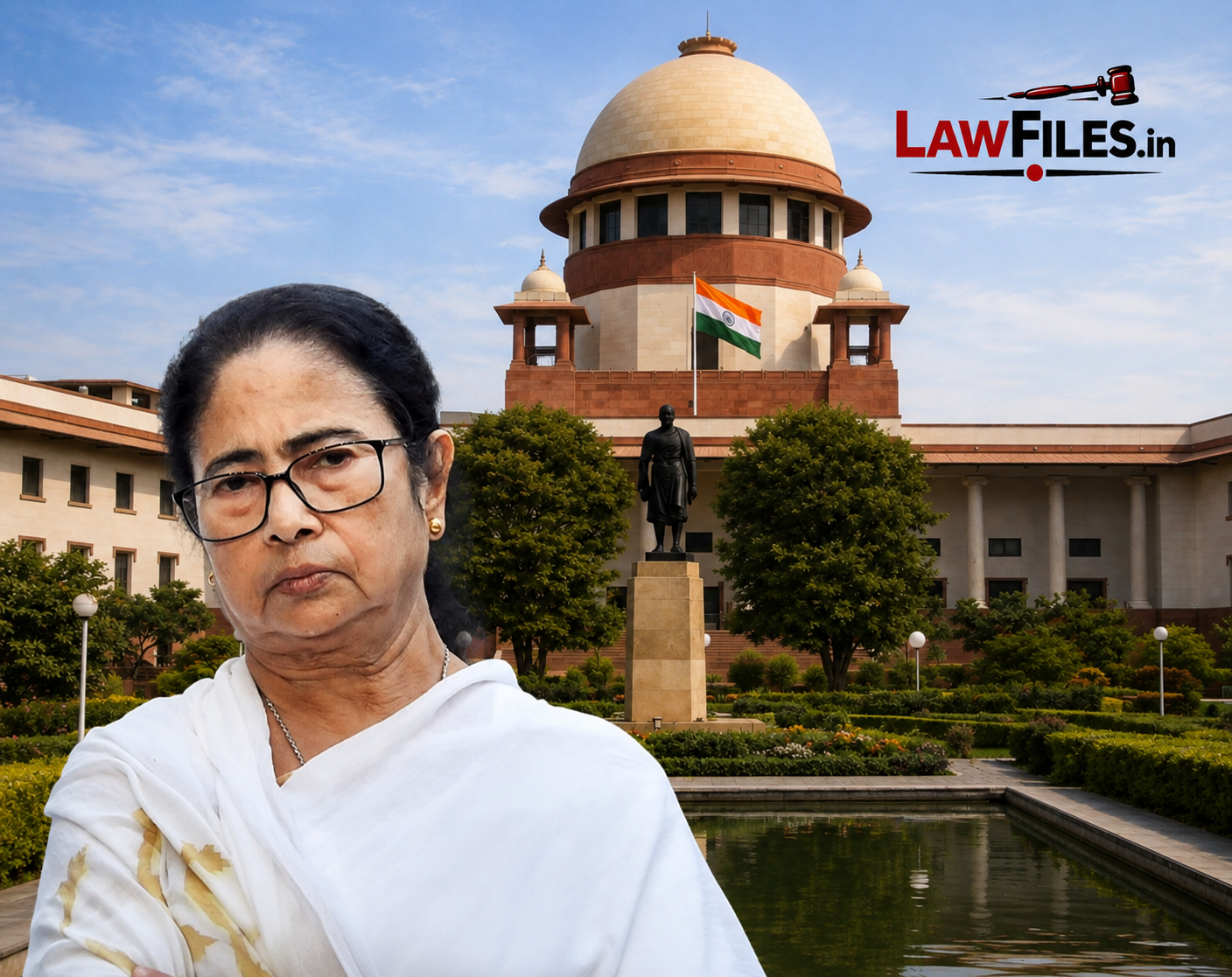
The Supreme Court has intervened in the dispute over the identity of the All India Trinamool Congress, not by deciding which faction is entitled to the party’s name and reserved “Flowers & Grass” symbol, but by directing the Election Commission of India to indicate how quickly it can complete the substantive adjudication. A Bench comprising Chief Justice of India Surya Kant and Justices Joymalya Bagchi and V. Mohana, hearing a challenge brought by Mamata Banerjee, on September 24, 2026 asked the Election Commission to work out a realistic timeline that would allow both sides a fair opportunity to present evidence while ensuring that the dispute does not remain pending indefinitely. The matter has been posted for further consideration on September 28.
The immediate controversy concerns the Election Commission’s September 17 interim order restraining both rival groups from using the name “All India Trinamool Congress” and the party’s reserved “Flowers & Grass” symbol until the Commission makes a final determination under Paragraph 15 of the Election Symbols (Reservation and Allotment) Order, 1968. The Commission concluded, on the material before it, that rival groups were each claiming to represent the recognised political party and that the competing claims required substantive adjudication. The interim arrangement was expressly framed as a measure for the impending West Bengal Assembly by-elections rather than a final determination of organisational control.
The legal importance of the proceedings therefore lies in separating three questions which can easily become conflated in political discourse: who controls the political party as a matter of internal organisation; which faction is entitled to use the recognised party’s name and reserved symbol for electoral purposes; and whether the Election Commission has acted within the scope of its statutory and constitutional powers while making an interim arrangement. The Supreme Court, at the present stage, has not answered any of those substantive questions. Its immediate concern is the pace and fairness of the process through which the Commission is expected to answer them.
The petition before the Supreme Court was instituted by Mamata Banerjee after the Election Commission’s interim order. Senior Advocate Kapil Sibal, appearing for Banerjee, argued that the timing of the Commission’s intervention had placed the petitioner in a difficult procedural position. According to the submission, the dispute had been pending before the Commission for months, yet the interim order was passed after the by-elections had already been announced. Sibal questioned whether an electoral authority could defer consideration of a dispute and then take a decision at a stage when ordinary judicial intervention might itself be constrained by the progress of the election process.
The submission raised an important public-law issue concerning timing as a component of electoral adjudication. A decision may be legally available to an authority at one point in an electoral cycle but have substantially different practical consequences if taken immediately before nominations or polling. In election law, therefore, procedural delay is not always neutral. The timing of an administrative or quasi-judicial decision can affect the ability of a party or candidate to obtain an effective remedy before an election is completed.
The Bench, however, did not proceed on the assumption that the Election Commission’s interim order should simply be stayed. The Court recognised that the electoral process was already underway and that judicial intervention at such a stage could itself generate complications. Instead, the Bench moved towards a narrower and institutionally restrained solution: if the Election Commission is the authority entrusted with deciding the factional dispute, it should indicate how long it reasonably needs to complete that determination. Chief Justice Surya Kant emphasised the need for a period sufficient for both parties to present their evidence and for the Commission to apply its mind, but not so long that the proceedings become effectively indefinite.
That approach is significant because the Supreme Court has not substituted itself for the Election Commission. The dispute over the party’s identity is one which Parliament and the constitutional framework have placed substantially within the Commission’s specialised electoral jurisdiction. The Court’s intervention is instead directed towards ensuring that the exercise of that jurisdiction is completed within a reasonable procedural timeframe.
Paragraph 15 of the Election Symbols Order is the central legal provision. It empowers the Election Commission, where rival sections or groups of a recognised political party each claim to be that party, to examine the available facts and circumstances, hear the representatives of the competing groups and determine which group, if any, constitutes the recognised political party. The decision is binding upon the rival sections for the purposes covered by the provision.
The provision is therefore not merely a mechanism for distributing an electoral symbol after an internal dispute. It creates a specialised adjudicatory framework for a particular kind of political-party fragmentation. Its rationale is practical as well as institutional. An election cannot operate effectively if two competing organisations simultaneously claim the legal identity of the same recognised party and seek to use the same reserved symbol. The Commission must consequently determine who is entitled to the electoral identity attached to that party.
The present dispute illustrates why that jurisdiction can become extraordinarily consequential. An election symbol is not simply an administrative graphic placed next to a candidate’s name. In India’s electoral system, reserved symbols function as an important means of identifying political parties and candidates, particularly in a large and diverse electorate. Judicial and electoral jurisprudence has recognised the practical significance of symbols in facilitating voter identification.
This is why freezing the original symbol is materially different from an ordinary interim order concerning a corporate trademark or a private association. A reserved election symbol operates within the electoral process itself. Its temporary withdrawal can alter how candidates appear on ballot or voting interfaces and can require voters to identify a political formation through a different name or symbol. The Commission’s interim arrangement must therefore be understood against the need to preserve electoral certainty while the underlying organisational dispute remains unresolved.
The Election Commission accordingly directed both factions to propose alternative names and free symbols for the purposes of the impending by-elections. The Mamata Banerjee-led faction was subsequently allotted the name “Mamata All India Trinamool Congress” along with the “football player” symbol, while the rival faction was allotted the name “Democratic Trinamool Congress” and the “envelope” symbol. These allocations are temporary and do not amount to a final determination of which group is entitled to the original party identity.
That distinction is legally crucial. An interim allocation cannot be treated as an adjudication of the underlying rights. The Commission itself stated that its September 17 arrangement would operate pending substantive determination under Paragraph 15. The temporary names and symbols are therefore instruments for conducting the immediate electoral exercise, not declarations concerning the ultimate legitimacy of either faction.
The Court’s present concern with expedition also reflects a larger principle of administrative adjudication: a right to a hearing is meaningful only if the hearing culminates in a decision within a reasonable period. Procedural fairness cannot become a justification for endless proceedings. At the same time, speed cannot be allowed to destroy fairness. The Chief Justice’s formulation during the hearing—sufficient time for both parties to lead evidence and for the Commission to apply its mind, but not an unnecessarily prolonged process—captures that balance.
This is especially important under Paragraph 15 because factional disputes can involve substantial documentary and organisational material. The Commission may have to examine party constitutions, organisational elections, membership records, resolutions, office-bearer appointments, competing claims concerning internal authority and the conduct of party units. A rushed determination could expose the decision to challenge on grounds of inadequate hearing or failure to consider relevant evidence.
At the same time, an election cannot realistically be held hostage indefinitely to an internal political dispute. If competing groups can keep a Paragraph 15 proceeding pending through repeated procedural steps, the uncertainty
