


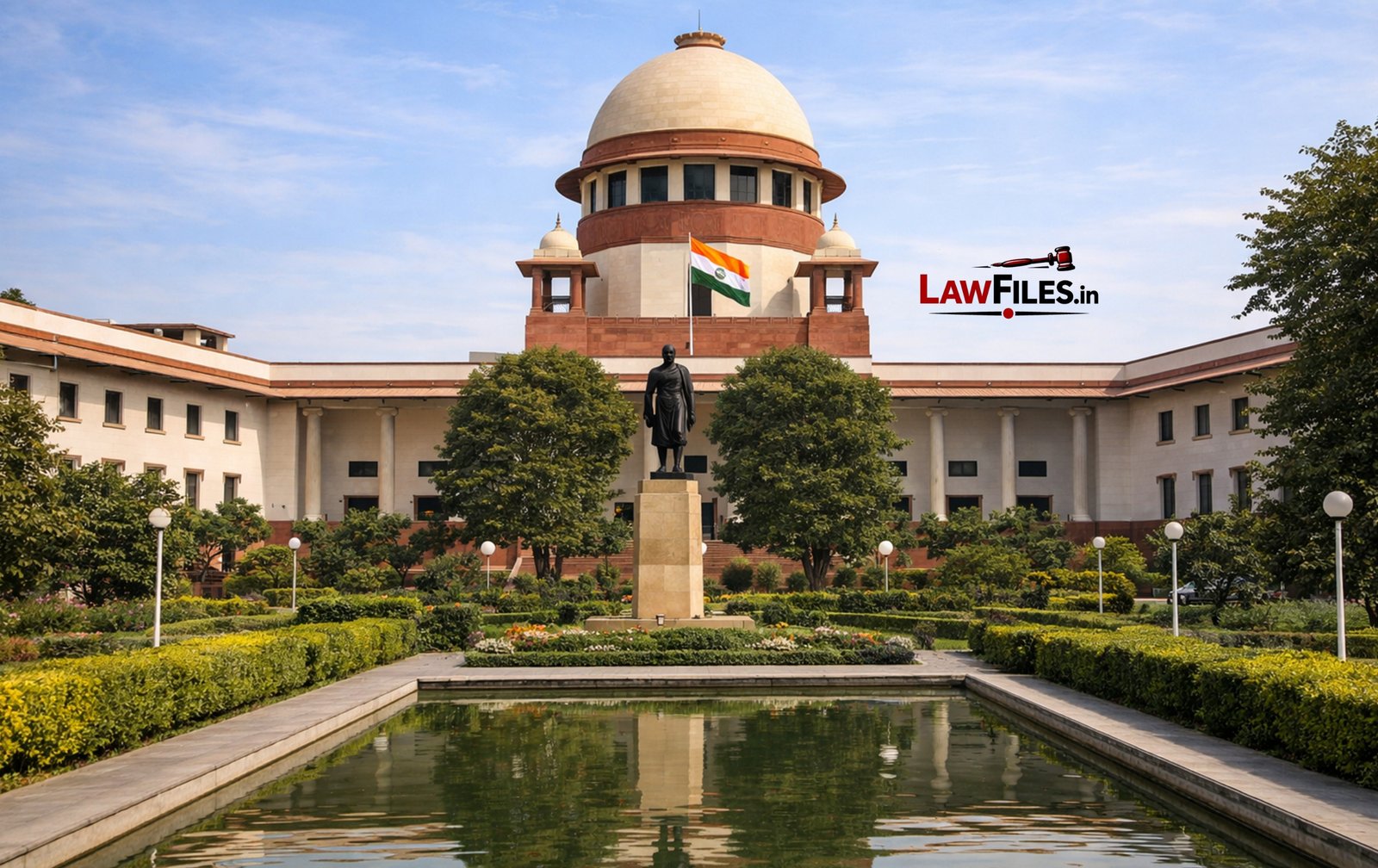
The Supreme Court’s split verdict has now placed the constitutional validity of the Election Commissioners’ appointment framework before a larger Bench. The important point is that the Court has not yet decided whether the 2023 law is constitutionally valid. What has emerged is a sharp judicial disagreement over whether the existing selection mechanism sufficiently protects the independence and perceived neutrality of the Election Commission.
The Supreme Court has referred the constitutional challenge to the law governing the appointment of the Chief Election Commissioner and Election Commissioners to a larger Constitution Bench, after a two-Judge Bench delivered differing opinions on whether such a reference was necessary. The Bench comprising Justice Dipankar Datta and Justice Satish Chandra Sharma was considering a batch of petitions challenging the Chief Election Commissioner and Other Election Commissioners (Appointment, Conditions of Service and Term of Office) Act, 2023. While Justice Datta found that the constitutional principles necessary to decide the challenge were already substantially settled and did not consider a fresh reference necessary, Justice Sharma took the view that the controversy raised substantial questions requiring authoritative determination by a Constitution Bench. In order to avoid another round of preliminary litigation and further delay, the matter has now been placed before the Chief Justice of India for constitution of an appropriate larger Bench.
The controversy concerns a deceptively simple but constitutionally significant question: who should participate in choosing the persons entrusted with conducting India’s elections? Article 324 of the Constitution establishes the Election Commission of India and vests in it the superintendence, direction and control of elections. The Constitution itself provides that the President shall appoint the Chief Election Commissioner and other Election Commissioners, subject to any law made by Parliament. For decades, however, Parliament had not enacted a comprehensive statutory framework governing the appointment process. The resulting executive-controlled arrangement eventually became the subject of constitutional scrutiny.
That legislative vacuum was examined by a Constitution Bench in Anoop Baranwal v. Union of India, decided in March 2023. The Court held that, until Parliament enacted a law governing appointments, the President was to make appointments on the recommendation of a committee comprising the Prime Minister, the Leader of the Opposition in the Lok Sabha or the leader of the largest opposition party where no recognised Leader of Opposition was available, and the Chief Justice of India. The judgment was expressly framed as an interim arrangement pending legislation by Parliament.
Parliament subsequently enacted the 2023 Act. The legislation altered the composition of the selection committee in a significant manner. Instead of the Chief Justice of India, the committee now comprises the Prime Minister as Chairperson, a Union Cabinet Minister nominated by the Prime Minister, and the Leader of Opposition in the Lok Sabha. The result is a three-member committee in which two members belong to, or are nominated by, the Union executive. It is this structural change that has become the central constitutional issue before the Supreme Court.
The petitioners contend that Parliament’s power to legislate under Article 324 cannot be understood as an unrestricted power to design a mechanism that effectively places the appointment process under the control of the incumbent executive. Their argument is not, in its essential form, that the Chief Justice of India possesses an inherent constitutional entitlement to sit on the selection committee. Rather, the challenge is directed towards the degree of executive influence permitted by the statutory arrangement and whether such influence is compatible with the constitutional requirement of an independent Election Commission.
This distinction became particularly important during the hearing. Senior counsel appearing for the petitioners argued that the constitutional question is not whether the CJI must necessarily be the third member of the committee, but whether the governing executive can acquire decisive influence over appointments to an institution whose constitutional function is to supervise elections involving that very executive. The petitioners relied upon Anoop Baranwal to contend that institutional independence is a constitutional principle rather than merely a matter of administrative preference.
The Union Government, on the other hand, defended the legislation by emphasising the language of Article 324(2). Its case was that the Constitution expressly leaves the appointment mechanism to Parliament and that the arrangement prescribed by the 2023 Act is therefore an exercise of legislative power. The Government also argued that Anoop Baranwal itself acknowledged the temporary nature of the judicially prescribed mechanism and expressly contemplated Parliament subsequently making a law. According to this position, Parliament cannot be treated as constitutionally bound to reproduce the exact composition devised by the Court for the interim period.
That argument brings the dispute to the heart of constitutional separation of powers. The question before the larger Bench will not simply be whether the 2023 Act differs from the arrangement prescribed in Anoop Baranwal. Parliament was expressly authorised to legislate. The deeper question is whether there are constitutional limits on the kind of appointment mechanism Parliament may create when the office being constituted performs a function fundamental to representative democracy.
Justice Datta’s observations during the proceedings brought this issue into particularly sharp focus. He expressed the prima facie view that an Election Commission must not merely be independent in its actual functioning; the institutional arrangement must also generate public confidence that it is independent. In his reasoning, the composition of the selection committee becomes relevant because public perception of neutrality is itself important to the credibility of electoral administration. (Live Law)
Justice Datta questioned whether a Cabinet Minister nominated by the Prime Minister could realistically constitute an independent counterweight within the committee. The concern, as articulated during the proceedings, was not an assertion that an individual Minister would necessarily act improperly. Rather, it concerned the structural design of the institution. If two of the three members of the selection committee are drawn from the executive, the constitutional question is whether the process contains an adequate institutional counterweight against executive dominance.
The Court’s discussion therefore moved beyond the traditional idea that institutional independence can be proved only by examining the conduct of an individual office-holder. Constitutional independence can also have an institutional dimension. A judge may be personally impartial, a regulator may be personally honest and an election commissioner may discharge duties conscientiously. But constitutional design can nevertheless become vulnerable if the process by which such office-holders are selected creates a reasonable basis for apprehending institutional dependence.
Justice Datta used an analogy from cricket to illustrate the distinction between actual impartiality and perceived impartiality. An umpire may take correct decisions, but if the process by which the umpire was selected appears to favour one of the competing sides, confidence in the outcome can nevertheless be affected. The analogy was used to underscore that in electoral governance, the legitimacy of the referee cannot be separated entirely from the credibility of the process through which the referee is chosen.
This concept of “independence by design” could become one of the most important constitutional questions before the larger Bench. The Court will have to determine whether constitutional independence is sufficiently protected by the obligations imposed upon Election Commissioners after appointment, or whether the appointment mechanism itself must contain structural safeguards against executive predominance.
Justice Datta also questioned whether the presence of the Leader of Opposition can meaningfully operate as a counterweight when the other two members of the committee are the Prime Minister and a Cabinet Minister nominated by the Prime Minister. This is not a finding that the Leader of Opposition’s participation is legally meaningless. Rather, it raises the constitutional question whether one opposition member, within a three-member committee, provides sufficient institutional balance where the other two members are associated with the government of the day.
The Government’s response to such reasoning is likely to be central before the Constitution Bench. A selection committee does not necessarily operate on the assumption that its members must belong to opposing institutional camps. Parliament may legitimately have considered executive accountability, democratic mandate and parliamentary responsibility relevant to the design of the selection process. The constitutional inquiry will therefore have to determine whether the legislature’s choice crosses a constitutional boundary or remains within the discretion expressly conferred by Article 324.
The controversy is consequently not adequately described as a simple contest between the judiciary and the executive. At a deeper level, it concerns the relationship between parliamentary law-making and constitutional institutional independence. Article 324 gives Parliament legislative authority over appointments, but that authority operates within the larger constitutional framework. The Constitution Bench will have to identify where that boundary lies.
The petitioners’ reliance on Anoop Baranwal creates another important doctrinal question. The 2023 Constitution Bench had not permanently prescribed the CJI-PM-Leader of Opposition formula. It expressly contemplated parliamentary legislation. Yet the judgment’s reasoning concerning the importance of an independent Election Commission was considerably broader than the interim mechanism itself. The larger Bench may therefore have to distinguish between the binding operative direction in Anoop Baranwal and the constitutional principles underpinning that direction.
That distinction is crucial. If Anoop Baranwal is understood merely as an interim arrangement, Parliament remains comparatively free to create a different selection mechanism. But if the judgment is understood as recognising a constitutional requirement that the Election Commission must be insulated from executive dominance, Parliament’s freedom may be subject to a substantive constitutional limitation. The larger Bench will have to determine precisely which proposition survives Parliament’s subsequent exercise of legislative power.
The case also raises the scope of Article 145(3), under which cases involving a substantial question of law as to the interpretation of the Constitution are required to be heard by a Bench of at least five judges. Justice Sharma considered that the present controversy squarely engages this constitutional threshold. Justice Datta, however, was of the view that the matter could be decided without another Constitution Bench reference because the governing constitutional principles had already been settled.
The disagreement between the two judges illustrates an important institutional question about precedent. Not every constitutional challenge to a subsequent statute requires a fresh Constitution Bench merely because an earlier Constitution Bench judgment exists. At the same time, where Parliament has enacted legislation directly implicating the interpretation of a constitutional provision and the relationship between legislative power and a previously recognised constitutional principle, a larger Bench may provide greater institutional certainty.
Ultimately, the two judges converged on a pragmatic procedural solution despite their disagreement on the merits of the reference. Rather than sending the question first to another three-Judge Bench solely to determine whether a five-Judge Bench was required, they directed that the matter be placed before the Chief Justice for constitution of an appropriate larger Bench. The objective was to avoid another layer of preliminary proceedings delaying determination of the substantive constitutional challenge.
The issue of delay is itself noteworthy. During the proceedings, concerns were raised about the time taken by the Supreme Court to constitute larger Benches in constitutional matters. The Court acknowledged that petitions involving constitutional references can remain pending for extended periods and suggested consideration of a permanent five-Judge Constitution Bench for constitutional cases. Such an institutional suggestion, if acted upon, could have implications well beyond the Election Commission dispute because constitutional questions often remain unresolved while the challenged statutory framework continues to operate. (Bar and Bench – Indian Legal news)
That observation highlights a structural tension in constitutional adjudication. A reference to a larger Bench is designed to provide authoritative resolution and institutional stability. Yet if the reference mechanism itself produces years of delay, the very objective of constitutional certainty can be undermined. A permanent Constitution Bench could potentially address this difficulty, although questions concerning judicial administration, workload and allocation of constitutional matters would necessarily arise.
There is another important aspect to the present litigation: the Supreme Court has previously declined to stay the operation of the 2023 appointment law. Consequently, the statutory mechanism has continued to operate while its constitutional validity remains under challenge. The larger Bench will therefore be examining an appointment framework that has already been used in practice, rather than an entirely theoretical legislative arrangement. (Live Law)
The Court had also, in an earlier order concerning the 2024 appointments, expressed concern about the manner in which information concerning shortlisted candidates was supplied to members of the selection committee. The Court observed that constitutional appointments require adequate material to be circulated so that members can deliberate meaningfully on the suitability of candidates. It nevertheless declined to interfere with those appointments at that stage, particularly in view of the approaching general election and the institutional consequences that an interruption could have caused.
That earlier episode gives the current challenge an additional procedural dimension. Independence is not determined solely by the names of the members of a selection committee. The quality of the selection process itself matters—including the adequacy of information supplied to selectors, the time available for deliberation, the criteria used for shortlisting, the transparency of the search process and the extent to which the statutory committee genuinely exercises independent judgment.
The 2023 Act creates a search committee headed by the Union Law Minister, which prepares a panel of eligible persons. However, the selection committee is not confined to that shortlist and may consider other eligible persons as well. This statutory design gives the final committee considerable discretion over the pool from which appointments can be made. Whether such flexibility promotes genuine merit-based selection or creates excessive scope for executive discretion is likely to form part of the broader constitutional discussion. (The Indian Express)
At the same time, the existence of executive participation cannot by itself establish constitutional invalidity. Executive participation in appointments to constitutional and statutory bodies is not inherently prohibited. The Constitution itself distributes appointment powers among different institutions, and Parliament may reasonably conclude that elected governments should have some role in selecting persons who will administer public institutions. The constitutional question arises when that role allegedly becomes so dominant that the independence required for the institution’s functioning is materially compromised.
The Election Commission presents a particularly sensitive case because it regulates the electoral process through which the political executive itself derives democratic authority. This creates an institutional relationship unlike an ordinary regulatory body. The government is simultaneously a participant in elections and part of the machinery that selects those who administer them. The constitutional design must therefore address not only actual impartiality but also the possibility of institutional dependence or perceived conflict.
The principle of free and fair elections has repeatedly been treated by the Supreme Court as fundamental to constitutional democracy. In Anoop Baranwal, the Court linked the independence of the Election Commission with the credibility of the electoral process and referred to the constitutional importance of insulating election administration from executive influence. The present litigation now asks how that principle should operate after Parliament has exercised the legislative power contemplated by Article 324. (The Indian Express)
The larger Bench will therefore confront a carefully balanced constitutional problem. It cannot simply assume that the judicially prescribed 2023 interim arrangement must become permanent, because Parliament was expressly expected to legislate. Equally, Parliament’s authority to legislate cannot necessarily mean that any appointment mechanism it chooses is constitutionally immune from scrutiny. The decisive inquiry will be whether the Constitution permits the legislature to design a mechanism in which the executive has the degree of influence created by the 2023 Act.
The case also has implications for the broader concept of constitutional bodies. The issue is not merely who occupies the offices of CEC and EC. It concerns the institutional conditions under which constitutional authorities are expected to exercise power. Independence, transparency, accountability and democratic legitimacy must operate together. A system designed entirely around insulation from elected institutions could raise its own accountability concerns; a system dominated by the incumbent executive could raise concerns about neutrality. The constitutional task is to identify an arrangement capable of reconciling both.
For citizens, the legal significance of the litigation lies in something more fundamental than the identity of any particular Election Commissioner. Electoral administration derives legitimacy not only from the fact that elections are conducted according to formally prescribed rules, but also from confidence that the institution supervising those rules is capable of acting without favour. That confidence cannot be manufactured by judicial declaration alone. It must be supported by institutional architecture, transparent procedures and credible safeguards.
The Constitution Bench will also have to determine the proper standard of judicial review applicable to Parliament’s choice. The Court is not constitutionally positioned to design an ideal selection committee merely because another arrangement may appear institutionally preferable. The question will be whether the enacted mechanism violates a constitutional limitation whether express, structural or flowing from the basic features of democratic governance. That makes the case one of constitutional adjudication rather than institutional preference.
The eventual ruling could therefore clarify several unsettled aspects of Indian constitutional law: the precise scope of Parliament’s power under Article 324(2); the continuing significance of Anoop Baranwal after enactment of the 2023 statute; the constitutional status of institutional independence of the Election Commission; the relevance of perceived neutrality as a constitutional consideration; and the extent to which the basic structure doctrine can constrain legislative choices concerning constitutional appointments.
Until that determination is made, it would be premature to treat the observations made by Justice Datta as a final judicial conclusion that the 2023 Act is unconstitutional. They are part of a split decision concerning the reference issue, and the constitutional validity of the statute remains to be authoritatively determined by the larger Bench. Justice Sharma’s contrary view on the necessity of a Constitution Bench similarly does not amount to a finding upholding the legislation. The substantive constitutional question remains open.
What the September 23 proceedings have accomplished, however, is to place the institutional design of the Election Commission squarely before a Constitution Bench. The debate has moved beyond the narrower question of whether Parliament was entitled to replace the CJI in the selection committee. It now concerns a larger constitutional proposition: when an institution is entrusted with administering the democratic process, how much influence can the government of the day constitutionally exercise over the selection of the persons who will supervise that process?
The answer will have consequences extending beyond the present legislation. It may define how India understands the independence of constitutional bodies in an era where Parliament increasingly legislates on matters previously governed by convention, executive practice or judicially evolved interim arrangements. It may also clarify an equally important democratic principle: institutional independence does not mean institutional isolation, and executive accountability does not necessarily justify executive dominance.
For now, the Supreme Court has chosen to place that difficult balance before a larger constitutional forum rather than allow the controversy to remain caught in procedural disagreement over the appropriate Bench strength. The eventual Constitution Bench judgment will therefore have the task not merely of interpreting one appointment statute, but of defining the constitutional relationship between electoral independence, parliamentary law-making and executive accountability three components that must coexist if the constitutional promise of free and fair elections is to have institutional substance.
