


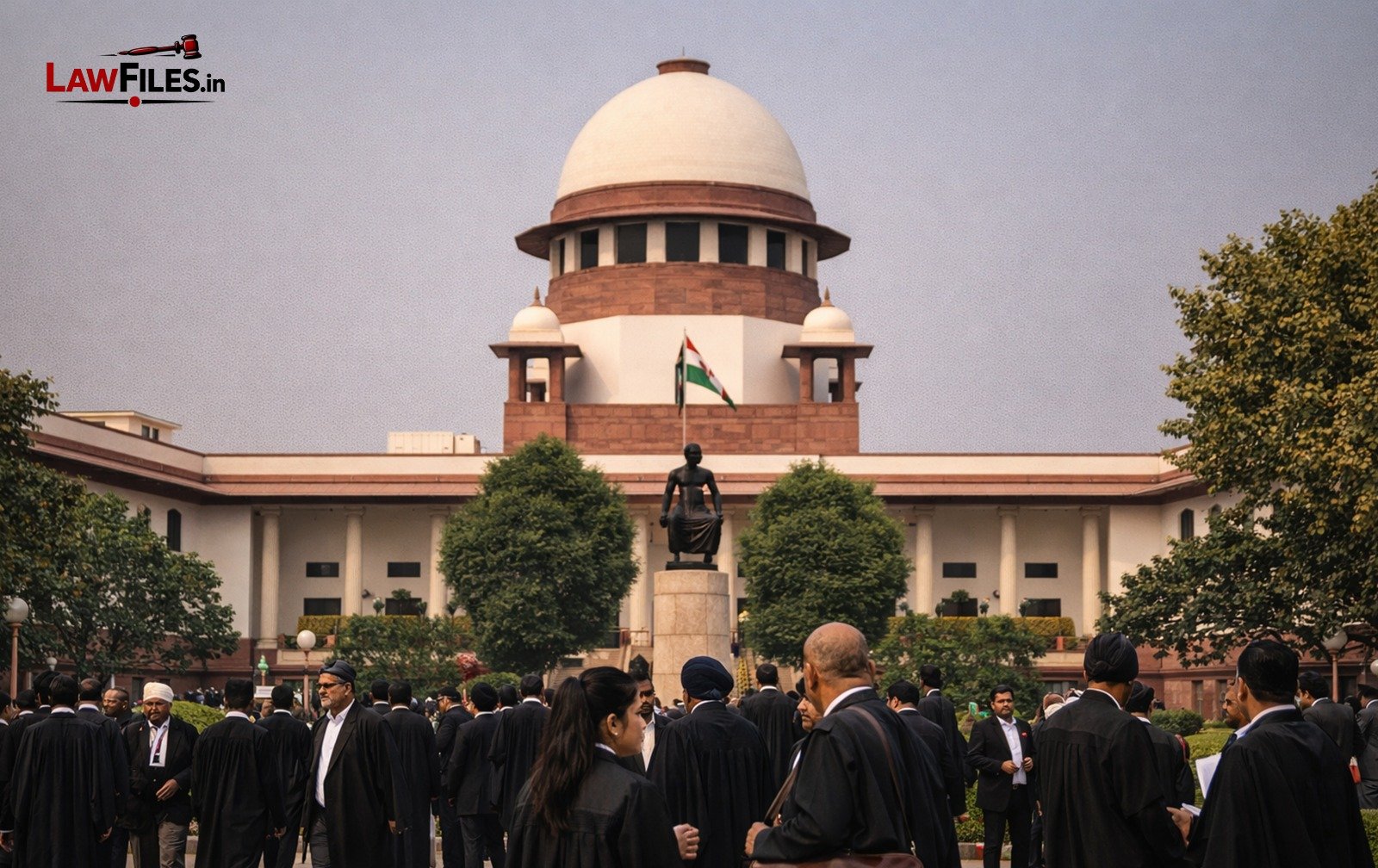
The Supreme Court has laid down an important framework governing the custody, disposal and confiscation of vehicles seized in cases under the Narcotic Drugs and Psychotropic Substances Act, 1985, holding that a Drug Disposal Committee cannot independently dispose of a seized vehicle without an order from the competent criminal court. The Court has further clarified that the statutory power of confiscation belongs to the court trying the NDPS offence and that, where a vehicle is proposed to be sent for disposal because its owner has not sought interim custody, the owner must first receive notice and an opportunity of hearing. The ruling in R. Manimaran v. State of Tamil Nadu, delivered by a Bench of Justice J.B. Pardiwala and Justice K. Vinod Chandran, consequently places judicial oversight at the centre of the administrative mechanism created for disposal of seized conveyances.
The judgment arose from the seizure of an Ashok Leyland lorry after the police allegedly recovered 66 kilograms of ganja from it. Three persons travelling in the vehicle were arrested and another accused, who had allegedly fled from the spot, was subsequently arrested. The lorry was seized as the conveyance allegedly used for transporting the contraband. The prosecution ultimately failed to establish the guilt of the accused beyond reasonable doubt, and the Additional District and Sessions Court dealing with EC and NDPS cases at Pudukottai acquitted them. Importantly, the trial court also directed that the lorry be released to its owner after the expiry of the period available for challenging the acquittal.
The acquittal was not founded upon a mere technicality. The trial court identified several deficiencies in the prosecution’s case, including the presence of the crime number on an arrest memo prepared at a time preceding the registration of the FIR, the absence of a proper police-station record showing when and how the seized contraband had been placed in safe custody, the inability of official witnesses to satisfactorily explain how the lorry had been permitted to operate during the COVID-19 restrictions, and delay in transmitting samples to the court and thereafter to the laboratory. These circumstances persuaded the trial court that the prosecution had failed to establish the accused persons’ involvement in the alleged offence.
Despite the acquittal and the direction concerning the vehicle, the dispute did not end there. After the appeal period had expired, the owner approached the trial court seeking release of the lorry. The application was rejected. The Madras High Court subsequently affirmed that position, reasoning that disposal of a vehicle seized under the NDPS Act had to take place through the Drug Disposal Committee constituted under Section 52A of the Act and the framework contained in the NDPS (Seizure, Storage, Sampling and Disposal) Rules, 2022. The Investigating Officer had also moved the trial court seeking reference of the vehicle to the Drug Disposal Committee. The owner was therefore effectively directed towards the administrative disposal mechanism rather than being permitted to secure release through the trial court.
It was this interpretation that required reconsideration before the Supreme Court. The Bench examined the apparent tension between Section 63 of the NDPS Act, which deals with confiscation, and Section 52A along with the 2022 Rules, which establish a mechanism for dealing with seized narcotic substances and conveyances. The question was not whether vehicles can be disposed of under the statutory framework. Rather, the crucial question was who possesses the legal authority to determine the fate of such a vehicle and whether administrative disposal can operate independently of the judicial process.
The Supreme Court answered the question by drawing a firm distinction between disposal and confiscation. Under Section 60(3) of the NDPS Act, a conveyance used for transporting narcotic drugs or psychotropic substances may become liable to confiscation. However, the statute also protects an innocent owner by permitting the owner to establish that the vehicle was used without his or her knowledge or connivance and that reasonable precautions had been taken to prevent such misuse. Section 63, in turn, prescribes the procedure by which the court determines whether an article or conveyance is liable to confiscation.
This statutory design, according to the Supreme Court, makes judicial determination indispensable where confiscation is concerned. A vehicle may be physically seized by the investigating agency and may subsequently come within the administrative disposal mechanism, but that does not transfer the statutory power of confiscation from the criminal court to the Drug Disposal Committee. The DDC is an administrative mechanism for disposal; it is not a substitute for the judicial forum entrusted with deciding whether the State is legally entitled to deprive the owner of the property.
The distinction is particularly important because confiscation is not simply a method of getting rid of an unused vehicle. It carries the consequence of permanent deprivation of property. Once the State confiscates a vehicle, the owner’s proprietary interest is extinguished. Such a consequence cannot be treated as an ordinary administrative disposal merely because the vehicle happened to be seized during an NDPS investigation. The Supreme Court therefore insisted upon preserving the statutory jurisdiction of the trial court under Section 63.
At the same time, the Court recognised the practical problem that lies behind the creation of the Drug Disposal Committees. Vehicles seized in criminal cases frequently remain parked for prolonged periods at police stations or other storage locations. Exposure to weather, lack of maintenance, theft of parts, deterioration and depreciation can substantially diminish their value. A commercial vehicle that remains immobilised for years may become economically worthless even before the criminal proceedings conclude. The State gains little from such deterioration, while the owner, financier and the wider economy bear the loss.
The Court had previously addressed this concern in Biswajit Dey v. State of Assam, where it held that the NDPS Act contains no absolute prohibition against granting interim custody of a seized vehicle. By virtue of Section 51 of the NDPS Act, the general procedural provisions concerning custody of property could operate where they were not inconsistent with the special statute. The powers contained in Sections 451 and 457 of the Code of Criminal Procedure could therefore be invoked for appropriate interim release. With the coming into force of the Bharatiya Nagarik Suraksha Sanhita, corresponding provisions are now contained in Sections 497 and 503.
The present judgment builds upon that principle rather than restricting it. The Court made clear that the existence of the 2022 Rules does not extinguish the trial court’s jurisdiction over the vehicle. The Rules are subordinate legislation and must operate consistently with the parent statute. Rule 16 permits conveyances to be disposed of as soon as practicable after seizure through the procedure contemplated under Section 52A. But the Rule cannot be interpreted as silently transferring to an administrative committee a power which Section 63 expressly places in the court.
The Supreme Court consequently adopted a harmonising interpretation. The DDC can participate in the disposal of a seized conveyance, but it cannot independently assume control over the ultimate fate of the vehicle in a manner that bypasses the court. Proper judicial authorisation must precede the administrative disposal process. This interpretation prevents the Rules from operating as an alternative statutory regime detached from the judicial safeguards contained in the NDPS Act.
The Court then addressed a particularly practical situation: what happens when the owner simply does not come forward to seek interim custody? The Supreme Court did not suggest that an abandoned vehicle should be left indefinitely in police custody. On the contrary, it recognised that such prolonged retention can result in the destruction of economic value. The Investigating Officer may therefore approach the competent court and seek an order referring the vehicle to the DDC for disposal.
But even in such a situation, the Court insisted upon procedural fairness. Before the court makes such a reference, the owner must be given notice and an opportunity of hearing. The hearing is not an empty procedural formality. The owner may have legitimate reasons for retaining the vehicle, may dispute the proposed disposal, may establish ownership, or may seek interim custody. More importantly, the owner’s statutory defence under Section 60(3) cannot be rendered meaningless by disposing of the vehicle before the judicial process has determined the question of confiscation.
The Supreme Court went one step further. Even after the court has permitted the matter to be referred to the DDC, the Committee must itself give the owner an opportunity of hearing before proceeding to sell the vehicle by public auction. This two-stage protection—first before the court and subsequently before the DDC—ensures that the administrative disposal mechanism does not become an irreversible process operating without the knowledge or participation of the person whose property is being sold.
The Court also drew an important distinction concerning the proceeds of such a sale. Disposal through auction pursuant to the 2022 Rules does not itself amount to confiscation. Therefore, the money realised from the sale cannot simply be treated as revenue or as having been finally forfeited to the State. The sale proceeds must be deposited before the jurisdictional court. The court retains control over the proceeds because the ultimate question of confiscation remains governed by Section 63 of the NDPS Act.
This distinction is doctrinally significant. Physical destruction or sale of an asset and legal confiscation are not necessarily the same event. Disposal may be undertaken because continued physical custody is economically wasteful, whereas confiscation is a legal determination that the owner is not entitled to retain the property. The Supreme Court’s approach ensures that the administrative necessity of preserving economic value does not prejudge the judicial question of proprietary entitlement.
The facts of the present case made the need for such judicial scrutiny particularly compelling. The accused had already been acquitted. The trial court had itself directed release of the lorry after the appeal period. No confiscation proceedings had been initiated during the trial or immediately following the judgment. The Investigating Officer’s subsequent attempt to have the vehicle referred to the DDC could not therefore override the operative legal position flowing from the trial court’s order. The Supreme Court found that the High Court had erred in treating the DDC mechanism as the exclusive route for the owner to obtain release of the vehicle.
The Court also noted that the earlier decision of the Madras High Court in Nahoorkani v. State had taken a different approach by treating Section 63 as a mechanism that operated during the trial and by suggesting that the ordinary provisions relating to custody of property could not be invoked. The Supreme Court expressly held that this approach was inconsistent with the law declared in Biswajit Dey. The ruling therefore has significance not merely for the individual appellant but also for the manner in which courts across jurisdictions are expected to understand the relationship between Sections 52A, 60 and 63 of the NDPS Act and the general procedural law concerning seized property.
The judgment also reflects a broader principle concerning subordinate legislation. Administrative rules may create mechanisms for efficiency, standardisation and disposal, but they cannot enlarge the substantive powers conferred by the parent enactment. Where Parliament has entrusted the determination of confiscation to a court, an executive committee cannot acquire that power merely because subsequent rules provide for disposal of seized articles. The Rules must therefore be read in a manner that advances their administrative purpose without displacing the statutory adjudicatory function.
There is an equally important constitutional dimension to the decision. Article 300A of the Constitution provides that no person shall be deprived of property save by authority of law. A seized vehicle remains the property of its owner unless and until the lawfully prescribed process results in a different determination. The owner’s proprietary interest cannot disappear merely because the vehicle has entered police custody. The Supreme Court’s insistence on notice and hearing therefore serves not only ordinary procedural fairness but also the deeper constitutional requirement that deprivation of property must have a lawful foundation.
The ruling should not, however, be misunderstood as conferring an unconditional right upon every vehicle owner to obtain immediate release whenever a vehicle is seized in an NDPS case. The Court has not diluted the stringent nature of the NDPS framework. The question of interim custody remains dependent upon the facts and circumstances of each case, including the identity of the owner, the owner’s connection with the alleged offence, the possibility of misuse, and the need to preserve the vehicle as evidence. Appropriate safeguards can be imposed, including conditions relating to production of the vehicle whenever required, restriction on its sale or transfer, identification and documentation of its physical condition, and other measures necessary to protect the prosecution’s interests.
Earlier Supreme Court decisions, particularly Sainaba v. State of Kerala and Biswajit Dey, had already established that continued detention of a vehicle is not invariably necessary merely because the vehicle was allegedly used for transporting narcotics. The courts can balance competing considerations through conditions imposed upon interim custody. The present judgment adds another layer by clarifying that where disposal rather than interim release is contemplated, judicial control cannot be bypassed.
The ruling is also particularly relevant for owners of commercial vehicles. A truck, lorry, taxi or other transport vehicle is often not merely an item of personal property but the instrument through which the owner earns a livelihood or services financial obligations. Prolonged seizure can result in loan defaults, loss of business, depreciation and termination of contractual relationships. Where the owner is genuinely uninvolved in the alleged narcotics offence, allowing the vehicle to deteriorate for years can produce a punishment-like consequence without any adjudication of guilt or confiscability.
At the same time, the judgment maintains an appropriate distinction between the interests of an innocent owner and those of a person who knowingly facilitates narcotics trafficking. Section 60(3) itself embodies this balance by requiring an owner seeking protection against confiscation to establish absence of knowledge or connivance and the taking of reasonable precautions. Thus, the Court’s decision does not immunise vehicles from confiscation; it ensures that confiscation occurs through the legally prescribed adjudicatory process rather than through an administrative shortcut.
The decision consequently establishes a useful institutional division of responsibility. The investigating agency identifies and seizes the vehicle; the trial court exercises judicial authority over its custody and determines questions of confiscation; and the DDC performs the administrative function of disposal within the statutory framework and under appropriate judicial supervision. None of these institutions is rendered redundant, but none can simply assume the function assigned to another by Parliament.
The Supreme Court ultimately directed that the lorry be released to the appellant. It further ordered that if the vehicle had already been transmitted to the Drug Disposal Committee, the Committee should release it forthwith. The High Court’s order and the subsequent rejection of the release application were accordingly set aside.
The larger significance of R. Manimaran lies in its refusal to allow administrative efficiency to eclipse judicial determination of property rights. The NDPS Act is intentionally stringent because narcotics offences present serious social and economic consequences. But stringent legislation does not mean that every procedural safeguard disappears. The severity of the offence and the severity of the statutory consequences make legally disciplined procedure even more important.
The judgment therefore strikes a careful balance between two competing concerns. On one side is the State’s legitimate interest in preventing seized vehicles from becoming wasted or deteriorating assets and in ensuring that conveyances connected with narcotics offences can ultimately be dealt with effectively. On the other is the owner’s right to have the fate of the property determined through a lawful process, with an opportunity to contest confiscation and seek custody where the circumstances justify it.
In that sense, the Supreme Court’s decision is not merely about the release of one lorry. It clarifies the architecture of property seizure under the NDPS Act and draws a constitutional line between seizure, interim custody, administrative disposal and confiscation. A vehicle may be seized as part of an investigation; it may, in appropriate circumstances, be released on interim custody; it may be administratively disposed of where judicial permission and procedural safeguards are satisfied; but the ultimate power to declare that the vehicle stands confiscated belongs to the court entrusted with the criminal proceedings. By insisting upon that distinction, the Supreme Court has ensured that the fight against narcotics does not become detached from the equally fundamental requirement that State power over private property must remain accountable to law and judicial process.
