


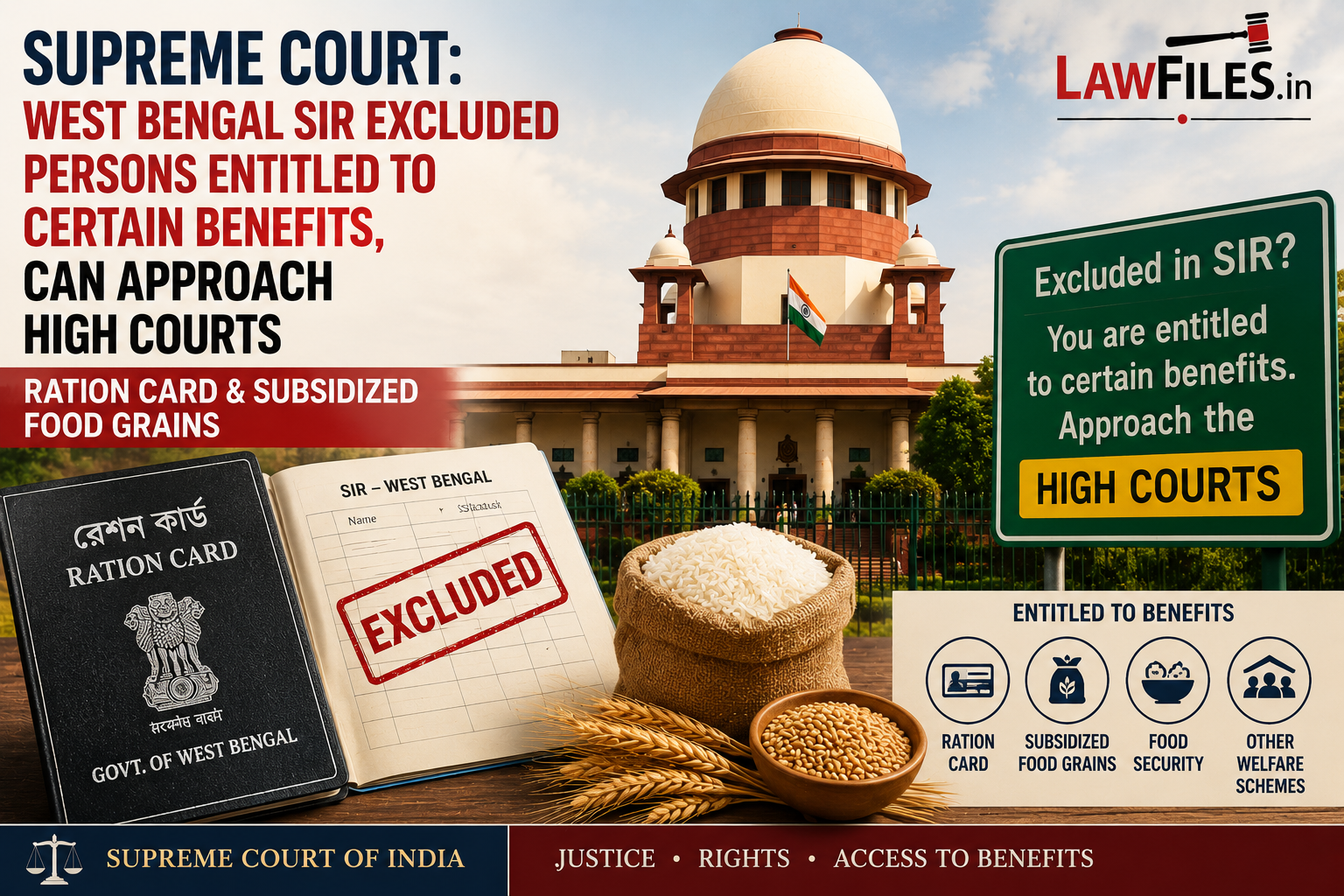
In an important clarification with far-reaching implications for constitutional rights, electoral law and welfare governance, the Supreme Court has observed that removal of a person’s name from the electoral roll does not automatically deprive that individual of statutory welfare benefits such as subsidised food grains or ration entitlements. While disposing of a writ petition filed by a resident of West Bengal whose ration benefits were allegedly threatened following his exclusion from the State’s Special Intensive Revision (SIR) of electoral rolls, the Court reiterated that the legal consequences of deletion from the voters’ list are strictly confined to electoral participation and cannot, by themselves, extinguish other rights flowing from citizenship or statutory welfare legislation. At the same time, the Court declined to exercise its extraordinary jurisdiction under Article 32 of the Constitution, observing that the grievance could be effectively addressed by the Calcutta High Court, while granting liberty to the petitioner to pursue appropriate remedies there. The order, though brief, reinforces an important constitutional principle that the Election Commission’s electoral determination cannot be mechanically transformed into a determination of civil status or welfare eligibility.
The matter came before a Bench comprising Chief Justice Surya Kant, Justice Joymalya Bagchi and Justice V. Mohana, in a petition filed by Mohibulla Mondal, who challenged administrative measures allegedly linking his eligibility for ration benefits to his exclusion from the electoral rolls following the Special Intensive Revision exercise undertaken in West Bengal. The petitioner sought directions restraining the authorities from cancelling or suspending his ration card and prayed that the supply of subsidised food grains should continue until his statutory appeal against exclusion from the electoral roll was finally decided. During the hearing, Senior Advocate Shadan Farasat, appearing for the petitioner, argued that the issue possessed national significance because similar questions could arise in other States undertaking electoral verification exercises. It was contended that unless the Supreme Court clarified the legal position, administrative authorities might continue treating deletion from electoral rolls as sufficient ground for withdrawing welfare entitlements under various government schemes.
Responding to these submissions, Chief Justice Surya Kant made an observation that may well become the defining legal principle emerging from the proceedings. The Court orally remarked that even if a person’s name is removed from the electoral roll, that individual remains entitled to certain statutory benefits, including benefits such as subsidised ration where the governing legislation independently recognises such entitlement. The Bench, however, simultaneously observed that the immediate relief sought by the petitioner could be effectively granted by the jurisdictional High Court. Declining to entertain the petition directly under Article 32, the Supreme Court disposed of the proceedings while granting liberty to approach the Calcutta High Court and requested the Appellate Tribunal dealing with the petitioner’s challenge to electoral exclusion to decide the pending appeal preferably within two months. The Court further clarified that if the petitioner’s grievances remained unresolved thereafter, he would be free to seek appropriate relief before the High Court.
Although the order does not finally determine the legality of the State Government’s policy, it assumes considerable constitutional importance because it reiterates a distinction that the Supreme Court itself had emphasised while deciding the larger challenge concerning the Special Intensive Revision (SIR) exercise. In that judgment, the Court had categorically held that the Election Commission’s role is confined to determining eligibility for inclusion in electoral rolls under the Representation of the People Act and the Constitution. Such determination affects only the person’s right to participate in elections. It does not authoritatively determine citizenship under the Citizenship Act, 1955, nor does it automatically extinguish statutory or constitutional rights unrelated to voting. The present proceedings therefore reaffirm that electoral registration and citizenship-linked welfare entitlements operate within distinct legal frameworks and cannot be conflated merely because both concern the same individual.
The distinction drawn by the Court reflects the constitutional architecture itself. The right to vote in India, though undoubtedly fundamental to democratic governance, is recognised as a statutory right governed principally by the Representation of the People Act, 1950 and 1951. Welfare entitlements, however, frequently arise from entirely different legislative sources. Benefits under the National Food Security Act, 2013 (NFSA), for instance, derive from statutory eligibility criteria framed under food security legislation and implemented through the Public Distribution System (PDS). The NFSA confers legal entitlements upon identified beneficiaries for subsidised food grains, with the objective of securing food and nutritional security for vulnerable sections of society. Consequently, unless the governing statute itself makes electoral registration a condition for eligibility, administrative authorities cannot ordinarily withdraw food security benefits merely because a person’s name no longer appears in the electoral roll.
This distinction also carries significant implications under Article 21 of the Constitution. Over the past three decades, the Supreme Court has progressively interpreted the guarantee of life and personal liberty to include the right to live with dignity, encompassing access to food, nutrition and essential means of subsistence. Beginning with the landmark PUCL v. Union of India (Right to Food Cases), constitutional courts have repeatedly emphasised that food security schemes are not matters of executive charity but components of the State’s constitutional obligation to protect human dignity. Although welfare schemes remain subject to statutory conditions and administrative verification, their withdrawal must conform to principles of legality, fairness and non-arbitrariness under Articles 14 and 21. The Supreme Court’s observations therefore reinforce the idea that electoral verification cannot automatically override independently existing welfare rights without explicit legal authority.
Another noteworthy aspect of the proceedings concerns the Court’s approach towards judicial federalism. Instead of entertaining the dispute directly under Article 32, the Supreme Court consciously directed the petitioner to approach the Calcutta High Court. This reflects the Court’s consistent jurisprudence that High Courts exercising jurisdiction under Article 226 remain the primary constitutional courts for adjudicating fact-intensive disputes involving State action. Since the petition primarily challenged administrative implementation of welfare policy within West Bengal, the Bench considered that the jurisdictional High Court was institutionally better placed to examine factual issues concerning ration eligibility, administrative orders and statutory compliance. Such judicial restraint strengthens the federal judicial structure by recognising the pivotal role of High Courts as constitutional guardians within their respective States.
The controversy also raises broader questions regarding the relationship between electoral verification exercises and welfare administration. Governments undoubtedly possess legitimate authority to prevent fraud, eliminate duplicate beneficiaries and ensure that public resources reach genuinely eligible recipients. Simultaneously, constitutional governance requires that different statutory regimes maintain their own legal standards and procedural safeguards. Electoral rolls are prepared for the purpose of determining voting eligibility; food security legislation serves an entirely different constitutional objective. Treating deletion from one statutory database as automatic proof of ineligibility under another legal regime risks collapsing distinct statutory frameworks into a single administrative process without legislative sanction. The Supreme Court’s observations implicitly caution against precisely such administrative overreach.
From an administrative law perspective, the case also illustrates the importance of reasoned decision-making. If welfare benefits are proposed to be withdrawn, authorities must ordinarily demonstrate statutory authority, provide affected persons an opportunity to contest the decision wherever required by law and ensure that administrative action remains proportionate to the objective sought to be achieved. Mere reliance upon electoral exclusion, without independent examination of the governing welfare statute, may expose such decisions to judicial scrutiny on grounds of arbitrariness and violation of natural justice.
The proceedings are particularly significant because they reaffirm that citizenship, electoral status and welfare eligibility are legally distinct concepts. The Supreme Court expressly reiterated that deletion from the electoral roll neither constitutes a conclusive declaration regarding citizenship nor automatically deprives an individual of rights flowing from other statutes. This clarification assumes considerable importance in contemporary public law, where administrative databases increasingly intersect across different welfare and governance functions. The judgment serves as an institutional reminder that constitutional rights cannot be reduced to algorithmic or database-driven consequences unsupported by statutory authority.
Ultimately, the Supreme Court’s order is not merely about ration cards or electoral rolls. It is a reaffirmation of a deeper constitutional principle that the consequences of an administrative determination must remain confined to the legal purpose for which that determination is made. Electoral exclusion may affect the statutory right to vote, but it does not, without express authority of law, extinguish independent welfare entitlements created under separate legislation. By directing the petitioner to seek relief before the Calcutta High Court while simultaneously recognising that exclusion from the electoral roll does not automatically deprive a person of food security benefits, the Supreme Court has reinforced the constitutional commitment to legality, procedural fairness and the careful separation of distinct statutory rights. In an era of increasing digitisation of governance and interconnected administrative databases, that clarification may prove to be one of the most enduring contributions of the Court’s observations.
