


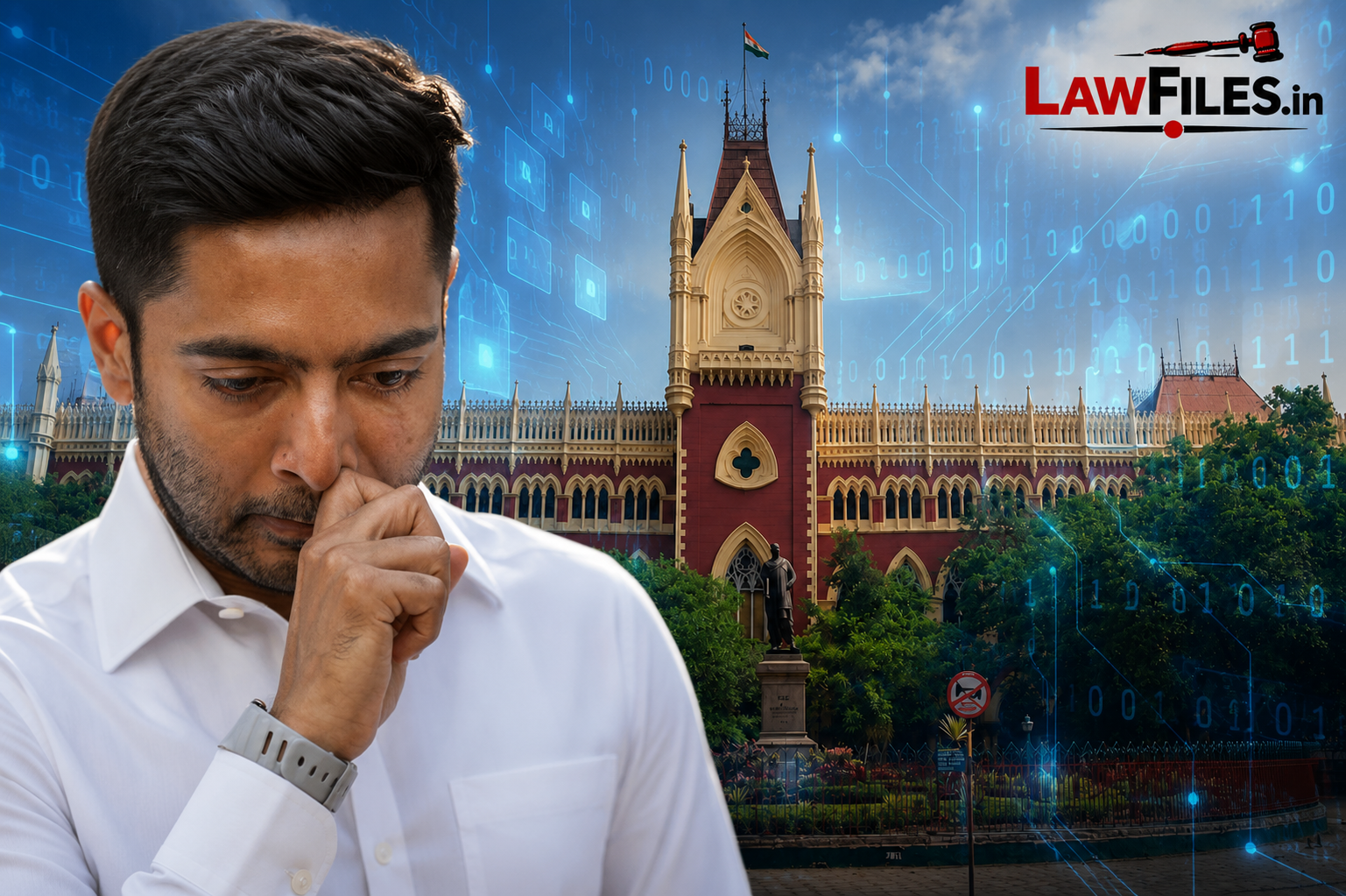
In a significant development concerning the ongoing investigation into the alleged “DJ remark” case, the Calcutta High Court has directed Trinamool Congress MP Abhishek Banerjee to cooperate with the investigation by providing his voice sample, while simultaneously directing the police administration to ensure that law and order is maintained during his appearance before the trial court. The Court specifically instructed the police to prevent any untoward incident, including reported apprehensions of protesters pelting eggs or creating disturbances outside the court premises. The order reflects the judiciary’s dual responsibility of ensuring that criminal investigations proceed unhindered while simultaneously safeguarding the dignity of judicial proceedings and protecting individuals appearing before courts from public disorder. The matter remains at the stage of investigation, and the High Court has not expressed any opinion regarding the truthfulness of the allegations forming the basis of the criminal case.
The controversy stems from statements allegedly made by Abhishek Banerjee during the West Bengal Assembly election campaign, where remarks relating to “DJ” celebrations after the declaration of election results led to the registration of an FIR following a complaint that the speech amounted to intimidation and was capable of disturbing public order. During the investigation, the Criminal Investigation Department (CID) sought permission from the jurisdictional Magistrate to obtain Banerjee’s voice sample for forensic comparison with audio recordings forming part of the investigation. The Magistrate permitted collection of the sample under the provisions of the Bharatiya Nagarik Suraksha Sanhita (BNSS), after which Banerjee approached the High Court challenging the legality of the order.
Before the High Court, counsel appearing for Banerjee argued that the direction to provide a voice sample was legally unsustainable. It was submitted that the Magistrate’s order failed to satisfy the requirements contemplated under Section 349 of the Bharatiya Nagarik Suraksha Sanhita, which governs the collection of voice samples during criminal investigations. The petitioner contended that he had never disputed that the speech under investigation had been delivered by him and, therefore, compelling him to furnish another voice sample served no investigative necessity. It was further argued that the Magistrate had not recorded adequate reasons while authorising collection of the sample and that the investigating agency had failed to disclose the existence of interim protection granted by the High Court against coercive action while obtaining the Magistrate’s order.
The State opposed the challenge, arguing that collection of a voice sample constitutes a recognised investigative technique and forms an important component of modern forensic investigation. According to the prosecution, an accused person cannot dictate the methodology through which the investigating agency collects evidence. Even where a person acknowledges making a speech, forensic comparison of voice recordings remains relevant for establishing authenticity, integrity of digital recordings and evidentiary reliability during trial. The State therefore maintained that judicial interference at this stage would unnecessarily impede an ongoing investigation.
During the proceedings, the High Court emphasised that every person against whom criminal investigation is pending has a corresponding legal obligation to cooperate with lawful investigative processes. At the same time, the Court recognised concerns regarding maintenance of public order during the petitioner’s appearance before the Magistrate. Taking note of submissions expressing apprehension that political workers or protesters might attempt to disrupt the proceedings by pelting eggs or creating disorder, the Court directed the police authorities to make adequate security arrangements so that judicial proceedings could continue peacefully and without interference. Such directions underline the constitutional responsibility of the State to preserve the dignity of courts and ensure that criminal investigations are not influenced by public demonstrations or political mobilisation.
The case assumes broader legal significance because it concerns the increasingly important issue of collection of voice samples during criminal investigations. Historically, the Supreme Court in Ritesh Sinha v. State of Uttar Pradesh (2019) recognised the authority of courts to direct accused persons to provide voice samples for purposes of criminal investigation, holding that such directions facilitate effective administration of justice and do not, by themselves, violate constitutional protections against self-incrimination under Article 20(3). Parliament subsequently incorporated an express statutory framework through the Bharatiya Nagarik Suraksha Sanhita, thereby providing legislative recognition to investigative techniques involving voice recording and forensic examination. The present proceedings therefore concern not the existence of such investigative powers but the procedural safeguards governing their exercise.
An important constitutional issue emerging from the litigation relates to the balance between individual rights and investigative necessity. Voice samples occupy a distinct legal position because they constitute physical identifying characteristics rather than testimonial evidence. Indian constitutional jurisprudence has consistently distinguished between compelling an accused to communicate incriminating information—which may attract Article 20(3)—and requiring production of physical evidence such as fingerprints, handwriting samples, signatures or voice exemplars for scientific examination. Courts have generally regarded the latter category as permissible investigative measures provided they are authorised by law and accompanied by procedural safeguards.
The proceedings also illustrate the growing importance of forensic science within the criminal justice system. Contemporary criminal investigations increasingly rely upon digital evidence, electronic recordings and scientific comparison techniques rather than solely upon oral testimony. Voice spectrography, waveform analysis and forensic audio comparison have become important evidentiary tools, particularly in cases involving speeches, intercepted communications and digital recordings. Nevertheless, courts continue to insist that such forensic evidence remains subject to judicial scrutiny regarding authenticity, chain of custody and scientific reliability before being accorded evidentiary value during trial.
Equally noteworthy is the Court’s concern for preserving judicial decorum. The direction to the police to prevent demonstrations, including alleged attempts at egg-pelting, reflects an important constitutional principle that court premises must remain insulated from political confrontation. Regardless of the political affiliation or public profile of an accused person, appearances before judicial forums must occur in an atmosphere free from intimidation, public spectacle or disorder. The administration of criminal justice depends not only upon lawful investigation but also upon maintaining the dignity and independence of judicial institutions.
The litigation also highlights the procedural discipline governing parallel judicial proceedings. Earlier, another Bench of the Calcutta High Court had declined to entertain a separate criminal revision challenging the Magistrate’s order because a connected writ petition arising from the same FIR was already pending before a coordinate Bench. The Court observed that entertaining multiple proceedings concerning the same investigation could result in conflicting judicial orders and therefore directed that all connected issues be considered together. Such judicial restraint reinforces institutional consistency and avoids contradictory rulings during ongoing criminal investigations.
Importantly, the High Court’s order should not be construed as expressing any view regarding the merits of the criminal allegations. The Court has neither adjudicated the legality of the speech under investigation nor determined whether any offence has actually been committed. The present proceedings remain confined to ensuring cooperation with the investigative process and maintaining orderly administration of justice. The presumption of innocence continues to operate in favour of the accused until any charges are established through a trial conducted in accordance with law.
Ultimately, the Calcutta High Court’s order reflects the judiciary’s continuing effort to reconcile effective criminal investigation with constitutional safeguards protecting individual liberty and procedural fairness. By directing cooperation with the collection of the voice sample while simultaneously ensuring adequate police protection and judicial decorum, the Court has emphasised that criminal investigations must proceed through lawful procedures rather than political confrontation. The case is likely to contribute further to the evolving jurisprudence governing forensic evidence, investigative powers under the BNSS and the constitutional standards applicable to scientific methods employed during criminal investigations.
