

Close Menu
LawFilesLawFiles

    Subscribe to Updates

    Get the latest creative news from FooBar about art, design and business.

    What's Hot

    Delhi High Court Upholds Rajpal Yadav’s Conviction in Cheque Bounce Cases; Ruling Reaffirms Sanctity of Commercial Transactions and the Deterrent Purpose of the Negotiable Instruments Act

    July 11, 2026

    Delayed Payment by Auction Purchaser Under the SARFAESI Act: Supreme Court Reinforces Mandatory Compliance With Auction Timelines; A Landmark Shift in India’s Banking Recovery Jurisprudence

    July 11, 2026

    Anil Ambani Withdraws Bombay High Court Plea Against Bank of Baroda’s Fraud Classification; Case Highlights Evolving Judicial Standards Governing RBI Fraud Tagging Framework

    July 11, 2026
    Facebook X (Twitter) Instagram Threads
    Saturday, July 11
    LawFilesLawFiles
    Facebook X (Twitter)
    • Home
      • Who We Are
      • Our Mission
      • Advisory board
      • Contact US
    • Supreme Court
    • High Courts
      • Gujarat High Court
      • Jharkhand High Court
      • Rajasthan High Court
      • Karnataka High Court
      • Andhra Pradesh High Court
      • Allahabad High Court
      • Himachal Pradesh High Court
      • Chhattisgarh High Court
      • Jammu & Kashmir and Ladakh High Court
      • Kerala High Court
      • Punjab and Haryana High Court
      • Patna High Court
      • Madhya Pradesh High Court
      • Madras High Court
      • Bombay High Court
      • Orissa High Court
      • Calcutta High Court
      • Meghalaya High Court
      • Delhi High Court
      • Manipur High Court
      • Gauhati High Court
    • Corporate
    • Taxation Laws
      • Income Tax
      • GST
      • Customs & Excise
    • Global Affairs
    • Articles
      • Sitting Judge’s’ Views
      • Senior Advocate
      • Policy Analysis
      • Tax Expert
    • PILS
      • Free/Affordable Legal Aid
      • PIL Cell
      • Law student Volunteer Cell (research & Drafting)
      • NGO & Legal services Authority Tie-ups
      • Online Legal Formats
      • Online Legal Help Form
    Subscribe Premium
    LawFilesLawFiles
    Home»Political News»Savarkar Defamation Trial: Pune Court Hears Grandnephew’s Testimony on Mercy Petitions; Proceedings Highlight Limits of Historical Opinion and Criminal Defamation Law
    Political News

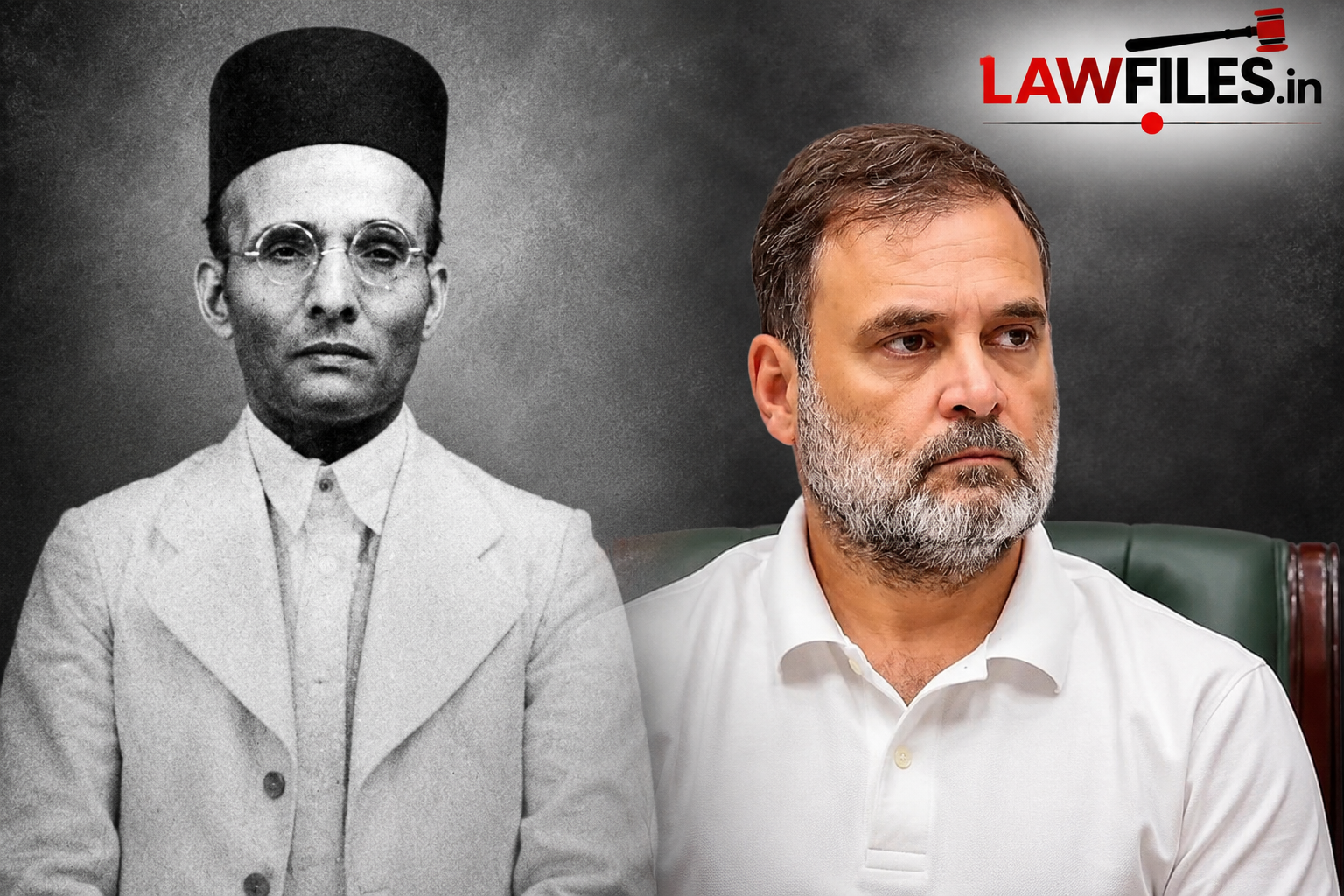
    Savarkar Defamation Trial: Pune Court Hears Grandnephew’s Testimony on Mercy Petitions; Proceedings Highlight Limits of Historical Opinion and Criminal Defamation Law

    Anvita DwivediBy Anvita DwivediJuly 8, 2026No Comments7 Mins Read
    WhatsApp Facebook Twitter Copy Link
    Share
    Facebook Twitter Pinterest Copy Link WhatsApp

    A criminal defamation proceeding pending before a Pune court has once again brought one of India’s most enduring historical debates into the judicial arena, as the grandnephew of Vinayak Damodar Savarkar deposed before the trial court regarding the controversial characterisation of the freedom fighter’s mercy petitions addressed to the British colonial administration. The witness, during the course of cross-examination, stated that he could not conclusively say whether Savarkar should be described as a “Mahaveer” or as a “British agent” merely because he had submitted mercy petitions during his incarceration in the Cellular Jail. The testimony assumes significance not because it resolves the long-standing historical controversy surrounding Savarkar, but because it illustrates the evidentiary challenges courts encounter when criminal defamation proceedings intersect with competing interpretations of history, political discourse and constitutional free speech. Importantly, the observations recorded before the trial court constitute witness testimony and not judicial findings on Savarkar’s legacy or the historical accuracy of competing narratives.

    The proceedings arise from a criminal defamation complaint instituted against Congress leader Rahul Gandhi over remarks allegedly made during a public speech concerning Vinayak Damodar Savarkar. The complaint has been filed by Satyaki Savarkar, the grandnephew of the late freedom fighter, who contends that the statements made by Gandhi were false, defamatory and intended to tarnish the reputation of Savarkar by portraying him as someone who repeatedly apologised to the British Government in exchange for his release from imprisonment. The complainant maintains that the remarks exceeded the limits of permissible political criticism and amounted to criminal defamation punishable under Sections 499 and 500 of the Indian Penal Code, provisions which now find corresponding place in the Bharatiya Nyaya Sanhita, 2023. The trial before the Pune court is presently at the stage of recording evidence.

    During cross-examination, defence counsel questioned the complainant regarding the historical implications of the mercy petitions submitted by Savarkar while lodged in the Cellular Jail in the Andaman and Nicobar Islands. Responding to questions put during the proceedings, the witness stated that he was unable to definitively conclude whether the filing of mercy petitions, by itself, justified describing Savarkar either as a heroic freedom fighter or as an agent of the British Government. The answer assumes evidentiary significance because it reflects the witness’s acknowledgement that the historical interpretation of those documents cannot be reduced to simplistic legal characterisations. The testimony, however, forms only one part of the evidentiary record and will ultimately be assessed by the trial court in conjunction with documentary evidence, historical material and the legal ingredients required to establish the offence of criminal defamation.

    The controversy surrounding Savarkar’s mercy petitions has remained a subject of historical and political debate for several decades. It is an undisputed historical fact that Savarkar, after being sentenced to transportation for life following his conviction in 1911, submitted multiple mercy petitions to the British colonial authorities during his incarceration in the Cellular Jail. These petitions are preserved in official archival records and have been extensively discussed by historians across the ideological spectrum. However, the legal and historical significance attributed to those petitions remains sharply contested. One school of thought characterises them as strategic legal representations intended to secure release so that the struggle for India’s independence could continue outside prison, while another interprets them as evidence of compromise with colonial authorities. Courts adjudicating defamation disputes are ordinarily not called upon to conclusively resolve such historical controversies; rather, they examine whether the impugned statements satisfy the statutory ingredients of defamation in light of the available evidence.

    The proceedings also highlight the limited institutional role of criminal courts in adjudicating historical controversies. Judicial determination in a defamation case does not amount to an authoritative rewriting of history. Instead, the court’s inquiry remains confined to whether the impugned statement lowered the complainant’s reputation within the meaning of criminal defamation law, whether the statement falls within any of the statutory exceptions contained in Section 499 of the Indian Penal Code (or the corresponding provision under the Bharatiya Nyaya Sanhita), and whether the accused acted with the requisite legal intent. Historical truth, public good, fair comment and good-faith criticism continue to occupy an important place within the statutory exceptions recognised by Indian defamation law.

    From a constitutional perspective, the litigation once again illustrates the continuing tension between the right to freedom of speech under Article 19(1)(a) and the right to reputation recognised as an integral component of Article 21. The Supreme Court, in Subramanian Swamy v. Union of India (2016), upheld the constitutional validity of criminal defamation by recognising that while political speech occupies a preferred constitutional position, the protection of individual reputation equally constitutes a legitimate constitutional interest. The Court held that freedom of expression, though fundamental, is not absolute and remains subject to the reasonable restrictions contemplated under Article 19(2), including defamation. Consequently, political criticism enjoys broad constitutional protection, but where such criticism allegedly crosses into false factual assertions damaging another’s reputation, courts may be called upon to determine whether the statutory threshold for criminal defamation has been crossed.

    The present proceedings also underscore the distinction between historical interpretation and legal adjudication. Historians routinely disagree regarding the motives underlying archival documents, speeches and political decisions. Such disagreements are ordinarily resolved through academic research rather than judicial determination. Criminal courts, by contrast, operate on evidentiary standards prescribed by law and determine whether specific legal ingredients of an offence have been established beyond reasonable doubt. Thus, while historical debates may inform the factual background of a defamation case, the ultimate judicial inquiry remains confined to the statutory framework governing criminal liability rather than competing schools of historical interpretation.

    Another noteworthy aspect concerns the evidentiary value of witness testimony. Under the Indian Evidence Act and its successor legislation, the Bharatiya Sakshya Adhiniyam, the testimony of a witness constitutes one component of the evidentiary record rather than conclusive proof of disputed historical facts. The complainant’s acknowledgment during cross-examination regarding the complexity of interpreting Savarkar’s mercy petitions neither determines the legal merits of the prosecution nor resolves the broader historical debate. Instead, it forms part of the factual matrix that the trial court will evaluate alongside documentary records, contextual evidence and legal submissions advanced by both parties.

    The proceedings further illustrate the increasingly common phenomenon of constitutional courts and criminal courts becoming forums for politically significant historical disputes. In recent years, litigation concerning historical personalities, freedom fighters and national icons has frequently reached courts through actions alleging defamation, hate speech or protection of personality rights. Such cases require judges to maintain careful institutional restraint by focusing upon the legal issues before them without transforming judicial proceedings into adjudications of history itself. This distinction preserves both judicial neutrality and the autonomy of historical scholarship.

    Ultimately, the Pune court proceedings are not a judicial referendum on Vinayak Damodar Savarkar’s place in India’s freedom movement. Rather, they represent the adjudication of a narrowly framed criminal complaint requiring the court to determine whether the impugned statements satisfy the legal requirements of criminal defamation. The testimony recorded during cross-examination nevertheless serves as a reminder that historical personalities often continue to generate competing narratives long after the events themselves have passed into history. The role of the criminal court is not to endorse one historical interpretation over another, but to ensure that legal liability, if any, is determined strictly in accordance with constitutional principles, statutory requirements and the evidence placed on record. In doing so, the proceedings reaffirm an important constitutional principle: while history may remain open to debate, criminal responsibility must always rest upon proof established through the rule of law rather than political or ideological contestation.

    Proceedings Highlight Limits of Historical Opinion and Criminal Defamation Law Pune Court Hears Grandnephew's Testimony on Mercy Petitions; Savarkar Defamation Trial:
    Share. WhatsApp Facebook Twitter Pinterest Email
    Anvita Dwivedi

    Related Posts

    Delhi High Court Upholds Rajpal Yadav’s Conviction in Cheque Bounce Cases; Ruling Reaffirms Sanctity of Commercial Transactions and the Deterrent Purpose of the Negotiable Instruments Act

    July 11, 2026

    Delayed Payment by Auction Purchaser Under the SARFAESI Act: Supreme Court Reinforces Mandatory Compliance With Auction Timelines; A Landmark Shift in India’s Banking Recovery Jurisprudence

    July 11, 2026

    Anil Ambani Withdraws Bombay High Court Plea Against Bank of Baroda’s Fraud Classification; Case Highlights Evolving Judicial Standards Governing RBI Fraud Tagging Framework

    July 11, 2026
    Add A Comment
    Leave A Reply Cancel Reply

    Demo
    Top Posts

    Digital Forensics Fail to convince Supreme Court: Bail Denied to Gagan Khanna in BNS Assault Case

    June 15, 2026241 Views

    Wrongful Claim Rejection Amounts to Deficiency in Service: Delhi Consumer Commission Holds Star Health Liable

    March 16, 202672 Views

    Bombay High Court Quashes POCSO Case, Directs Accused to Fund MacBook for Victim’s Education

    February 28, 202658 Views

    Supreme Court Quashes FIR Over ‘Improved’ Second Complaint: A Reminder That Criminal Law Cannot Be Built on Shifting Narratives

    June 4, 202654 Views
    Don't Miss

    Delhi High Court Upholds Rajpal Yadav’s Conviction in Cheque Bounce Cases; Ruling Reaffirms Sanctity of Commercial Transactions and the Deterrent Purpose of the Negotiable Instruments Act

    By Anvita DwivediJuly 11, 2026

    In a significant reaffirmation of India’s cheque dishonour jurisprudence, the Delhi High Court has upheld…

    Delayed Payment by Auction Purchaser Under the SARFAESI Act: Supreme Court Reinforces Mandatory Compliance With Auction Timelines; A Landmark Shift in India’s Banking Recovery Jurisprudence

    July 11, 2026

    Anil Ambani Withdraws Bombay High Court Plea Against Bank of Baroda’s Fraud Classification; Case Highlights Evolving Judicial Standards Governing RBI Fraud Tagging Framework

    July 11, 2026

    Supreme Court Examines Challenge to Navy Recruitment Rules for Group ‘B’ Non-Gazetted Officers; Notice to Centre Puts Promotional Equality and Service Jurisprudence Under Judicial Scrutiny

    July 11, 2026
    Stay In Touch
    • Facebook
    • Twitter

    Subscribe to Updates

    Get the latest creative news from SmartMag about art & design.

    Top Posts

    Digital Forensics Fail to convince Supreme Court: Bail Denied to Gagan Khanna in BNS Assault Case

    June 15, 2026241 Views

    Wrongful Claim Rejection Amounts to Deficiency in Service: Delhi Consumer Commission Holds Star Health Liable

    March 16, 202672 Views

    Bombay High Court Quashes POCSO Case, Directs Accused to Fund MacBook for Victim’s Education

    February 28, 202658 Views
    Don't Miss

    Delhi High Court Upholds Rajpal Yadav’s Conviction in Cheque Bounce Cases; Ruling Reaffirms Sanctity of Commercial Transactions and the Deterrent Purpose of the Negotiable Instruments Act

    By Anvita DwivediJuly 11, 2026

    In a significant reaffirmation of India’s cheque dishonour jurisprudence, the Delhi High Court has upheld…

    Delayed Payment by Auction Purchaser Under the SARFAESI Act: Supreme Court Reinforces Mandatory Compliance With Auction Timelines; A Landmark Shift in India’s Banking Recovery Jurisprudence

    July 11, 2026

    Anil Ambani Withdraws Bombay High Court Plea Against Bank of Baroda’s Fraud Classification; Case Highlights Evolving Judicial Standards Governing RBI Fraud Tagging Framework

    July 11, 2026

    Supreme Court Examines Challenge to Navy Recruitment Rules for Group ‘B’ Non-Gazetted Officers; Notice to Centre Puts Promotional Equality and Service Jurisprudence Under Judicial Scrutiny

    July 11, 2026
    Stay In Touch
    • Facebook
    • YouTube
    • TikTok
    • Instagram
    Top Trending
    About Us
    About Us

    LawFiles.in is a comprehensive legal news platform delivering real-time updates from the Supreme Court, High Courts, Tribunals, Corporate and Tax law, Regulators, Politics, Crime, Consumer cases, and Global Affairs.

    Email Us: lawfilesoffical@gmail.com
    Contact: +91 8800026066

    Contact Us:
    India International Centre
    40, Max Mueller Marg
    Lodhi Estate, New Delhi-110003

    Facebook X (Twitter)
    Our Picks

    Delhi High Court Upholds Rajpal Yadav’s Conviction in Cheque Bounce Cases; Ruling Reaffirms Sanctity of Commercial Transactions and the Deterrent Purpose of the Negotiable Instruments Act

    July 11, 2026

    Delayed Payment by Auction Purchaser Under the SARFAESI Act: Supreme Court Reinforces Mandatory Compliance With Auction Timelines; A Landmark Shift in India’s Banking Recovery Jurisprudence

    July 11, 2026

    Anil Ambani Withdraws Bombay High Court Plea Against Bank of Baroda’s Fraud Classification; Case Highlights Evolving Judicial Standards Governing RBI Fraud Tagging Framework

    July 11, 2026

    Supreme Court Examines Challenge to Navy Recruitment Rules for Group ‘B’ Non-Gazetted Officers; Notice to Centre Puts Promotional Equality and Service Jurisprudence Under Judicial Scrutiny

    July 11, 2026

    SCBA Condemns Abusive Conduct by Litigant in Supreme Court; Seeks Regulatory Framework for Circulation of Courtroom Videos Amid Growing Debate on Open Justice and Digital Accountability

    July 11, 2026
    Most Popular

    Madhya Pradesh High Court Examines Plea to Extend NRI Quota to Stray Vacancy Round in Medical Admissions

    February 26, 20260 Views

    Supreme Court Rules Limitation Period Under CrPC Starts When Offender’s Identity Is Known, Not From First Complaint

    February 27, 20260 Views

    Maharashtra State Consumer Commission Slams HP Employees’ Co-operative Credit Society for Enforcing Undisclosed Restriction, Orders Refund with Interest and Compensation

    March 2, 20260 Views

    NCDRC Dismisses Consumer Complaint Filed Nearly a Decade After Possession, Holds Claim Barred by Limitation

    March 2, 20260 Views

    Supreme Court CJI Uses T20 Cricket Analogy to Stress Importance of Specialization in Legal Practice

    March 2, 20260 Views
    © 2026 LawFiles. Owned by Varta24 Media.
    • Articles
    • Careers
    • Corporate
    • Global Affairs
    • Law Firms & Lawyers
    • PILS
    • Regulatory

    Type above and press Enter to search. Press Esc to cancel.