


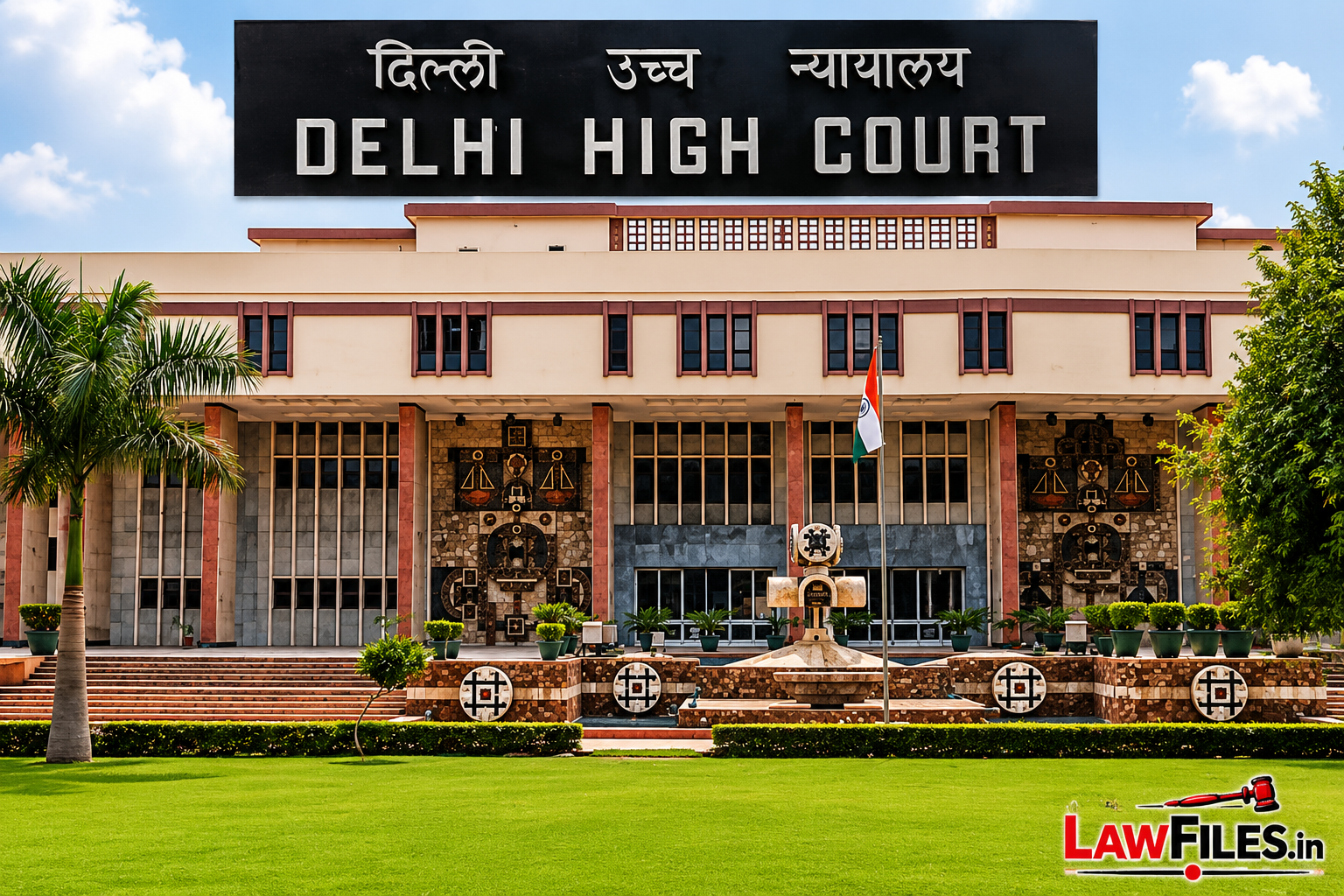
In a significant ruling that is likely to shape the evolving jurisprudence on personality rights in India, the Delhi High Court has held that political criticism cannot automatically be converted into a claim for protection of personality rights, even while directing the removal of a limited number of social media posts found to be prima facie obscene, vulgar and defamatory against BJP Rajya Sabha Member Raghav Chadha. The decision underscores the delicate constitutional balance between an individual’s right to reputation under Article 21 and the equally fundamental guarantee of freedom of speech and expression under Article 19(1)(a). While granting partial interim relief, the Court made it unequivocally clear that the present dispute was essentially one of alleged defamation and not an infringement of personality rights, thereby drawing an important jurisprudential distinction between two legal doctrines that are increasingly invoked in the digital era.
The matter was heard by Justice Subramonium Prasad in a civil suit instituted by Raghav Chadha against several identified and unidentified defendants, including John Doe entities, alleging misuse of his photographs, identity and personal attributes through manipulated social media posts, AI-generated content, morphed images and allegedly defamatory material circulated after his political shift from the Aam Aadmi Party to the Bharatiya Janata Party. Chadha sought wide-ranging reliefs, including protection of his personality rights, removal of objectionable content, restraint against future misuse of his identity and damages for loss of reputation. The suit also sought what is commonly known as an “Ashok Kumar” or John Doe injunction against unknown persons responsible for creating and disseminating the disputed material.
While pronouncing the interim order, Justice Prasad observed that only five specific social media posts crossed the permissible constitutional threshold by containing explicit, profane and vulgar material that could not be categorised as harmless political satire. The Court accordingly directed that those posts be taken down. However, the remaining content was not found to be prima facie defamatory. The Court categorically stated, “There is no personality right involved. I have ordered takedown of only five documents. The rest are not defamatory prima facie.” This observation became the defining feature of the judgment, signalling that not every use of a public figure’s image or identity on social media constitutes a violation of personality rights merely because the content is critical or politically unflattering.
The Court’s reasoning was consistent with its earlier oral observations made while reserving judgment, where Justice Prasad had remarked that the impugned material largely appeared to constitute criticism of Chadha’s political decision rather than unlawful commercial exploitation of his identity. The Bench had observed that the line separating political criticism from actionable defamation is “quite thin,” particularly in a democratic society where elected representatives are expected to remain subject to intense public scrutiny. These observations indicate the Court’s conscious effort to prevent the expanding doctrine of personality rights from becoming an instrument capable of suppressing legitimate political expression or public commentary.
Legally, the judgment assumes significance because it distinguishes between the doctrines of personality rights and defamation—two concepts that are often incorrectly invoked together. Personality rights, also referred to as publicity rights, primarily protect an individual’s exclusive control over the commercial exploitation of their name, likeness, image, voice or other identifiable attributes. These rights have gradually evolved in Indian jurisprudence through judicial interpretation under Article 21 of the Constitution and have traditionally been invoked where a person’s identity is commercially exploited without consent, particularly in advertisements, endorsements, merchandise, artificial intelligence-generated content and digital impersonation. Defamation, on the other hand, protects reputation from false and injurious statements. While the two doctrines may occasionally overlap, they remain conceptually distinct, and the High Court’s ruling reinforces that distinction with considerable clarity.
Over the last few years, the Delhi High Court has emerged as the principal forum shaping India’s developing jurisprudence on personality rights. Coordinate Benches have granted protection to numerous public personalities including Shashi Tharoor, Pawan Kalyan, Aman Gupta, Allu Arjun, Mohanlal, Sunil Gavaskar, Jubin Nautiyal, Kajol, R. Madhavan, NTR Jr., Raj Shamani, Sudhir Chaudhary, Sri Sri Ravi Shankar, Nagarjuna, Aishwarya Rai Bachchan, Abhishek Bachchan and Karan Johar, particularly against unauthorised AI-generated content, deepfakes, fake endorsements and commercial misuse of their identities. However, the present case marks an important jurisprudential qualification by clarifying that these precedents cannot be mechanically extended to shield politicians from criticism arising out of their political conduct or ideological choices.
The Court’s approach also reflects an emerging judicial recognition of the constitutional role played by satire in democratic discourse. Political satire has historically occupied a protected space within free speech jurisprudence because it enables robust public debate and criticism of those occupying positions of public authority. While satire may be sharp, exaggerated or uncomfortable, constitutional protection generally extends to such expression unless it degenerates into obscenity, false factual assertions or unlawful attacks upon an individual’s reputation. By directing removal only of posts that were found to be profane and explicitly abusive while permitting criticism that remained within permissible constitutional limits, the Court adopted a narrowly tailored approach rather than imposing a blanket prohibition upon online expression.
Another important dimension of the case concerns the growing legal challenges posed by artificial intelligence and digitally manipulated content. Chadha’s suit specifically referred to deepfake videos, morphed visuals, voice cloning and synthetic media allegedly created using artificial intelligence. The rapid advancement of generative AI has significantly complicated the legal distinction between parody, satire, misinformation and identity theft. Courts across jurisdictions are increasingly required to determine whether manipulated digital content merely constitutes political expression or crosses into unlawful impersonation capable of damaging an individual’s reputation or misleading the public. Although the High Court did not finally adjudicate these issues at the interim stage, the proceedings demonstrate that future personality rights litigation is likely to be deeply intertwined with emerging AI technologies.
From a constitutional perspective, the judgment also reinforces an equally important proposition—that public office carries with it a correspondingly higher degree of tolerance for criticism. Indian constitutional jurisprudence has consistently recognised that politicians, unlike private individuals, voluntarily participate in public life and therefore remain subject to greater scrutiny, criticism and commentary. Courts have repeatedly cautioned against employing civil injunctions in a manner that chills political speech or discourages democratic criticism. The High Court’s refusal to characterise political commentary as a personality rights violation reflects this well-established constitutional principle.
Equally noteworthy is the Court’s measured use of interim injunctive powers. Instead of directing wholesale removal of all content identified by the plaintiff, the Court independently examined the disputed posts and confined interim relief only to material that, prima facie, crossed the constitutional limits of protected expression. Such an approach is consistent with the settled principle that prior restraint upon speech should remain narrowly tailored and proportionate, particularly where the impugned expression concerns political affairs or public figures.
The decision is therefore likely to occupy an important place in the continuing evolution of Indian digital rights jurisprudence. It clarifies that personality rights cannot become a substitute for defamation law, nor can they be invoked merely because online content is politically embarrassing or critical. At the same time, the judgment recognises that constitutional protection of free speech is not absolute and does not extend to content that is obscene, explicitly abusive or demonstrably defamatory. By carefully separating legitimate political criticism from unlawful attacks on reputation, the Delhi High Court has reaffirmed that constitutional adjudication in the digital age requires calibrated judicial balancing rather than absolutist protection of either speech or reputation.
The final adjudication of the suit will likely provide further guidance on the interface between personality rights, artificial intelligence, online anonymity and political expression. For the present, however, the High Court’s interim ruling establishes an important constitutional marker that while every individual possesses a legally protectable reputation, personality rights cannot be transformed into a legal shield against democratic criticism, particularly when the challenged content concerns political conduct rather than commercial exploitation of identity. In doing so, the Court has contributed meaningfully to the developing jurisprudence governing digital expression in India, reaffirming that constitutional freedoms and individual dignity must coexist through careful judicial balancing rather than categorical preference for one over the other.
