


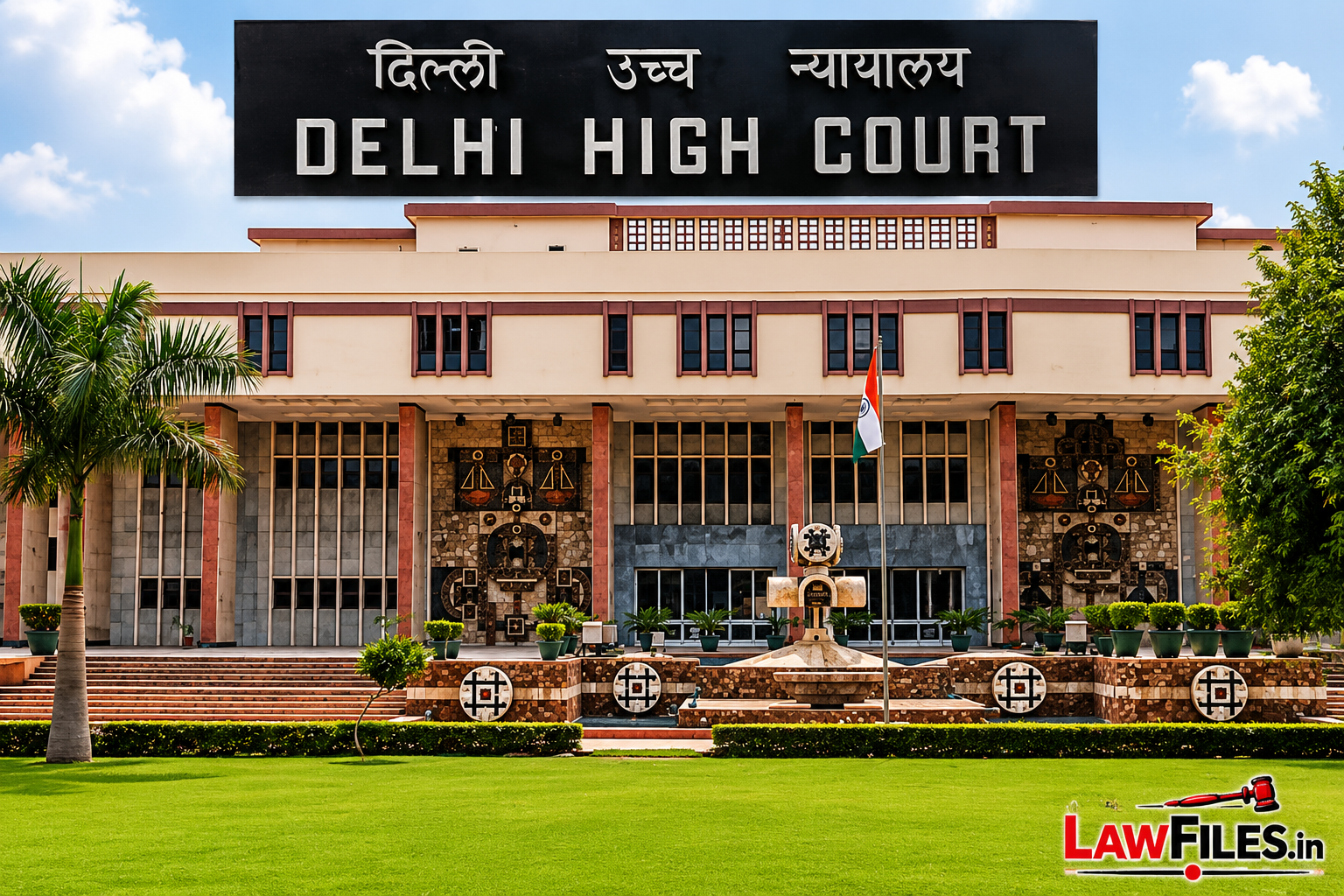
When a marriage is born dead, forcing a couple to wait out a strict legal timeline does not save the relationship it only stretches out their misery. In a landmark ruling, the Delhi High Court has declared that the mandatory one-year waiting period to file for divorce under the Special Marriage Act, 1954, can be waived if a couple faces “exceptional hardship.” The ruling marks a massive shift from the judiciary’s past approach, choosing the emotional well being and personal liberty of struggling couples over rigid statutory deadlines.
A Division Bench comprising Justice Vivek Chaudhary and Justice Renu Bhatnagar gave this crucial verdict while hearing an appeal from a couple of different faiths. The two had married under the Special Marriage Act, but the union quickly triggered severe family turmoil. The husband’s father suffered a health collapse from the shock, resulting in liver failure, while the wife had to hide the marriage entirely from her family out of fear of a violent backlash.
The couple never lived together, and the marriage was never consummated. Realizing the relationship had no future, they moved a Family Court to waive the mandatory one-year waiting period required under Section 29 of the Special Marriage Act so they could part ways quickly.
The Family Court flatly refused, stating that family disapproval did not count as “exceptional hardship” and that the couple hadn’t tried hard enough to save the marriage. Setting aside that rigid order, the Delhi High Court stood firmly with the couple. The High Court pulled up the mechanical approach to family law, the Bench observed:
“Where a marriage is only notional, has never been consummated, and has received no social or familial acceptance, insistence on the statutory waiting period would serve no meaningful purpose.” The judges made it clear that while law aims to protect the institution of marriage, it cannot be used to trap people in a state of permanent distress. The Bench added:
“It is an admitted position that the marriage between the parties was purely in law, not in substance.”
Earlier in the 2022 case of Rishu Aggarwal v. Mohit Goyal, a couple had separated just days after their wedding due to extreme temperamental differences and a mutual denial of sexual relations. When they asked the court to waive the one-year window, the Delhi High Court rejected it. Back then, the court held that ordinary marital issues, lack of intimacy, or immediate incompatibility did not meet the high legal bar of “exceptional hardship” or “exceptional depravity.” The court’s philosophy was that the law required a “cooling-off” period to prevent impulsive divorces.
The first major shift began in December 2025. A Full Bench of the High Court comprising Justices Navin Chawla, Anup Jairam Bhambhani, and Renu Bhatnagar ruled on a similar one-year separation rule under the Hindu Marriage Act. They declared that these timelines are “directory, not mandatory.”
Crucially, the Full Bench connected a person’s marital status directly to their fundamental rights, stating:
“The statutory period of 01-year prescribed… as a pre-requisite for presenting the first motion, can be waived, by applying the proviso… and forcing unwilling parties to remain legally bound serves no societal or constitutional purpose, and may in fact violate their dignity, autonomy, and right to life under Article 21 of the Constitution.”
With this latest 2026 judgment, the High Court has seamlessly extended that human centric logic to interfaith and secular court marriages under the Special Marriage Act. The courts are now openly recognizing that psychological trauma, societal pressure, and complete lack of cohabitation are valid grounds for “exceptional hardship.”
This update does not mean a couple can walk into court and get an immediate divorce just because they had an argument. The High Court has warned that waivers will not be given “for the asking.”
When a marriage falls apart immediately after the wedding, the legal system’s traditional “cooling-off” period can feel less like a buffer and more like a sentence.
However, under the updated approach of the Delhi High Court, the strict one-year bar under the Special Marriage Act is no longer an absolute wall. To bypass this timeline, an estranged couple must present a ironclad case built upon two critical, objective pillars: proving a Total Breakdown of the marital bond and demonstrating that any attempt at Futile Reconciliation is a mathematical impossibility.
To establish a “Total Breakdown,” the couple must demonstrate to the court that their marriage exists strictly as a legal fiction. This means providing objective evidence that the union never functioned as a partnership in reality often characterized by zero cohabitation, immediate physical separation days after the ceremony, or a complete lack of marital consummation. It requires showing that the traditional elements of a shared domestic life were never established.
Crucially, the litigants must link this paper only status to ongoing trauma. They must prove that being forced to remain legally shackled to a dead relationship causes “exceptional hardship” in the form of severe mental agony, psychological distress, or social and familial hostility that actively damages their well-being and halts their ability to move forward with their lives.
The second pillar shifts the focus from the broken nature of the relationship to the absolute impossibility of its revival. A Family Court will not grant an early waiver based on a couple’s emotional declaration alone it requires empirical proof that all institutional safety nets have completely failed. This means the parties must have actively participated in court mandated counseling or institutional mediation services, and those neutral experts must have concluded that the divide is unbridgeable.
By showing that formal mediation has been thoroughly exhausted, the couple proves to the judge that there is “absolutely zero mathematical chance” of a reunion. When the record reflects that no amount of time, counseling, or therapeutic intervention can breathe life back into the union, the court is forced to recognize that maintaining the one-year waiting period serves no logical or social purpose, paving the way for an early exit.
By prioritizing human dignity over a calendar date, the Delhi High Court has sent a clear message: when a marriage is broken beyond repair, the law should act as an exit route, not a prison cell.
