


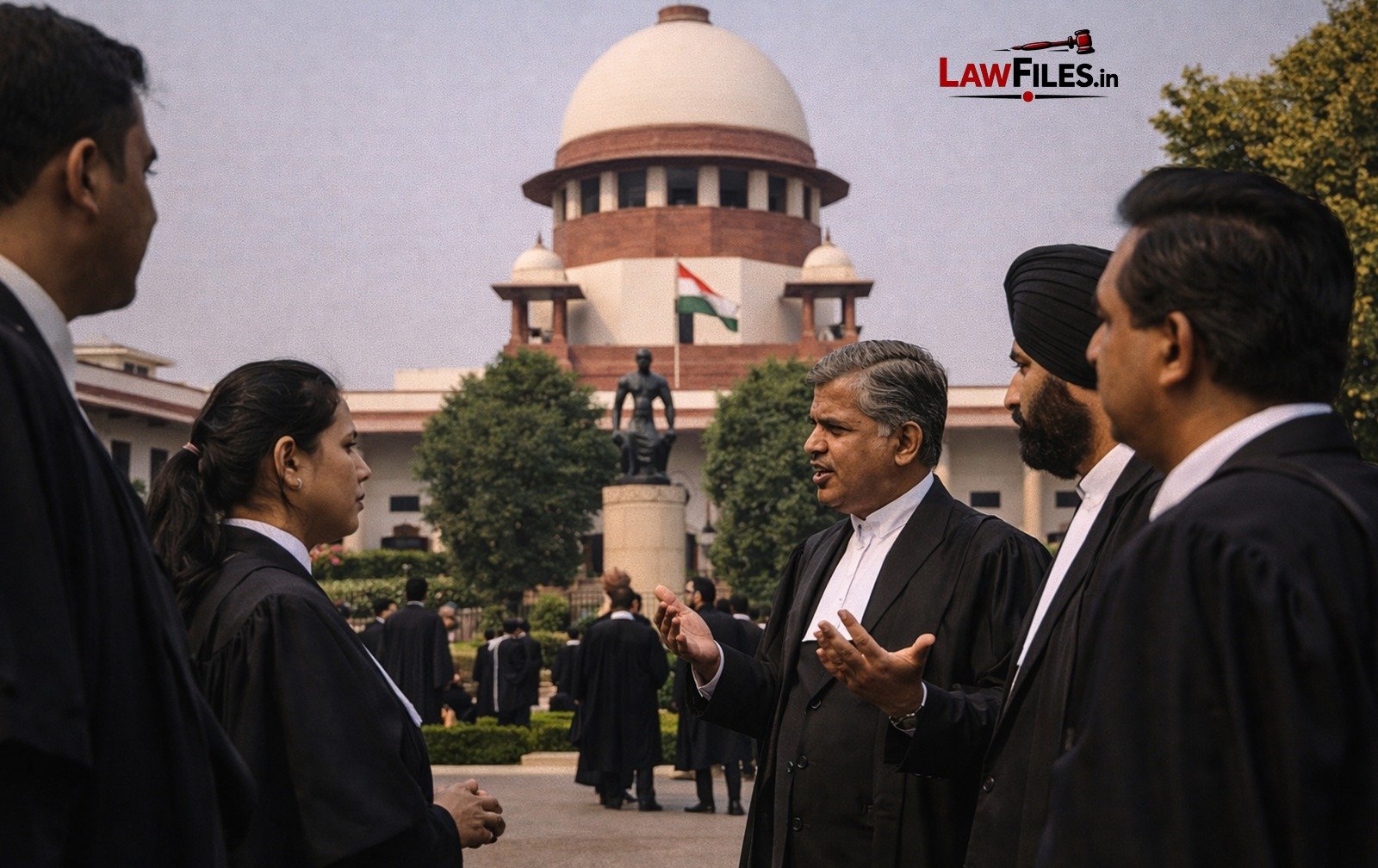
In a deeply concerning observation that has sent ripples through India’s legal fraternity, the Supreme Court recently expressed serious anxiety over the growing presence of allegedly fraudulent lawyers practising across courts in the country. During the hearing of a matter concerning verification of law degrees and enrolment practices, Chief Justice of India B.R. Gavai and Justice Surya Kant remarked that “thousands of fraudulent lawyers” may currently be practising within the Indian judicial system, while sharply questioning the effectiveness of regulatory oversight exercised by the Bar Council of India (BCI). The Bench further indicated that an independent investigative mechanism, potentially involving the Central Bureau of Investigation (CBI), may become necessary to verify the authenticity of law degrees and professional enrolments.
The Court’s observations have reignited a long-standing institutional crisis concerning legal education, professional accreditation, and regulatory accountability within India’s justice delivery system. The remarks came while the Supreme Court was considering issues surrounding fake educational qualifications, irregular enrolments, and the inability of existing regulatory bodies to effectively identify and eliminate unqualified practitioners from the profession. According to reports from the proceedings, Justice Surya Kant openly stated that the Bar Council of India had failed to adequately address the issue despite repeated concerns over the years.
The Bench reportedly expressed dissatisfaction over the lack of a robust nationwide verification mechanism capable of distinguishing genuine law graduates from those allegedly using fabricated or dubious degrees to obtain enrolment as advocates. The Court observed that the problem was no longer isolated or administrative in nature but had assumed systemic proportions capable of undermining public faith in the legal profession itself.
The issue of fake lawyers has periodically surfaced in India over the past two decades, with multiple State Bar Councils discovering advocates allegedly practising on forged educational documents, fabricated enrolment records, or degrees obtained from unrecognised institutions. Several investigative reports and disciplinary proceedings in different States have revealed instances where individuals without valid legal qualifications appeared in courts, represented litigants, and even participated in judicial proceedings for years before detection.
The Supreme Court’s latest intervention is significant because it directly questions the institutional capacity of the Bar Council system established under the Advocates Act, 1961. The BCI and State Bar Councils are statutorily entrusted with regulating legal education, maintaining standards of professional conduct, and supervising enrolment of advocates. However, the Court’s observations suggest growing judicial concern that the existing regulatory framework has failed to keep pace with the rapid expansion of legal education institutions and enrolment processes across the country.
Critically analysed, the controversy exposes a deeper structural crisis within India’s legal education ecosystem. Over the last two decades, India witnessed a massive proliferation of private law colleges and distance-learning institutions, many of which have repeatedly faced allegations concerning poor academic standards, inadequate infrastructure, irregular admissions, and questionable degree-granting practices. The rapid commercialization of legal education created an environment where professional certification sometimes became detached from meaningful academic training and ethical preparation.
The Court’s concerns also reflect broader anxieties regarding the quality of legal representation and access to justice. Lawyers occupy a constitutionally significant position within the justice delivery system because they function not merely as private professionals but as officers of the court responsible for safeguarding rule of law. If individuals lacking genuine qualifications are permitted to practise, the consequences extend beyond professional misconduct and directly affect litigants’ rights, judicial efficiency, and public confidence in the legal process.
The Bench’s suggestion that the CBI may be required to undertake verification of law degrees reveals the extent of institutional distrust surrounding the issue. Ordinarily, professional regulation falls within the domain of statutory bodies like the BCI. However, the Court’s remarks imply that the alleged scale of irregularities may require an independent investigative exercise transcending ordinary administrative scrutiny. Such observations are particularly significant because they indicate judicial perception that internal regulatory mechanisms may no longer be sufficient to address the crisis effectively.
Another important dimension of the controversy concerns digitization and verification failures in India’s higher education system. Unlike certain professional sectors where centralized digital verification systems now exist, legal education and advocate enrolment continue to suffer from fragmented record-keeping, inconsistent documentation standards, and absence of real-time verification infrastructure across universities and Bar Councils. This institutional fragmentation creates opportunities for fraudulent enrolment practices to flourish undetected.
The Supreme Court’s observations additionally revive debate surrounding the All India Bar Examination (AIBE), introduced by the BCI to assess minimum professional competence before advocates begin practice. While the AIBE was intended to strengthen professional standards, critics have repeatedly argued that the examination itself remains insufficiently rigorous and incapable of addressing deeper structural issues involving fraudulent degrees and compromised legal education quality.
The matter also raises serious constitutional implications concerning the administration of justice. Under Article 21 of the Constitution, access to competent legal representation forms an integral component of fair procedure and meaningful justice. If litigants are unknowingly represented by individuals possessing forged qualifications or invalid enrolment, the integrity of judicial proceedings themselves may become vulnerable. In extreme cases, such representation could potentially affect criminal trials, civil adjudication, and constitutional litigation involving substantial rights and liberties.
From an institutional perspective, the Court’s remarks highlight the judiciary’s growing frustration with professional regulatory bodies across sectors. In recent years, constitutional courts have repeatedly intervened in matters involving medical education, engineering colleges, coaching institutions, and professional accreditation systems due to perceived regulatory failures. The present controversy indicates that the legal profession itself is no longer insulated from similar scrutiny.
The issue becomes even more sensitive because lawyers occupy a unique constitutional role in democratic governance. Advocates routinely appear in matters involving constitutional rights, criminal liberty, electoral disputes, public policy, and governmental accountability. Consequently, integrity within the legal profession is not merely a professional concern but a constitutional necessity linked to preservation of rule of law itself.
The Court’s observations also expose the paradoxical condition of India’s legal profession: while constitutional courts continue to expand access to justice jurisprudence, institutional weaknesses within legal education and enrolment systems threaten the quality and credibility of legal representation available to ordinary citizens. This contradiction raises fundamental questions regarding whether India’s legal regulatory architecture remains equipped to supervise one of the world’s largest legal professions.
Another significant aspect concerns disciplinary enforcement. Although Bar Councils possess authority to suspend or remove advocates for misconduct, disciplinary proceedings are often criticised for excessive delays, lack of transparency, and inconsistent enforcement. Several instances involving fake lawyers have reportedly remained unresolved for years, allowing questionable practitioners to continue appearing before courts despite serious allegations.
The controversy additionally intersects with the growing debate over judicial reforms and modernisation of the legal profession. Many experts have argued that India urgently requires a centralised national digital database integrating university records, Bar Council enrolments, examination results, and professional disciplinary histories. Such a system could substantially reduce the possibility of forged qualifications entering the legal profession while improving transparency and accountability.
At a deeper level, the Supreme Court’s remarks reflect institutional anxiety about declining ethical standards within parts of the legal profession. Concerns regarding fake lawyers are not merely about forged documents; they symbolise wider fears concerning erosion of professional ethics, inadequate training, commercialisation of legal practice, and weakening regulatory oversight. The judiciary’s unusually strong language therefore appears intended as a warning that credibility of the justice system itself may be jeopardised if corrective measures are not urgently implemented.
The possibility of a nationwide verification exercise, potentially involving investigative agencies, could have far-reaching consequences for thousands of practising advocates. If implemented, such scrutiny may expose irregular enrolments, fake degrees, and institutional lapses accumulated over decades. However, it may simultaneously trigger concerns regarding procedural fairness, administrative capacity, and the possibility of disruption within court systems already burdened by severe pendency.
Ultimately, the Supreme Court’s observations on fraudulent lawyers represent more than a passing institutional criticism. They expose a deeper crisis concerning regulation, accountability, and professional integrity within India’s legal system. By questioning the effectiveness of the Bar Council framework and contemplating independent verification mechanisms, the Court has effectively reopened a larger constitutional conversation about who is entitled to practise law in India and how the integrity of the legal profession can be preserved in an era of expanding legal education and increasing institutional complexity.
