


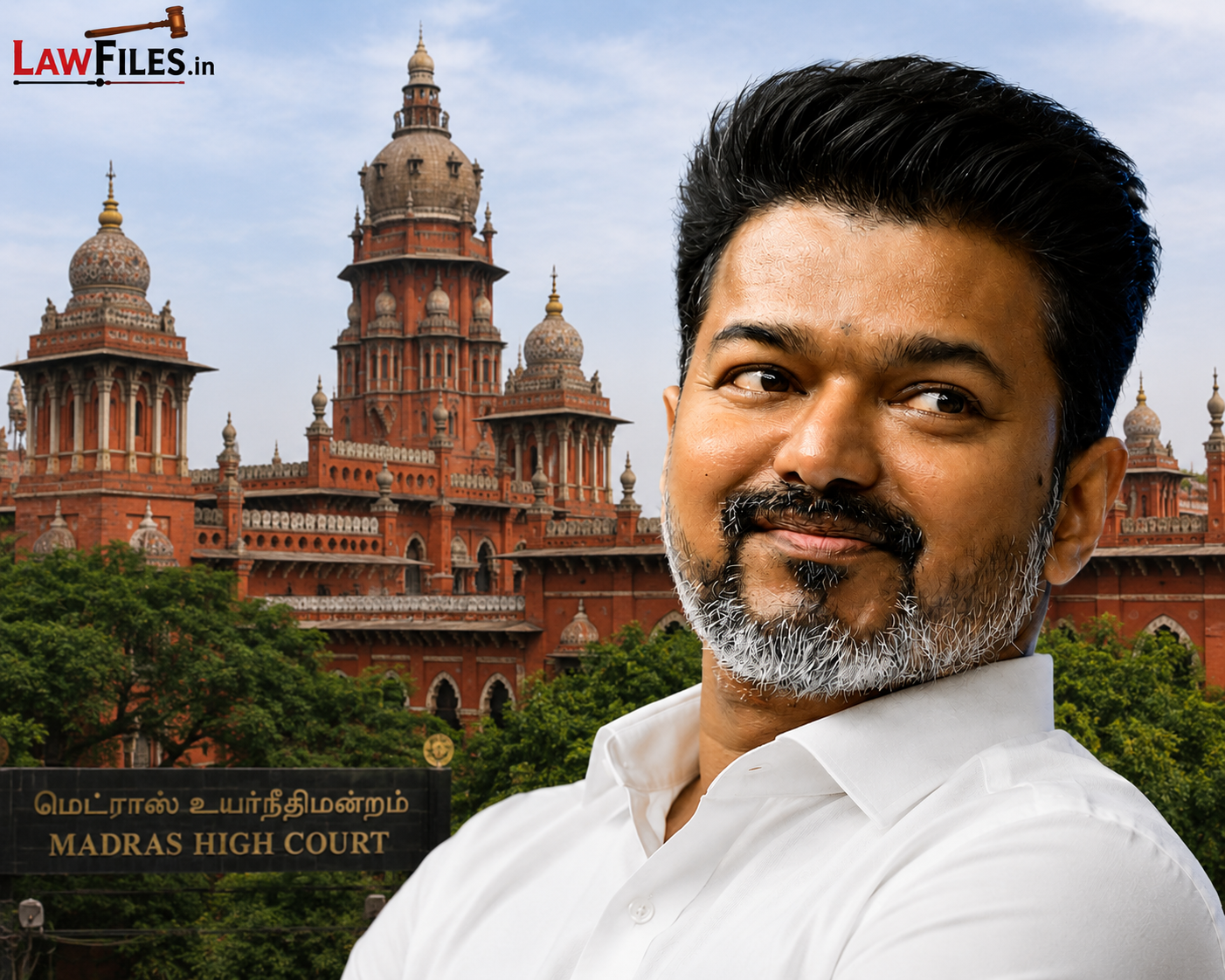
A fresh constitutional controversy has emerged in Tamil Nadu after a petition was moved before the Madras High Court challenging the appointment of astrologer Rickey Radhan Pandit Vettrivel as Officer on Special Duty (OSD) to Chief Minister C. Joseph Vijay. The litigation, filed within days of the newly formed Tamilaga Vettri Kazhagam (TVK) government assuming office, has rapidly transformed from a political controversy into a larger constitutional debate concerning public appointments, administrative legality, and the place of personal belief systems within democratic governance.
The matter was urgently mentioned before a Vacation Bench comprising Justices Victoria Gowri and N. Senthilkumar of the Madras High Court. The petitioner, advocate R. Rathi, sought issuance of a writ of quo warranto questioning the legal authority under which Vettrivel was appointed as OSD to the Chief Minister (Political). The plea contends that the appointment was arbitrary, unconstitutional, and contrary to established principles governing public employment.
According to the petition, Vettrivel is widely known as an astrologer who had publicly predicted Vijay’s political rise and the electoral success of TVK long before the 2026 Tamil Nadu Assembly elections. Following TVK’s victory and Vijay’s elevation as Chief Minister, the Tamil Nadu government issued an order appointing Vettrivel to the politically significant post of Officer on Special Duty. Critics immediately alleged that the appointment appeared to reward personal loyalty and astrological influence rather than administrative competence or a transparent selection process.
The petitioner argued before the High Court that the appointment violated Articles 14 and 16 of the Constitution, which guarantee equality before law and equal opportunity in public employment. The plea specifically alleged that no recruitment notification was issued, no applications were invited, no eligibility criteria were prescribed, and no transparent selection procedure was followed before appointing Vettrivel.
Importantly, the petition relies heavily upon the Supreme Court’s landmark judgment in Secretary, State of Karnataka v. Uma Devi, where the Court held that public appointments cannot be made through arbitrary or “backdoor” methods inconsistent with constitutional norms. By invoking Uma Devi, the petitioner seeks to frame the controversy not as a political disagreement but as a constitutional issue involving the integrity of public administration itself.
The litigation has acquired wider public significance because it touches upon Tamil Nadu’s deeply rooted political culture of rationalism and anti-superstition discourse. Dravidian politics historically positioned itself against religious orthodoxy, superstition, and ritualistic authority in governance. Consequently, the appointment of an astrologer to a government post triggered sharp criticism not only from opposition parties but also from sections within Vijay’s broader political support base.
Several political parties reportedly questioned whether appointment of an astrologer to the Chief Minister’s office was compatible with constitutional secularism and scientific temper. Critics argued that while political leaders may privately consult astrologers or spiritual advisers, formal incorporation of such individuals into official governmental structures risks blurring the constitutional boundary between personal belief and public administration.
The controversy intensified because the appointment order was reportedly circulated to the Pay and Accounts Office and the Accountant General, suggesting that the position involved public expenditure and official governmental authority. This aspect became central to the petitioner’s argument that the post was not merely advisory or informal but constituted a public office subject to constitutional scrutiny.
The constitutional remedy sought—a writ of quo warranto—is itself legally significant. Traditionally, courts issue such writs to examine whether a person occupying a public office possesses valid legal authority and satisfies statutory requirements for holding the position. Unlike ordinary service disputes, quo warranto jurisdiction directly implicates constitutional accountability in public appointments. The petition therefore raises the question whether discretionary political appointments can remain immune from judicial review where allegations of arbitrariness and constitutional violation arise.
The controversy also reveals the growing judicialisation of political appointments in contemporary India. Increasingly, courts are being asked to scrutinise appointments to governmental posts not merely for procedural legality but also for conformity with constitutional values of transparency, equality, and institutional integrity. The judiciary’s willingness to entertain such petitions reflects broader public concern regarding politicisation and informalisation of governance structures.
At another level, the dispute exposes an enduring tension within constitutional democracies: the distinction between private belief and public power. Indian constitutionalism protects freedom of religion and individual belief under Articles 25 and 19. Political leaders, like ordinary citizens, remain free to hold personal spiritual or astrological beliefs. However, the constitutional issue arises when such beliefs appear to influence formal State appointments or administrative structures funded by public resources.
Critically analysed, the controversy is not fundamentally about astrology itself. Rather, it concerns the standards governing public appointments in a constitutional State. Even if Vettrivel possessed genuine political advisory capabilities independent of astrology, the absence of transparent procedures and publicly identifiable qualifications creates constitutional discomfort because it undermines principles of equal opportunity and institutional accountability.
The case additionally reflects broader transformations in Indian political culture, where celebrity-driven politics and personalised leadership structures increasingly intersect with governance. Vijay’s rapid transition from film star to Chief Minister has fundamentally altered Tamil Nadu’s political landscape. However, the present controversy illustrates the institutional pressures accompanying such transitions, particularly when personal networks and informal advisers begin entering governmental frameworks.
Significantly, amid mounting criticism and political backlash, the Tamil Nadu government reportedly revoked Vettrivel’s appointment within twenty-four hours of the controversy escalating. Multiple reports indicate that the withdrawal followed objections from coalition partners, opposition parties, and public criticism regarding the propriety of the appointment. Nevertheless, the constitutional questions raised by the litigation may continue to retain legal relevance despite revocation of the appointment order.
The episode also revives constitutional discussion surrounding Article 51A(h), which imposes a fundamental duty upon citizens to develop scientific temper, humanism, and the spirit of inquiry and reform. Tamil Nadu’s political discourse has historically attached special importance to rationalist traditions associated with the Dravidian movement. Critics of the appointment therefore argued that institutional legitimisation of astrology within government structures symbolically conflicts with constitutional commitments to scientific temper and rational governance.
At the same time, defenders of the appointment argued that political executives possess broad discretion in selecting personal advisers and confidential staff. Chief Ministers and Prime Ministers routinely appoint individuals based on trust, political loyalty, or personal confidence rather than conventional bureaucratic recruitment procedures. From this perspective, the controversy risks conflating political discretion with constitutional illegality.
However, the counterargument remains constitutionally powerful: once such appointments acquire official status, public funding, and governmental authority, they inevitably become subject to constitutional standards of fairness, legality, and transparency. The central legal issue therefore concerns not private consultation with astrologers but formal institutional incorporation into the State apparatus.
The Madras High Court proceedings may ultimately determine whether the matter survives following revocation of the appointment. Yet irrespective of procedural outcome, the controversy has already triggered a larger constitutional conversation about governance ethics, public appointments, and the symbolic responsibilities attached to constitutional office.
Ultimately, the challenge to the appointment of Chief Minister Vijay’s astrologer as OSD represents more than a transient political controversy. It exposes deeper constitutional anxieties regarding arbitrariness in public appointments, the relationship between private belief and public administration, and the standards expected from democratic governance in a constitutional republic. In doing so, the case once again demonstrates how courts increasingly function as arenas where questions of political morality and constitutional legitimacy intersect.
