

Close Menu
LawFilesLawFiles

    Subscribe to Updates

    Get the latest creative news from FooBar about art, design and business.

    What's Hot

    Supreme Court Declines To Extend Pawan Khera’s Transit Anticipatory Bail: Reasserting Jurisdictional Discipline in Bail Law

    April 17, 2026

    Dowry Law and Victim Protection: Supreme Court Clarifies Immunity for Wife and Her Family

    April 17, 2026

    Women’s Reservation Law Notified: Reform Realised or Deferred Constitutional Promise?

    April 17, 2026
    Facebook X (Twitter) Instagram Threads
    Friday, April 17
    LawFilesLawFiles
    Facebook X (Twitter)
    • Home
      • Who We Are
      • Our Mission
      • Advisory board
      • Contact US
    • Supreme Court
    • High Courts
      • Gujarat High Court
      • Jharkhand High Court
      • Rajasthan High Court
      • Karnataka High Court
      • Andhra Pradesh High Court
      • Allahabad High Court
      • Himachal Pradesh High Court
      • Chhattisgarh High Court
      • Jammu & Kashmir and Ladakh High Court
      • Kerala High Court
      • Punjab and Haryana High Court
      • Patna High Court
      • Madhya Pradesh High Court
      • Madras High Court
      • Bombay High Court
      • Orissa High Court
      • Calcutta High Court
      • Meghalaya High Court
      • Delhi High Court
      • Manipur High Court
      • Gauhati High Court
    • Corporate
    • Taxation Laws
      • Income Tax
      • GST
      • Customs & Excise
    • Global Affairs
    • Articles
      • Former Judge’s’ Views
      • Senior Advocate
      • Policy Analysis
      • Tax Expert
    • PILS
      • Free/Affordable Legal Aid
      • PIL Cell
      • Law student Volunteer Cell (research & Drafting)
      • NGO & Legal services Authority Tie-ups
      • Online Legal Formats
      • Online Legal Help Form
    Subscribe Premium
    LawFilesLawFiles
    Home»Political News»Women’s Reservation Law Notified: Reform Realised or Deferred Constitutional Promise?
    Political News

    Women’s Reservation Law Notified: Reform Realised or Deferred Constitutional Promise?

    Anvita DwivediBy Anvita DwivediApril 17, 2026No Comments4 Mins Read
    WhatsApp Facebook Twitter Copy Link
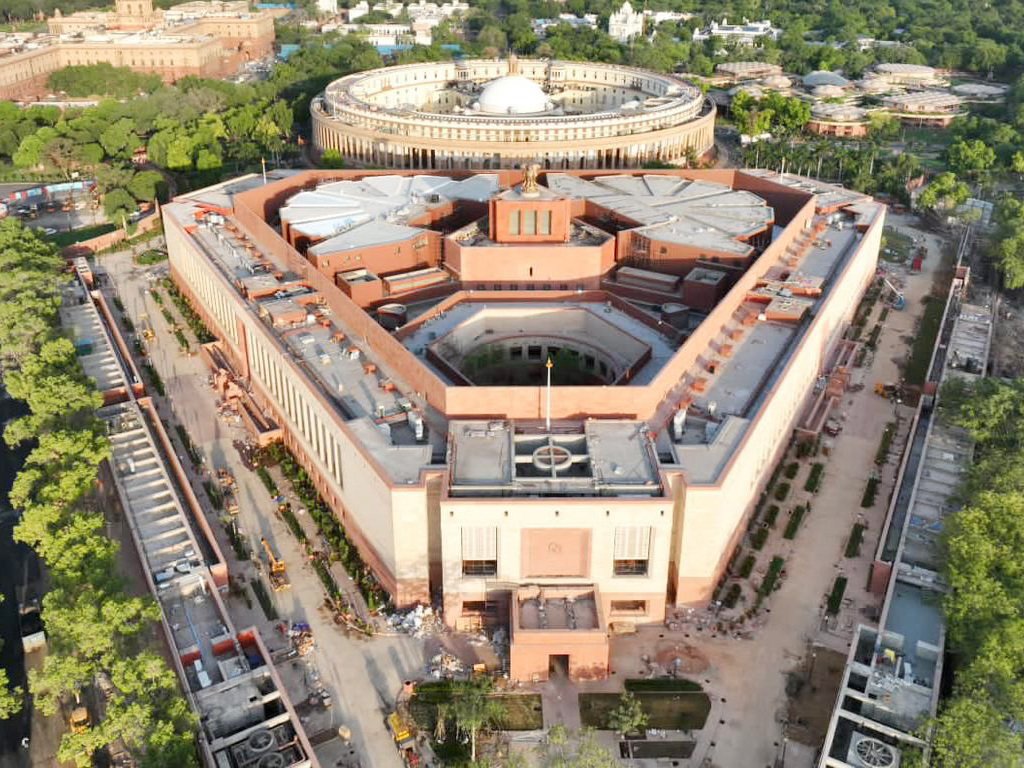
    Glimpses of the new Parliament Building, in New Delhi
    Share
    Facebook Twitter Pinterest Copy Link WhatsApp

    The Union Government’s notification bringing into force the Constitution (One Hundred and Sixth Amendment) Act, 2023 popularly known as the Women’s Reservation Law from April 16, 2026, marks a significant moment in India’s constitutional and political landscape. After decades of debate and legislative effort, the formal operationalisation of a law mandating 33% reservation for women in the Lok Sabha and State Legislative Assemblies appears, at first glance, to be a transformative step towards correcting gender imbalance in political representation. Yet, beneath this milestone lies a more complex constitutional reality the law’s implementation remains contingent, deferred, and structurally tied to future political processes.

    The amendment seeks to reserve one-third of all seats for women, including within the existing quotas for Scheduled Castes and Scheduled Tribes. In principle, this reflects a shift towards substantive equality, recognising that formal equality alone is insufficient to address entrenched barriers to women’s participation in governance. India’s legislatures have historically witnessed low female representation, and the amendment attempts to structurally correct this imbalance by ensuring guaranteed participation at the highest levels of law-making.

    However, the practical impact of the law is not immediate. The constitutional framework makes its implementation conditional upon the completion of the next Census and a subsequent delimitation exercise. This means that despite the law being formally in force, its benefits will not be realised until constituency boundaries are redrawn based on updated population data. Until then, the existing composition of Parliament and State Assemblies remains unchanged, effectively postponing the operationalisation of reservation.

    This linkage between reservation and delimitation introduces a layer of constitutional complexity. Delimitation, by its very nature, is a politically sensitive exercise that determines the distribution of seats across states based on population. It has historically been deferred to maintain a balance between regions that have experienced differing population growth rates. By tying women’s reservation to this process, the amendment effectively embeds a progressive reform within a contentious and uncertain procedural framework.

    The government has defended this sequencing as necessary to ensure that reservation is implemented in a manner that is both equitable and reflective of current demographic realities. From this perspective, the law is part of a broader restructuring of India’s electoral system, potentially linked to proposals for expanding the size of the Lok Sabha and recalibrating representation across states. However, critics argue that such linkage is not constitutionally inevitable. They contend that reservation could have been implemented within the existing framework, without waiting for delimitation, thereby ensuring immediate and tangible benefits.

    This divergence of views reflects a deeper constitutional question: whether a right recognised in principle but postponed in practice can be considered effectively realised. The Supreme Court has, in various contexts, emphasised that equality must be meaningful and not merely symbolic. In this light, the Women’s Reservation Law risks being perceived as a form of deferred constitutionalism, where the promise of representation exists, but its fulfilment remains uncertain and potentially delayed.

    The amendment also intersects with broader debates on federalism. Delimitation based on population is likely to alter the distribution of seats in favour of states with higher population growth, potentially reducing the relative representation of others. This has led to concerns, particularly from southern states, that the process may disturb the delicate balance of federal representation. As a result, the implementation of women’s reservation is no longer a standalone issue it is now intertwined with larger questions of political power and regional equity.

    At a structural level, the law represents both progress and paradox. It acknowledges the need for greater gender inclusion in governance and provides a constitutional framework to achieve it. At the same time, by making its operation dependent on future processes, it introduces uncertainty into what is otherwise a clear normative commitment. The effectiveness of the reform will therefore depend not merely on its existence in the statute book, but on the timely and efficient completion of the processes that trigger its implementation.

    The broader implication of this development is a shift in India’s constitutional approach to representation. The amendment moves beyond formal equality and attempts to engineer institutional inclusion through affirmative measures. Yet, its success will depend on whether the system can translate constitutional intent into political reality without undue delay.

    In conclusion, the notification of the Women’s Reservation Law is undoubtedly a historic step, but it is not the culmination of the reform process. It is, rather, the beginning of a new phase one that will test the capacity of India’s constitutional and political institutions to deliver on the promise of gender equality in representation.

    The central question that remains is whether this reform will emerge as a transformative milestone in democratic inclusion, or remain a deferred promise awaiting the uncertainties of future political and procedural development


    Reform Realised or Deferred Constitutional Promise? Women’s Reservation Law Notified
    Share. WhatsApp Facebook Twitter Pinterest Email
    Anvita Dwivedi

    Related Posts

    Supreme Court Declines To Extend Pawan Khera’s Transit Anticipatory Bail: Reasserting Jurisdictional Discipline in Bail Law

    April 17, 2026

    Dowry Law and Victim Protection: Supreme Court Clarifies Immunity for Wife and Her Family

    April 17, 2026

    Supreme Court Notice on Muslim Personal Law: Reopening the Constitutional Debate on Gender Equality and Faith

    April 16, 2026
    Add A Comment
    Leave A Reply Cancel Reply

    Demo
    Top Posts

    Wrongful Claim Rejection Amounts to Deficiency in Service: Delhi Consumer Commission Holds Star Health Liable

    March 16, 202655 Views

    Bombay High Court Quashes POCSO Case, Directs Accused to Fund MacBook for Victim’s Education

    February 28, 202648 Views

    Siyahat Meri Syahi Se: A Journey That Transforms Travel into Thought and Entrepreneurship

    March 18, 202636 Views

    Welfare or Electoral Strategy? Supreme Court’s Sharp Take on Pre-Poll Cash Schemes

    February 20, 202624 Views
    Don't Miss

    Supreme Court Declines To Extend Pawan Khera’s Transit Anticipatory Bail: Reasserting Jurisdictional Discipline in Bail Law

    By Anvita DwivediApril 17, 2026

    In a fresh setback to Congress leader Pawan Khera, the Supreme Court has declined to…

    Dowry Law and Victim Protection: Supreme Court Clarifies Immunity for Wife and Her Family

    April 17, 2026

    Women’s Reservation Law Notified: Reform Realised or Deferred Constitutional Promise?

    April 17, 2026

    Supreme Court Notice on Muslim Personal Law: Reopening the Constitutional Debate on Gender Equality and Faith

    April 16, 2026
    Stay In Touch
    • Facebook
    • Twitter

    Subscribe to Updates

    Get the latest creative news from SmartMag about art & design.

    Top Posts

    Wrongful Claim Rejection Amounts to Deficiency in Service: Delhi Consumer Commission Holds Star Health Liable

    March 16, 202655 Views

    Bombay High Court Quashes POCSO Case, Directs Accused to Fund MacBook for Victim’s Education

    February 28, 202648 Views

    Siyahat Meri Syahi Se: A Journey That Transforms Travel into Thought and Entrepreneurship

    March 18, 202636 Views
    Don't Miss

    Supreme Court Declines To Extend Pawan Khera’s Transit Anticipatory Bail: Reasserting Jurisdictional Discipline in Bail Law

    By Anvita DwivediApril 17, 2026

    In a fresh setback to Congress leader Pawan Khera, the Supreme Court has declined to…

    Dowry Law and Victim Protection: Supreme Court Clarifies Immunity for Wife and Her Family

    April 17, 2026

    Women’s Reservation Law Notified: Reform Realised or Deferred Constitutional Promise?

    April 17, 2026

    Supreme Court Notice on Muslim Personal Law: Reopening the Constitutional Debate on Gender Equality and Faith

    April 16, 2026
    Stay In Touch
    • Facebook
    • YouTube
    • TikTok
    • Instagram
    Top Trending
    About Us
    About Us

    LawFiles.in is a comprehensive legal news platform delivering real-time updates from the Supreme Court, High Courts, Tribunals, Corporate and Tax law, Regulators, Politics, Crime, Consumer cases, and Global Affairs.

    Email Us: lawfilesoffical@gmail.com
    Contact: +91 8800026066

    Contact Us:
    India International Centre
    40, Max Mueller Marg
    Lodhi Estate, New Delhi-110003

    Facebook X (Twitter)
    Our Picks

    Supreme Court Declines To Extend Pawan Khera’s Transit Anticipatory Bail: Reasserting Jurisdictional Discipline in Bail Law

    April 17, 2026

    Dowry Law and Victim Protection: Supreme Court Clarifies Immunity for Wife and Her Family

    April 17, 2026

    Women’s Reservation Law Notified: Reform Realised or Deferred Constitutional Promise?

    April 17, 2026

    Supreme Court Notice on Muslim Personal Law: Reopening the Constitutional Debate on Gender Equality and Faith

    April 16, 2026

    Free Speech or Incitement? Calcutta High Court Plea Against Suvendu Adhikari Rekindles Debate on Political Speech Limits

    April 16, 2026
    Most Popular

    ED Can Arrest Even If FIRs Are Added to ECIR Later: Punjab & Haryana High Court

    January 30, 20260 Views

    Non-Disclosure Of QCBS Criteria In Tender Alone Not Enough To Allege Malafides: Gauhati High Court

    January 31, 20260 Views

    Anticipatory Bail For Proclaimed Offenders: Evolution Of Law

    January 31, 20260 Views

    January 2026 Monthly Digest: Important Rulings of the Jammu & Kashmir and Ladakh High Court

    February 2, 20260 Views

    Custodial Death and State Liability : A Critical Analysis of the Allahabad High Court’s ₹10 Lakh Compensation Judgment

    February 22, 20260 Views
    © 2026 LawFiles. Owned by Varta24 Media.
    • Articles
    • Careers
    • Corporate
    • Global Affairs
    • Law Firms & Lawyers
    • PILS
    • Regulatory

    Type above and press Enter to search. Press Esc to cancel.