


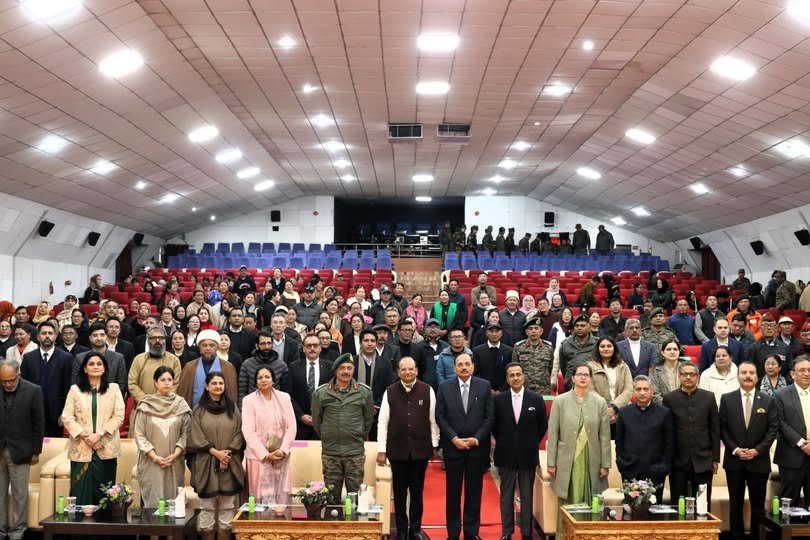
In a landmark moment reflecting the judiciary’s expanding vision of access to justice beyond conventional courtrooms, the Chief Justice of India, Justice Surya Kant, addressed Indian Army personnel at Leh, asserting a powerful constitutional principle that the law must travel to the soldier, because the soldier cannot always travel to the law.”
The address delivered at a high-altitude military base in Ladakh marks the first time a sitting Chief Justice of India has directly engaged with armed forces personnel in such a setting, signalling a transformative shift in how justice delivery is conceptualized for those serving in extreme and remote conditions. Justice Surya Kant highlighted a fundamental structural challenge like soldiers are often deployed in remote, high-risk terrains. They face legal disputes involving property, pensions, family matters, and service benefit yet, they lack physical access to courts, lawyers, and legal institutions
The Chief Justice drew a stark contrast between civilians and soldiers. While an urban citizen can easily approach courts, a soldier posted in Leh or Siachen cannot abandon duty to pursue litigation.
This framing elevates the issue from administrative inconvenience to a constitutional gap in justice delivery.
Anchoring his remarks in constitutional philosophy, the Chief Justice invoked Article 39A of the Constitution, which mandates equal access to justice and free legal aid.
He clarified that legal aid is not benevolence it is a constitutional commitment ensuring justice is not denied due to geography, status, or economic limitation. This articulation reinforces a crucial doctrinal point that access to justice is an enforceable constitutional value. It must extend equally to those serving in the most inaccessible parts of the country
To address these concerns, Justice Surya Kant highlighted the “Veer Parivar Sahayata Yojana”, a scheme launched under the National Legal Services Authority (NALSA) during his tenure as Executive Chairman.
The scheme provide free legal aid and advisory services, assistance for serving soldiers, ex-servicemen, and their familie. Coverage of disputes involving property and inheritance, pension and welfare entitlements, matrimonial issues, and education and dependent rights
The Chief Justice revealed that nearly 14,929 beneficiaries had been assisted as of December 2025 and a nationwide network of 438 legal aid clinics has been established. Over 1,100 legal aid personnel are engaged in the initiative
The address marks a critical evolution in Indian jurisprudence from being Court-Centric to Citizen-Centric Justice. The judiciary is moving toward a model where justice is delivered to the individual, rather than requiring individuals to access courts.
The Court acknowledges that certain classes like soldiers face structural barriers to legal access, requiring tailored institutional solutions.
The emphasis on legal aid reinforces the role of bodies like NALSA in bridging systemic inequalities.
The initiative is deeply rooted in constitutional guarantees such as Article 21: Right to life includes access to justice, Article 14 : Equality before law requires equal access to remedies. Article 39A : Directive principle mandating free legal aid
By focusing on soldiers, the judiciary extends these principles to a category often excluded from mainstream legal discourse due to operational constraints. Justice Surya Kant also made an important institutional observation that the armed forces protect national sovereignty and the judiciary protects constitutional rights and rule of law
He noted that both institutions serve a common constitutional purpose, and that ensuring legal support for soldiers is part of the nation’s obligation toward those who safeguard it.
The initiative could lead to expansion of specialised legal aid schemes for other vulnerable groups such as migrant workers and remote communities. It opens pathways for virtual courts, mobile legal clinics, and remote advisory systems.
The model may influence integration between defence administration and legal services authorities. The address by the Chief Justice of India at Leh is more than symbolic it is a jurisprudential shift in how access to justice is conceived in India. By asserting that “law must travel to the soldier,” the Court has reframed justice as a proactive constitutional service rather than a passive institutional mechanism. At its core, the message is clear: those who defend the nation’s borders must not be left outside the reach of its legal protections.
