


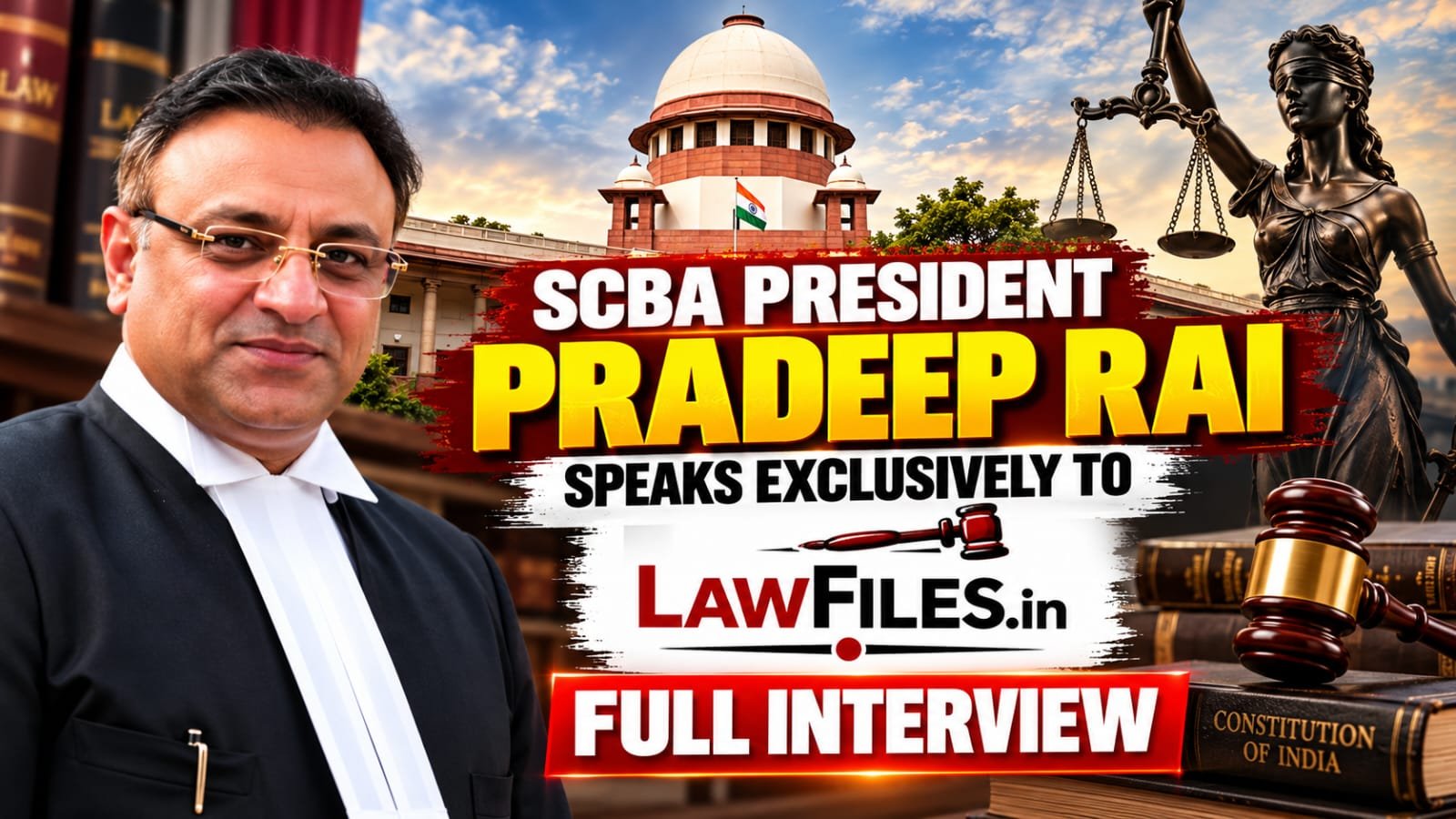
NEW DELHI: Supreme Court Bar Association (SCBA) President Pradeep Rai has spoken exclusively to law files following his election to lead the prominent association of lawyers practising before the Supreme Court of India. In the interview, Rai discussed judicial dignity, institutional accountability, the conduct of political leaders, and the boundaries between freedom of expression and contempt of court.
The SCBA has initiated contempt proceedings concerning alleged objectionable remarks about Chief Justice of India (CJI) Surya Kant and the judiciary by Shiv Sena (UBT) MP Sanjay Raut and senior journalist Nikhil Wagle. The controversy has renewed debate over public commentary on the judiciary, the limits of criticism, and the legal protections afforded to judicial institutions.
In the interview, Rai defended the decision to pursue contempt proceedings, arguing that public figures must exercise responsibility when commenting on constitutional institutions. He also questioned the appropriateness of political leaders seeking to approach the CJI outside established judicial procedures. The following are the key excerpts from the interview.
Q: If influential public figures do not respect the country’s esteemed institutions, who will?
Pradeep Rai: Rai alleged that Nikhil Wagle had made objectionable remarks in a social media post and said he should have corrected them in time but failed to do so. He also disputed claims concerning judges attending an event in London, describing them as false. Rai maintained that judges do not attend private functions in the manner alleged. “People like Nikhil Wagle, who hold influential positions in the media, must respect the country’s esteemed institutions. If they do not, what message are they sending to society?” Rai said, explaining why he considered it necessary to pursue contempt proceedings.
He also criticised individuals who, according to him, enter the Supreme Court premises to record videos, questioning whether such conduct was consistent with the responsibilities expected of lawyers practising before the country’s highest court. However, Rai distinguished between criticism of judicial decisions and remarks directed at institutions themselves. He said people were free to criticise judgments but urged them not to undermine the standing of the country’s respected institutions.
Q: The Supreme Court premises appeared to turn into a political battleground on October 9. What is your assessment?
Pradeep Rai: Responding to a question about Rahul Gandhi’s reported attempt to meet the CJI in connection with filing a petition, Rai said there was no established convention for approaching the Chief Justice in that manner to initiate judicial proceedings. He argued that Gandhi should have followed the prescribed legal process for filing his petition rather than attempting to approach the CJI outside established procedures. Rai said political leaders who departed from judicial procedures had faced consequences in the past. Asked whether the Opposition was attempting to exert pressure on the judiciary, he stressed that everyone should adhere to constitutionally and legally established procedures. His central argument was that political disagreements and legal grievances must be pursued through appropriate institutional channels rather than through actions that could raise questions about judicial independence.
Q: Is following the law an essential civic responsibility?
Pradeep Rai: Rai said it would have been appropriate for Gandhi to approach the CJI regarding legal reforms or specific legal difficulties through proper channels. However, he described the reported approach to the Court as inappropriate. During the discussion, Rai cited the action taken against Bal Thackeray in connection with restrictions on his voting rights, referring to the possibility of legal consequences in other cases as well. He said the advice given to Gandhi to enter the Court in the manner described was misguided and emphasised that public representatives should respect constitutional institutions. Rai’s remarks underscored his broader position that political stature does not place anyone above established legal procedures and that public representatives must demonstrate respect for the institutions with which they engage.
Q: Has the time come for the Supreme Court to establish a standard operating procedure (SOP) for such situations?
Pradeep Rai: Responding to Associate Editor Ashish Sinha’s question about the need for a formal SOP within the Court, Rai acknowledged the existence of differing political alignments among lawyers. He appealed to members of the legal fraternity to engage freely in politics while keeping the judiciary separate from political contestation. According to Rai, lawyers should be able to express their political views openly, but the judicial institution itself should not become a platform for political confrontation. His response highlighted the importance of maintaining a distinction between political participation by members of the Bar and the institutional independence of the judiciary.
Why Pradeep Rai’s position matters
The Supreme Court Bar Association is a prominent professional body representing advocates practising before the Supreme Court of India. As its president, Rai’s intervention in a controversy involving alleged remarks about the CJI and the judiciary is significant for the legal community. The dispute raises questions at the intersection of several constitutional principles: the dignity and authority of the judiciary, freedom of speech and expression, the scope of criminal contempt, and the right to criticise judicial decisions and institutions. Rai has defended the contempt proceedings on the grounds of institutional respect and responsible public discourse. The legal questions surrounding such proceedings, however, must ultimately be assessed under the applicable law and determined by the competent court.
His interview with law files provides insight into his position on these issues and his appeal to political leaders, journalists, and members of the legal profession to respect established judicial procedures.
