


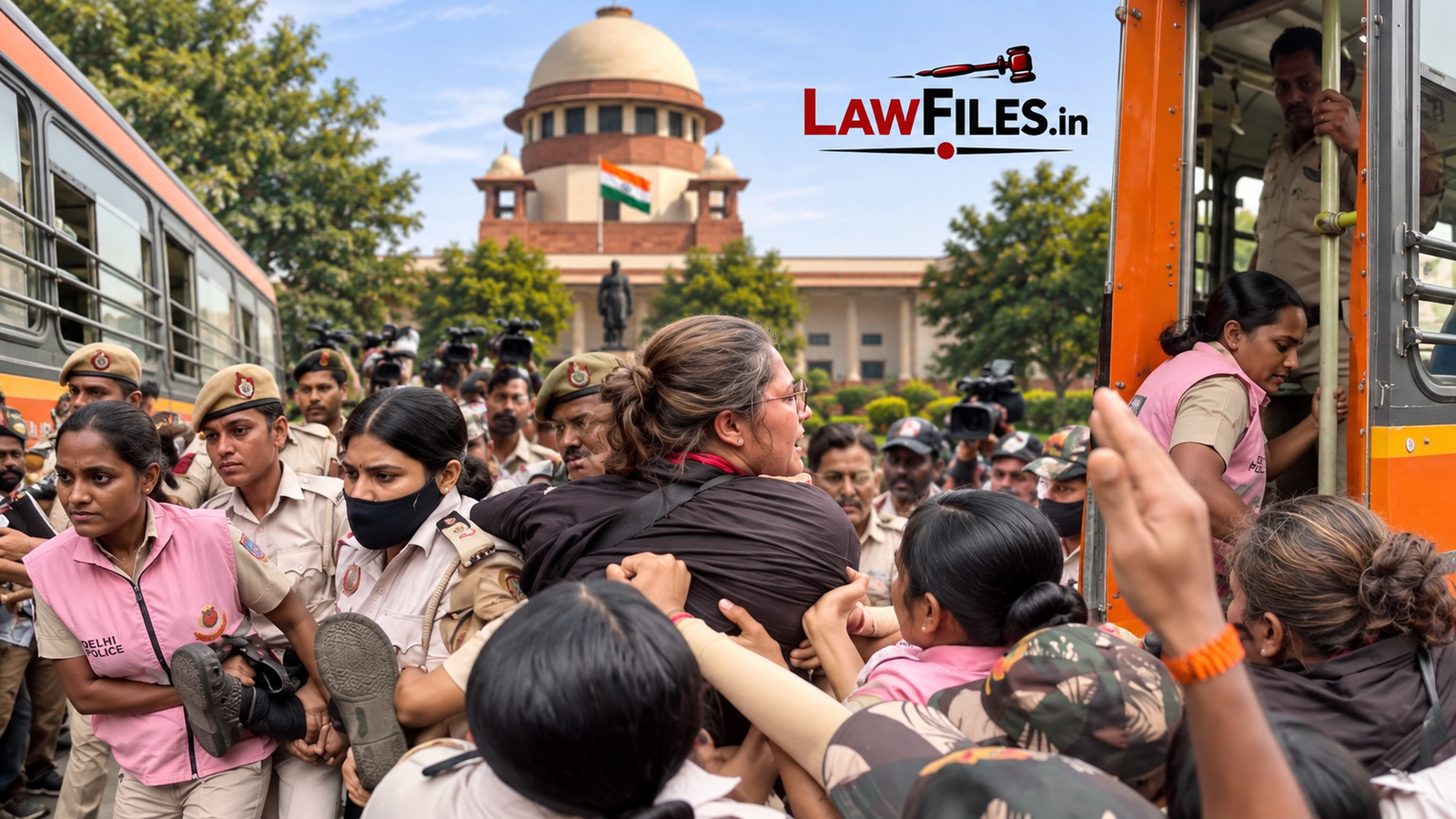
The Supreme Court of India has sought the personal presence of a senior Delhi Police officer to explain allegations that women journalists were assaulted, manhandled and detained while covering protests in the national capital, bringing the relationship between police powers, press freedom and the constitutional protection of women journalists into sharp judicial focus. Chief Justice of India Surya Kant, while hearing a mentioning concerning a petition filed by the Network of Women in Media, India (NWMI), indicated that the police administration would be required to respond to the allegations before the Court. The Bench made it clear that an explanation from a senior officer was necessary, observing that the police would have to account for the alleged conduct of its personnel. The petition has been directed to be listed on October 15, 2026, alongside connected proceedings arising from the recent protests in Delhi.
The intervention follows allegations of misconduct during demonstrations concerning the Special Intensive Revision (SIR) of electoral rolls and demands for the resignation of Chief Election Commissioner Gyanesh Kumar. Women journalists covering the protests reportedly alleged that they were subjected to physical handling, intimidation and detention despite identifying themselves as members of the press. Some complaints also raise allegations of inappropriate touching and sexual harassment. These allegations have assumed particular significance because the persons claiming to have been targeted were not merely participants in the demonstrations but journalists attempting to document police action and the treatment of protesters. The distinction is constitutionally material: a journalist reporting on a public assembly performs a function connected with the public’s right to receive information, even when the subject of the reporting is a contentious political demonstration.
Senior Advocate Indira Jaising, appearing in support of the NWMI petition, brought the matter to the attention of the Court and sought consideration of the specific safeguards required for women journalists covering protests and other public events. The Court was informed that advance notice had been given to Solicitor General Tushar Mehta. Chief Justice Surya Kant indicated that a senior police officer should remain present to assist the Court and explain the allegations. The matter was thus placed within the broader set of proceedings examining the restrictions imposed on demonstrators, the alleged detention of professionals and the conduct of the police during the protests.
The NWMI petition seeks enforceable safeguards to ensure that journalists engaged in legitimate newsgathering are not subjected to physical assault, intimidation, arbitrary detention or forcible removal merely because they are present at a protest, public gathering or crowd-control operation. It also raises concerns about whether existing inquiries into alleged police excesses adequately address the distinct difficulties faced by journalists, particularly women, while reporting from volatile public spaces. Questions of access to protest sites, the circumstances in which journalists may be detained, the use of physical force and the availability of effective remedies are central to the relief sought. The petition accordingly seeks a framework that would enable journalists to perform their professional duties without being exposed to arbitrary or discriminatory interference.
The proceedings have also acquired a contempt dimension. Senior Advocate Gopal Sankaranarayanan mentioned a petition filed by the Freedom Speech Collective alleging that police personnel had assaulted journalists in disregard of the Supreme Court’s earlier directions protecting their professional activities. Senior Advocate Chander Uday Singh also mentioned related proceedings. These petitions raise a question distinct from the underlying allegations of assault: whether the conduct complained of occurred in circumstances that would amount to non-compliance with an existing judicial direction. A contempt proceeding is not established merely because an individual alleges that an order has been violated. The Court must examine the language and scope of the order, the conduct attributed to the persons concerned, the evidence supporting the allegations and the legal requirements governing contempt. Nevertheless, the filing of such proceedings underscores the institutional importance of ensuring that judicial directions are translated into actual conduct on the ground.
The earlier order assumes particular relevance in this regard. On October 11, 2026, a Bench of Justice Joymalya Bagchi and Justice V. Mohana, while considering the wider dispute arising from the protests, recorded an assurance given by the Solicitor General that lawyers, journalists and other professionals would not be impeded in carrying out their work. The Court also directed that these professionals should not be hindered in the discharge of their professional duties. The subsequent allegations of detention and physical mistreatment have therefore raised the question whether the protection contemplated by that order was effectively observed. The Supreme Court’s decision to seek an explanation from a senior officer suggests that compliance cannot be assessed solely by reference to assurances made before a court; the practical implementation of those assurances is equally important.
The constitutional implications extend principally to Articles 19(1)(a) and 21 of the Constitution. Article 19(1)(a) guarantees freedom of speech and expression, a protection that encompasses the freedom of the press despite the absence of a separate, express constitutional provision exclusively devoted to press freedom. Journalists must be able to gather and communicate information about matters of public importance, including the exercise of state power. Their work enables citizens to evaluate official conduct, understand public controversies and participate meaningfully in democratic life. An environment in which journalists fear detention or physical retaliation for documenting police action can produce a chilling effect extending well beyond the individuals directly affected. Even without a formal prohibition on reporting, the credible threat of physical interference may discourage scrutiny of public authorities and deprive the public of information necessary for democratic accountability.
Article 21, which protects life and personal liberty, supplies a further constitutional dimension. Any deprivation of liberty must have a lawful basis and satisfy the requirements of fairness, reasonableness and non-arbitrariness. A person’s identification as a journalist does not confer absolute immunity from lawful police action, but neither does the existence of a public-order situation permit unrestricted interference with personal liberty. The legality of a detention must be assessed according to the applicable law, the circumstances in which the individual was detained and the justification for the action taken. Where journalists are allegedly detained while documenting events, the authorities must be able to distinguish between legitimate enforcement of a lawful restriction and action that obstructs newsgathering without adequate legal justification.
The Delhi Police have referred to the restrictions imposed under Section 163 of the Bharatiya Nagarik Suraksha Sanhita, 2023, which empowers the competent authority to issue directions in urgent cases of nuisance or apprehended danger, including restrictions on certain assemblies and activities where the statutory conditions are satisfied. The existence of such an order may be relevant to determining whether a gathering or particular conduct was lawful. However, a prohibitory order does not, by itself, settle every question concerning the manner in which the police may enforce it. The legality of the restriction, its territorial and temporal scope, the conduct of the person concerned and the proportionality of the response remain relevant considerations. Journalists cannot claim an unrestricted right to enter every prohibited area, but neither should a restriction on public assembly automatically be treated as authorisation to prevent bona fide reporting wherever it occurs.
The distinction between regulating a demonstration and suppressing the documentation of that demonstration is therefore critical. Police authorities have legitimate responsibilities to prevent violence, maintain public order, protect property and implement lawful restrictions. Journalists, in turn, are not exempt from generally applicable and lawful safety requirements. Yet the exercise of police powers must remain directed towards a legitimate objective and must not become a means of silencing scrutiny. Where a journalist is removed from a site, detained or prevented from recording an event, the circumstances must be examined carefully to determine whether the action was necessary, legally authorised and proportionate. The fact that an individual is wearing a press identification card may assist the police in recognising the person’s professional role, but the more fundamental obligation is to assess the legality of the action rather than to treat press identification as either an automatic immunity or an irrelevant detail.
The allegations concerning women journalists introduce an additional institutional concern. Reporting from demonstrations may expose journalists to physical proximity with police personnel, crowd-control operations and situations in which movement is restricted. Where complaints include alleged sexual harassment or inappropriate physical contact during detention, the investigation must address those allegations specifically rather than subsume them within a general inquiry into crowd management. The Delhi Police have stated that complaints concerning the reported incidents of October 3 were transferred to the Crime Branch for a fair and impartial inquiry. The complaints reportedly involved three women journalists who alleged sexual harassment and manhandling during their detention near Jantar Mantar. The police have also sought video material from members of the public as part of the inquiry. These remain allegations requiring investigation, and their merits must be determined through a fair process. At the same time, the seriousness of the allegations demands an inquiry capable of establishing the sequence of events, identifying the personnel involved and assessing available evidence, including relevant recordings and witness accounts.
An effective institutional response would require more than a general assurance that journalists will be protected. Clear operational protocols can help officers distinguish accredited or otherwise identifiable media personnel engaged in reporting from persons participating in unlawful conduct. Such protocols may address communication of lawful restrictions, designated points of access where necessary, the circumstances in which journalists may be moved away from a dangerous location, the recording of reasons for detention and the preservation of evidence when complaints of misconduct are made. They should also provide clear procedures for handling allegations of gender-based misconduct. The purpose of such safeguards would not be to obstruct police operations, but to reduce uncertainty, prevent avoidable confrontation and ensure that legitimate public-order measures do not unnecessarily interfere with independent reporting.
The Supreme Court’s scrutiny also raises the question of institutional accountability when allegations are made against the very agency responsible for investigating them. Referral of a complaint to a specialised unit may be an appropriate step, but the credibility of the process depends upon its independence in practice, the preservation of evidence, the identification of responsible personnel and the communication of meaningful findings. Where the allegations concern members of the police force, transparency is particularly important because the complainant may otherwise face difficulties in obtaining access to records, identifying individual officers or establishing the circumstances of the alleged misconduct. The Court’s decision to require the presence of a senior officer provides an opportunity to examine these issues at an institutional level rather than treating each complaint as an isolated dispute between an individual journalist and an unidentified member of the force.
The matter must nevertheless be approached with judicial restraint. The Supreme Court has not, merely by seeking an explanation, conclusively determined that the allegations are true or that any officer is guilty of misconduct or contempt. The purpose of the proposed hearing is to obtain an account from the police administration, consider the pending petitions and determine what further directions, if any, are justified. Equally, the police must be afforded an opportunity to explain the circumstances and produce relevant material. A fair judicial process must protect both the complainants’ right to an effective remedy and the requirement that adverse findings against public officials rest upon established facts.
The larger constitutional question is whether the right to report on public events can be meaningfully exercised when those documenting state action remain vulnerable to interference by the authorities being documented. A democracy does not require the police to abandon the maintenance of public order, nor does press freedom entitle journalists to disregard lawful restrictions. It does, however, require that the exercise of coercive power remain subject to legal limits and that journalists be able to scrutinise the conduct of public institutions without fear of unlawful retaliation. The Supreme Court’s intervention is significant because it places this relationship under direct judicial examination and shifts attention from broad assurances to the practical accountability of the police administration.
When the matter is taken up on October 15, 2026, the Court will have an opportunity to consider the police explanation alongside the petitions seeking safeguards and alleging non-compliance with its earlier directions. The proceedings may prove important in determining whether more precise standards are needed for police-media interactions during protests, including safeguards against arbitrary detention, physical intimidation and gender-based misconduct. Their ultimate significance will depend not simply on the observations made in court, but on whether any resulting directions are implemented effectively. The constitutional measure of success will be a framework in which police authorities can maintain public order lawfully while journalists remain able to document events independently, and in which allegations of abuse are investigated with sufficient seriousness to ensure that accountability is not reduced to a promise made before the judiciary.
