


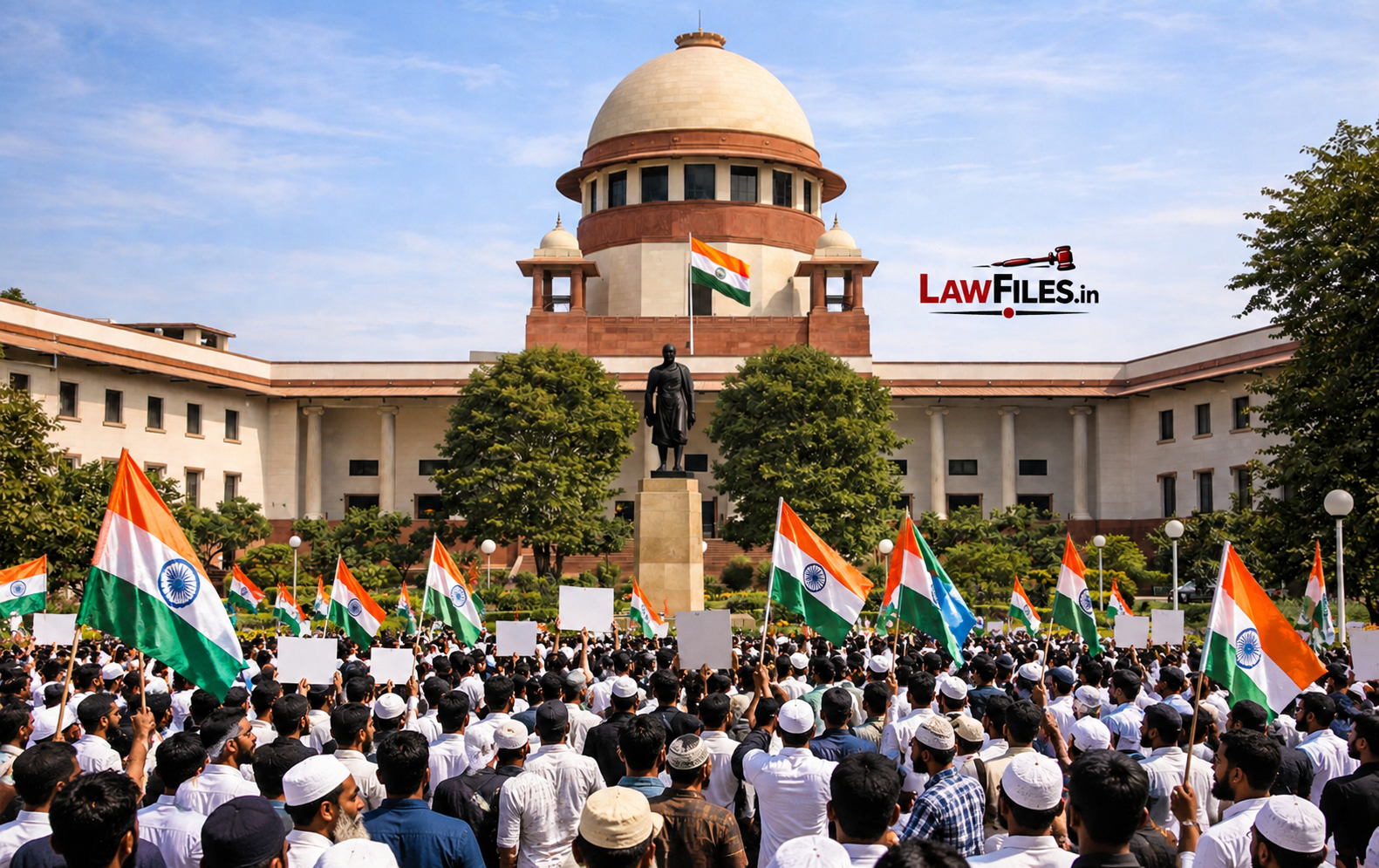
The Supreme Court’s intervention in the proposed October 10 protests in Delhi raises a fundamental constitutional question: can the State prevent a potential law-and-order problem by imposing restrictions so extensive that ordinary citizens are deprived of access to essential public transport? The Court’s answer, at least at the interim stage, was clear. Public order may justify regulating movement, but it cannot automatically justify bringing the city’s transport network to a complete halt. The Bench insisted that the authorities reconsider the proposed shutdown of Delhi Metro stations and cancellation of train services, directing that services be permitted to operate in a suitably regulated manner, guided by proportionality and the need to minimise hardship to the public.
The matter reached the Supreme Court through an urgent mentioning before Chief Justice of India Surya Kant and Justices Joymalya Bagchi and V. Mohana. Senior Advocates Kapil Sibal, Gopal Sankaranarayanan, Abhishek Manu Singhvi, N. Hariharan and Vrinda Grover, among others, brought the proposed restrictions to the Court’s attention. Sibal, appearing for CPI(M) general secretary M.A. Baby, submitted that several trains scheduled to reach New Delhi and Hazrat Nizamuddin between 4 a.m. and 2 p.m. on October 10 had been cancelled, while entry and exit gates at 57 metro stations were proposed to be closed. The restrictions, he argued, were affecting not merely those intending to participate in the protest but the wider public that depended on public transport for ordinary movement. The Bench initially asked why the petitioners had not approached the Delhi High Court, but was informed that a related petition filed by the Indian Youth Congress had been deferred until Monday, potentially leaving little time for an effective remedy before the scheduled demonstration.
The Court’s concern was directed principally at the scale of the restrictions rather than at any political position concerning the proposed demonstration. Chief Justice Surya Kant emphasised that the Court was concerned about commuters travelling from Gurugram, Greater Noida and different parts of Delhi for work, education and other necessities. Students, employees, senior citizens and people without access to private vehicles would bear the consequences of a widespread transport shutdown even though they had no connection with the protest. The Bench made it clear that the authorities could take measures to prevent disorderly movement and protect sensitive locations, but that a precautionary response could not indiscriminately transfer the entire burden of maintaining law and order onto the city’s residents. The Court’s concern was thus rooted in the distinction between preventing a foreseeable threat and imposing restrictions whose impact extends far beyond the persons or activity said to present that threat.
Solicitor General Tushar Mehta assured the Bench that he would impress upon the concerned authorities the need to reconsider the proposed prohibition and permit train and metro services to operate in a regulated manner. Recording that assurance, the Court directed that there should be no complete prohibition on the movement of metro trains and other railway services. The authorities were asked to take a considered decision on the manner in which services could operate safely, while ensuring that the decision received wide publicity through newspapers, websites and other appropriate channels. The Court also called for a traffic advisory to inform road users about the restrictions and arrangements. The direction was therefore not an unconditional order requiring every station and every train to function without security controls; it required the authorities to reconsider a blanket shutdown and adopt a proportionate arrangement that preserved public mobility while addressing genuine security concerns.
The immediate background to the dispute was the proposed October 10 demonstration called by the Cockroach Janata Party and other groups, including opposition-party organisations, seeking the resignation of Chief Election Commissioner Gyanesh Kumar. The protest was linked to objections concerning the Special Intensive Revision of electoral rolls and the wider controversy over the Election Commission’s functioning. Delhi Police had denied permission for the proposed gathering at Jantar Mantar, reportedly citing the short notice given by the organisers, alleged non-compliance with conditions imposed during an earlier demonstration and prevailing law-and-order concerns. Prohibitory orders under Section 163 of the Bharatiya Nagarik Suraksha Sanhita, 2023, were also cited by the authorities. These circumstances formed the State’s security context, but they did not, in themselves, settle the separate constitutional question of whether restrictions on public transport could extend to a scale that substantially disrupted movement across the capital.
The controversy is legally important because it illustrates that the right to protest and the State’s power to maintain public order are not mutually exclusive constitutional propositions. Article 19(1)(a) protects freedom of speech and expression, while Article 19(1)(b) guarantees citizens the right to assemble peacefully and without arms. Both rights are subject to constitutionally permitted reasonable restrictions. The State may regulate demonstrations to prevent violence, protect public infrastructure, preserve traffic movement and safeguard sensitive establishments. It may also require organisers to comply with lawful conditions concerning the venue, duration, route and size of a gathering. But the existence of a power to regulate does not necessarily justify every restriction that an authority considers convenient. The legality of a measure depends on its purpose, the material supporting it, its breadth and whether a less restrictive arrangement could reasonably achieve the same objective.
The principle of proportionality is particularly significant in this context. It requires the State to demonstrate a rational connection between the restriction imposed and the legitimate objective pursued, while also examining whether the measure is broader than necessary. Where authorities anticipate that demonstrators may travel to particular locations or attempt to reach sensitive government establishments, they may have legitimate grounds to restrict access to selected stations, regulate crowd movement, deploy additional personnel, alter train frequency or temporarily close a specific entrance. But a restriction affecting 57 metro stations across multiple parts of Delhi, coupled with cancellations of trains arriving in the capital, raises a different question: whether a measure designed to control a particular demonstration is proportionate when it interferes with the mobility of a much larger population. The Court’s intervention suggests that preventive action must be calibrated to the actual risk rather than determined solely by the administrative convenience of avoiding that risk altogether.
This approach is consistent with the Supreme Court’s decision in Mazdoor Kisan Shakti Sangathan v. Union of India (2018), which concerned restrictions on demonstrations in areas surrounding Parliament and other sensitive government establishments in Delhi. The Court recognised that peaceful assembly and expression are constitutionally protected, while acknowledging that the State may impose reasonable restrictions to protect public order and other legitimate interests. It called for a regulatory framework capable of balancing the rights of demonstrators with the requirements of security and the convenience of the public. The underlying principle was that regulation of a protest must not become a disguised method of eliminating the opportunity to protest altogether. In the present case, the same reasoning assumes a wider practical significance because the restrictions were not confined to the venue of the proposed demonstration; they affected transport infrastructure used by people throughout the city.
The decision in Amit Sahni v. Commissioner of Police (2020), arising from the Shaheen Bagh protest, provides another important point of reference. The Supreme Court held that public roads and public spaces cannot be occupied indefinitely in a manner that deprives others of their right to move freely and use common infrastructure. That ruling is sometimes invoked to argue that public inconvenience can justify restrictions on demonstrations. Its actual significance, however, lies in recognising competing rights rather than granting one side an absolute entitlement. Protesters cannot claim an unrestricted right to obstruct public roads indefinitely, just as the State cannot automatically treat every proposed demonstration as sufficient reason to suspend ordinary civic life. The constitutional task is to balance the right to assemble with the rights of commuters, residents, businesses and other members of the public. The present order reflects that reciprocal understanding: demonstrations may be regulated, but measures adopted in anticipation of them must also be assessed for their impact on people who are not participating in the gathering.
A further distinction must be drawn between the legality of the proposed protest and the legality of the restrictions imposed in response to it. During the hearing, Justice Bagchi emphasised that the right to association and peaceful assembly must be exercised within the framework of applicable law and that organisers are ordinarily expected to seek permission where the regulatory framework requires it. The Court also sought information about the proposed gathering and its scale, underscoring the need to understand the ground realities before determining the appropriate response. These observations are important because the right to protest does not exempt organisers from compliance with valid police directions, nor does a claim of peaceful intent prevent the State from acting on credible information about a potential security threat. But even if a demonstration lacks the required permission, that fact does not automatically establish the legality of every collateral restriction imposed upon the wider public. Each exercise of State power must be justified by its own legal basis and proportionality.
The distinction also explains why the Court’s order should not be misrepresented as granting blanket permission for the October 10 protest. The immediate direction concerned the complete prohibition on metro and railway movement and the need to permit services in a suitably regulated manner. It did not declare that the organisers had an unconditional right to assemble at Jantar Mantar, invalidate all prohibitory orders, or prevent police from taking lawful steps against violence or unlawful obstruction. Nor did it decide the merits of the political demands raised by the demonstrators. The Court addressed a narrower constitutional issue: whether preventive arrangements could be designed in a manner that avoided unnecessarily disrupting the daily lives of Delhi’s residents.
The public-transport dimension of the dispute deserves particular attention. Delhi Metro is not simply a convenience for commuters travelling within the city. It is a core component of the capital’s mobility infrastructure, connecting residential areas, workplaces, educational institutions, hospitals, railway stations and commercial centres. It also enables commuters from neighbouring cities to access employment and services in Delhi. A widespread closure can produce cascading effects: passengers may be diverted to already congested roads, travel costs may rise, workers may lose wages, students may miss examinations or classes, and people requiring medical attention may face additional difficulty reaching their destinations. Cancelling long-distance trains creates similar consequences for passengers who may have booked travel well in advance and have little practical ability to rearrange their journeys at short notice. These effects are especially severe for lower-income commuters, for whom public transport is not merely an affordable alternative to private vehicles but often the only realistic means of travel.
The Court’s emphasis on public inconvenience must therefore be understood as more than an administrative consideration. The State’s responsibility to protect public order exists alongside its responsibility to ensure that public infrastructure remains accessible to the extent reasonably possible. Restrictions on movement may engage Article 19(1)(d), which guarantees citizens the right to move freely throughout the territory of India, subject to reasonable restrictions under Article 19(5). Although the immediate challenge centred on transport closures, widespread restrictions that impede ordinary movement raise broader questions about how the State balances security with constitutionally protected liberty. The fact that the restrictions are temporary does not automatically make them proportionate; their legality still depends on their necessity, scope and impact.
The direction to publicise the revised arrangements is also legally and practically important. A decision to regulate transport is of little assistance if commuters do not know which stations are accessible, which trains are operating, where entry and exit restrictions apply or what alternative routes are available. Uncertainty can itself create crowding, panic and avoidable hardship. Wide publicity through newspapers, official websites and other public channels is therefore part of a responsible regulatory response. It enables the public to plan journeys, helps reduce congestion at affected locations and makes the exercise of executive power more transparent. In a city as dependent on interconnected transport networks as Delhi, communication is not an incidental administrative step; it is integral to ensuring that a security measure does not create unnecessary disorder of its own.
The case also highlights the importance of judicial review in situations where executive decisions are taken in anticipation of a possible disturbance. Preventive powers are necessarily exercised before the feared event occurs, and authorities cannot be expected to wait for violence to begin before responding to credible threats. Yet the preventive character of a measure also creates a risk that restrictions may be imposed on the basis of broad apprehensions rather than carefully assessed evidence. Judicial scrutiny does not require courts to assume the role of police planners or determine operational security arrangements themselves. It requires the State to explain why the restrictions are necessary and whether a narrower measure could protect public order without causing disproportionate collateral harm. The Supreme Court’s insistence on regulated services rather than complete prohibition reflects this limited but essential supervisory function.
The episode also raises a question about the allocation of responsibility between organisers and the authorities. Organisers of a public demonstration must provide adequate notice where required, comply with lawful conditions and take reasonable steps to ensure that the gathering remains peaceful. The police, in turn, must assess the request in a timely manner, communicate the grounds for restrictions and consider whether conditions can address the identified risks. Where permission is refused or the decision is delayed until the proposed date is imminent, the practical opportunity to seek judicial review may be substantially reduced. The Court’s intervention in the present matter demonstrates the value of an effective remedy before the event, but it also suggests that predictable administrative procedures could prevent recurring emergency litigation over protest permissions and public access.
Ultimately, the Supreme Court’s order places a constitutional limit on the logic that a city can be made inaccessible in order to prevent a gathering from becoming difficult to control. The State is entitled to preserve public order, protect sensitive installations and respond to credible threats. Protest organisers, for their part, must respect lawful restrictions and cannot claim immunity from the consequences of unlawful conduct. But neither proposition permits the public at large to be treated as collateral damage in a preventive operation. The requirement of proportionality demands a more careful response: targeted restrictions where necessary, regulated transport where feasible, clear public advisories and an evidence-based assessment of the risks involved.
The broader lesson is that the constitutional right to protest and the public’s right to move through the city must be accommodated together wherever reasonably possible. A democracy cannot function if peaceful assembly is treated as inherently illegitimate; nor can it function if the exercise of that right is permitted to extinguish the rights of others. The Supreme Court has not decided the legality of every restriction connected with the October 10 demonstration, but its direction that metro and train services should not be completely prohibited reinforces an important principle of constitutional governance. Security measures must be effective without becoming excessive, and the protection of public order must not be pursued through a blanket suspension of ordinary civic life when regulated alternatives are available. The measure of a constitutional State is not simply its capacity to prevent disruption, but its ability to do so without imposing avoidable hardship on those who have no part in the event giving rise to the restriction.
