


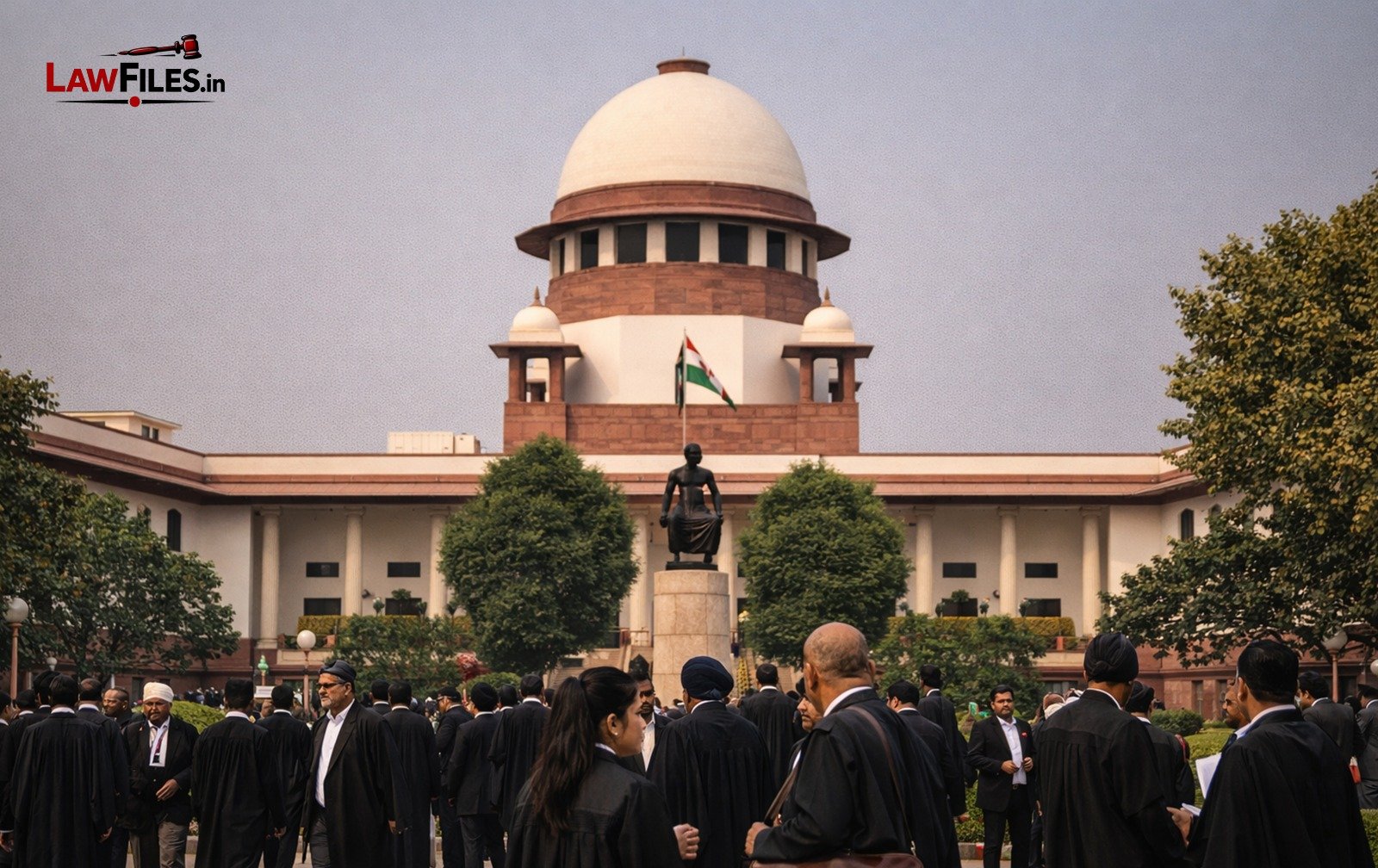
The Supreme Court has expressed strong disapproval over the Uttar Pradesh Government’s failure to release pensionary and other retiral benefits to a Class-IV employee for nearly a decade after his retirement, observing that the prolonged delay amounted to “grave injustice” to a person who had devoted more than three decades of his life to government service. A Bench of Justice K.V. Viswanathan and Justice Arun Palli, hearing Jagdish Prasad Tripathi v. State of U.P. through its Principal Secretary & Ors., not only questioned why the petitioner had been deprived of his legitimate dues for so many years but also directed the Chief Secretary of Uttar Pradesh to submit a report explaining the delay, identifying the officials responsible at different stages and indicating what action and compensation the State proposed to provide. The Court’s intervention is significant because it moves the issue beyond the individual grievance of a retired employee and towards institutional accountability for the manner in which governments process pension claims.
The petitioner had entered government service as a peon in 1984 and continued in that position until his superannuation on July 31, 2016, completing approximately 32 years of service. His post was pensionable. Yet, despite his retirement, his pension papers were not cleared in the ordinary course. He repeatedly approached the authorities and submitted representations seeking release of his retiral benefits, but the dispute remained unresolved. What should ordinarily have been the administrative conclusion of a long period of government service consequently became the beginning of another prolonged struggle for the employee, this time to secure benefits which had accrued from the service he had already rendered.
The petitioner eventually approached the Allahabad High Court in 2018 seeking release of his pension and other retiral dues. The litigation, however, did not bring an immediate resolution. In 2024, the High Court directed the concerned office to trace and place on record the State Government’s counter affidavit. The matter thereafter was not effectively listed for further adjudication. The petitioner made an application for early hearing in October 2025, but that application was disposed of in April 2026 without fixing a date for substantive hearing. With his pension dispute continuing years after retirement and the High Court proceedings failing to produce an effective resolution, the petitioner approached the Supreme Court.
The factual picture placed before the Supreme Court became particularly troubling because the State’s own affidavits appeared to contain an internal inconsistency regarding the reason for withholding the pension. One part of the compliance affidavit stated that the petitioner had remained absent from service between July 20, 2009 and November 30, 2010, and that on this basis only provisional pension had initially been sanctioned. It was also stated that the petitioner had not responded to requests to furnish documents. Yet another paragraph recorded that the petitioner had actually received his salary for the very period during which the alleged interruption in service was said to have occurred. If salary had been paid for that period, the justification based upon an interruption in service became difficult to sustain. The State ultimately recommended final pension after recognising the mistake.
The Bench was evidently troubled by the fact that an issue which the department itself ultimately recognised as erroneous had nevertheless remained capable of obstructing the petitioner’s pension for years. The Court observed that the alleged period of absence was essentially treated as an obstacle to pension processing even though the department subsequently realised the mistake and corrected its position. The episode illustrates a recurring administrative problem in service jurisprudence: an issue which may be minor at the level of departmental record verification can become devastating when it prevents the release of an elderly employee’s entire post-retirement income for years.
The financial consequences were not merely theoretical. The Court was informed that ₹7,16,295 towards the petitioner’s General Provident Fund had been released in 2025. A subsequent compliance affidavit stated that pension arrears and other benefits amounting to approximately ₹29,06,663 had been paid to him in 2026. He was also to receive regular monthly pension of ₹11,200 together with Dearness Allowance. These payments, however, did not persuade the Supreme Court to close the matter. The Bench made it clear that releasing the money after judicial intervention did not answer the more fundamental question of why the dues had remained unpaid for so long in the first place.
That distinction is legally important. If a government employee is eventually paid his pension after approaching a constitutional court, the administrative authorities cannot necessarily treat the subsequent payment as curing every aspect of the wrong. Delay itself can have serious consequences, particularly for a retired employee who depends upon pension as a regular source of livelihood. By the time the State finally releases the accumulated amount, the employee may have spent years without the monthly income to which he was entitled, incurred litigation expenses and suffered considerable uncertainty during old age. The question of compensation and accountability therefore becomes distinct from the question of merely calculating and paying arrears.
The Supreme Court’s description of pension as neither a bounty nor charity but as deferred payment for services already rendered reflects a long-established principle of Indian service law. Pension is not a discretionary favour which the State may release whenever administrative convenience permits. Where the governing service rules create an entitlement, pension represents a legally enforceable benefit arising from the employee’s service. The Court has repeatedly recognised that retiral dues have a distinct legal character and that administrative authorities cannot indefinitely withhold them without lawful justification. The present proceedings therefore reaffirm a principle that has existed in service jurisprudence for decades rather than creating a new category of entitlement.
The Supreme Court has previously dealt with situations in which governments attempted to postpone or withhold pensionary benefits on grounds unrelated to the employee’s actual entitlement. In Panchayat and Rural Development Department v. Santosh Kumar Shrivastava, for example, the Court reiterated that pension and retiral dues are not matters of governmental grace where the employee has a legal entitlement arising from the applicable rules. The principle is especially relevant because pension is ordinarily the financial consequence of a lifetime of service and not an ex gratia payment made at the State’s discretion.
The present case also brings Article 21 into the broader discussion concerning pension administration. While pension itself is principally governed by statutory and service rules, prolonged deprivation of an earned retirement benefit can have a direct bearing upon an individual’s dignity and ability to live with basic financial security. Article 21 jurisprudence has progressively moved beyond a narrow conception of physical liberty towards protection of dignified existence. For an elderly retired employee with no continuing salary, a prolonged denial of pension cannot realistically be treated as a purely technical administrative inconvenience.
The fact that the petitioner had reached the age of 71 and was reportedly suffering from several medical complications made the Court’s concern particularly acute. The Bench questioned how he had managed to survive for such an extended period without receiving the pension to which he was entitled. That observation is significant because it places the dispute in its actual human context. Pension litigation can sometimes appear in government files as a question of service records, qualifying service, missing documents or departmental correspondence. For a retired employee, however, those same administrative entries may determine whether he has money to meet ordinary living expenses and medical needs.
The Court was also critical of the fact that the petitioner had joined the State service as a peon and retired from the same post after approximately 32 years. The reference to his position is not merely rhetorical. Class-IV and other lower-ranking government employees often possess significantly fewer financial resources to withstand prolonged litigation than senior officers. A retired employee who has spent his working life on a modest salary cannot reasonably be expected to sustain years of litigation merely to secure a monthly pension that should have commenced automatically upon retirement. The case consequently raises questions of administrative justice that extend beyond the formal entitlement to pension.
The State, as the Court observed, has a heightened responsibility as a “model employer.” This principle has substantial implications for public administration. A government employer is not simply another litigant. It controls the service records, pension papers, departmental files and administrative machinery necessary for determining and releasing retiral benefits. The retired employee is ordinarily dependent upon that machinery and has limited ability to reconstruct or access official records independently. Consequently, where the State delays pension processing, the burden imposed upon the employee is considerably greater than in an ordinary private dispute between two parties.
The Supreme Court’s direction requiring the Chief Secretary to identify the officers responsible at different stages is therefore one of the most significant aspects of the order. Instead of treating the delay as an impersonal failure of the “department,” the Court has required the State to identify the human decision-making chain behind the delay. This approach is important because bureaucratic responsibility can otherwise become diffuse. A pension file may move through several offices, objections may be raised at multiple levels and years may pass without any individual officer being held responsible for the cumulative delay. Requiring identification of the officials involved introduces an element of personal accountability into an otherwise anonymous administrative process.
The Court has also asked the Chief Secretary to state what action is proposed against the officials responsible and how the State proposes to compensate the petitioner for the serious violation of his rights. This direction indicates that the Court is examining the matter from a remedial perspective rather than merely seeking an explanation for the past. If the State is required to compensate the petitioner beyond payment of the principal pensionary dues and arrears, the case could have broader significance for future service litigation involving unexplained administrative delay.
At the same time, compensation for delayed pension cannot become an automatic consequence of every administrative error. Government pension systems involve large numbers of employees, complex service records and occasional genuine disputes concerning qualifying service, disciplinary proceedings, verification of service or entitlement under amended pension rules. The law must therefore distinguish between a bona fide dispute requiring adjudication and an unjustified administrative failure where the employee’s entitlement is clear. The facts noted by the Supreme Court in the present case appear particularly serious because the State’s own record ultimately undermined the explanation initially advanced for the delay.
The episode also exposes the relationship between administrative delay and judicial delay. The petitioner did not immediately approach the Supreme Court. He first pursued the departmental route and then approached the Allahabad High Court in 2018. Even after the High Court directed that the State’s counter affidavit be traced and placed on record in 2024, the matter did not proceed to an effective hearing. His request for early listing in 2025 was disposed of in April 2026 without a date being fixed. Thus, the petitioner encountered two layers of delay: first in the administrative processing of his pension and subsequently in obtaining effective judicial adjudication.
The Supreme Court has responded to the second problem as well. A copy of its order has been directed to be placed before the Chief Justice of the Allahabad High Court, with a request to examine whether matters concerning non-release of pension can be prioritised for early disposal. This is an unusual but understandable intervention. Pension cases involving retired employees can lose much of their practical value if they remain pending for years. Unlike commercial disputes, where financial claims may sometimes be compensated through interest or damages, a pension dispute concerns the continuing subsistence of a person who has already exited the workforce. The passage of time therefore has an unusually direct impact upon the effectiveness of the remedy.
The direction for Standard Operating Procedures is equally important. The Supreme Court has asked the State to issue necessary orders or formulate an SOP so that pension papers of employees who are legitimately entitled to pension are not delayed even by a day. This shifts the focus from individual correction to systemic prevention. If the State merely releases the petitioner’s arrears and identifies a few officers, the immediate dispute may be resolved, but the underlying administrative vulnerability remains. An SOP can potentially prescribe timelines for verification, responsibility at each stage, escalation mechanisms where documents are incomplete, automatic monitoring of pending pension files and accountability where a file remains unattended beyond the prescribed period.
The emphasis on “not even by a day” is particularly meaningful when understood against the nature of pension. Retirement is a predictable administrative event. Unlike an unexpected litigation or emergency claim, pension processing can and should ordinarily begin well before the date of superannuation. Government departments have advance knowledge of the employees who are approaching retirement and can therefore verify service records and pension papers in advance. A system that waits until retirement has occurred before beginning the entire verification exercise creates avoidable risks of delay.
The case also raises questions about the quality of departmental record management. The alleged absence between 2009 and 2010 apparently remained significant enough to affect pension processing despite the fact that salary had been paid for the period. This suggests that the difficulty was not necessarily the absence of records but the failure to reconcile records before taking a decision affecting the employee’s retirement benefits. A basic administrative principle should apply in such circumstances: before withholding a statutory or service benefit, the authority must verify the factual basis of the objection and ensure that its own records are internally consistent.
There is another important lesson for service law practitioners. When a pension is withheld or reduced on the basis of an alleged break in service, absence, disciplinary issue or missing record, the employee should not be left indefinitely in an unresolved provisional status. The department must communicate the precise basis of the decision, identify the relevant rule, give the employee an opportunity to respond where required and reach a reasoned determination. Provisional pension can serve an important protective function in disputed cases, but it should not become a substitute for final adjudication of the employee’s entitlement.
The Court’s intervention also reinforces the principle that the State cannot benefit from its own administrative inaction. If a department fails to process pension papers and the employee is eventually compelled to litigate, the mere fact that the State ultimately pays the principal amount cannot erase the consequences of the delay. Courts have consistently recognised the importance of interest and other consequential relief where retiral dues are unjustifiably withheld. The precise question of compensation in the present case will become clearer when the Chief Secretary files the report sought by the Court.
It is particularly noteworthy that the Supreme Court did not stop at directing payment. According to the State’s subsequent compliance affidavit, the petitioner had already received approximately ₹29.06 lakh in arrears and other benefits and was to receive regular pension with Dearness Allowance. Yet the Bench expressly stated that it was not prepared to leave the matter there. This reflects an important judicial distinction between restitution and accountability. Paying what was always legally due restores, at least financially, part of the employee’s entitlement; it does not necessarily answer why the State permitted the deprivation to continue for years.
The order therefore carries a wider message for public employment. A government employee’s relationship with the State does not end on the date of retirement. The State’s obligations continue in relation to pension, gratuity, provident fund and other statutory or service benefits. Retirement merely changes the form of the relationship. The employee ceases to render service, but the State remains legally responsible for discharging the financial consequences of that service in accordance with the applicable rules.
The case is also a reminder that pension litigation should be approached differently from ordinary service disputes. A serving employee may, in some circumstances, continue to receive salary while challenging an adverse service order. A retired employee whose pension is withheld has no equivalent continuing income from the employer. Every month of delay can therefore have immediate consequences. Courts and administrative authorities must account for that difference when deciding whether such matters deserve expedited consideration.
The Supreme Court’s direction to the Allahabad High Court to examine prioritisation of pension matters is consequently consistent with the principle of effective access to justice. A legal right which can be vindicated only after the beneficiary has spent a substantial portion of his remaining years in litigation risks becoming practically hollow. Judicial efficiency in pension cases is not merely a matter of docket management; it can determine whether the remedy arrives while it is still meaningful.
The next stage of the proceedings will now require the Uttar Pradesh Chief Secretary to explain why the pension papers were not cleared immediately after the petitioner’s retirement, identify the officers or employees responsible at different stages, disclose what action is proposed against them and state how the State proposes to compensate the petitioner for the violation of his rights. The report is to be filed by December 31, 2026, and the matter has been listed for further hearing on January 4, 2027.
The significance of Jagdish Prasad Tripathi ultimately lies in the Court’s refusal to treat pension delay as an ordinary bureaucratic inconvenience. A person who serves the government for 32 years does not earn a favour upon retirement; he earns a legal entitlement arising from that service. When an elderly retired employee is forced to approach the constitutional courts because the administrative system failed to release that entitlement, the issue becomes one of rule of law and institutional responsibility. The Supreme Court’s insistence upon identifying responsible officials, considering compensation and creating preventive SOPs signals that pension administration must be measured not merely by whether the government eventually pays, but by whether it performs its legal duty when the payment becomes due.
The case therefore carries a simple but powerful administrative lesson: retirement should mark the commencement of pension, not the commencement of a decade-long struggle to obtain it. For the State, the obligation is not merely to correct mistakes after judicial intervention but to design a system in which legitimate pension claims are processed accurately, transparently and within a fixed timeframe. For courts, the matter underscores why pension disputes involving elderly and financially dependent retirees may require priority treatment. And for public servants approaching retirement, the case demonstrates that pension is a legally protected consequence of service not a discretionary benefit which can be held hostage to unexplained bureaucratic delay.
