


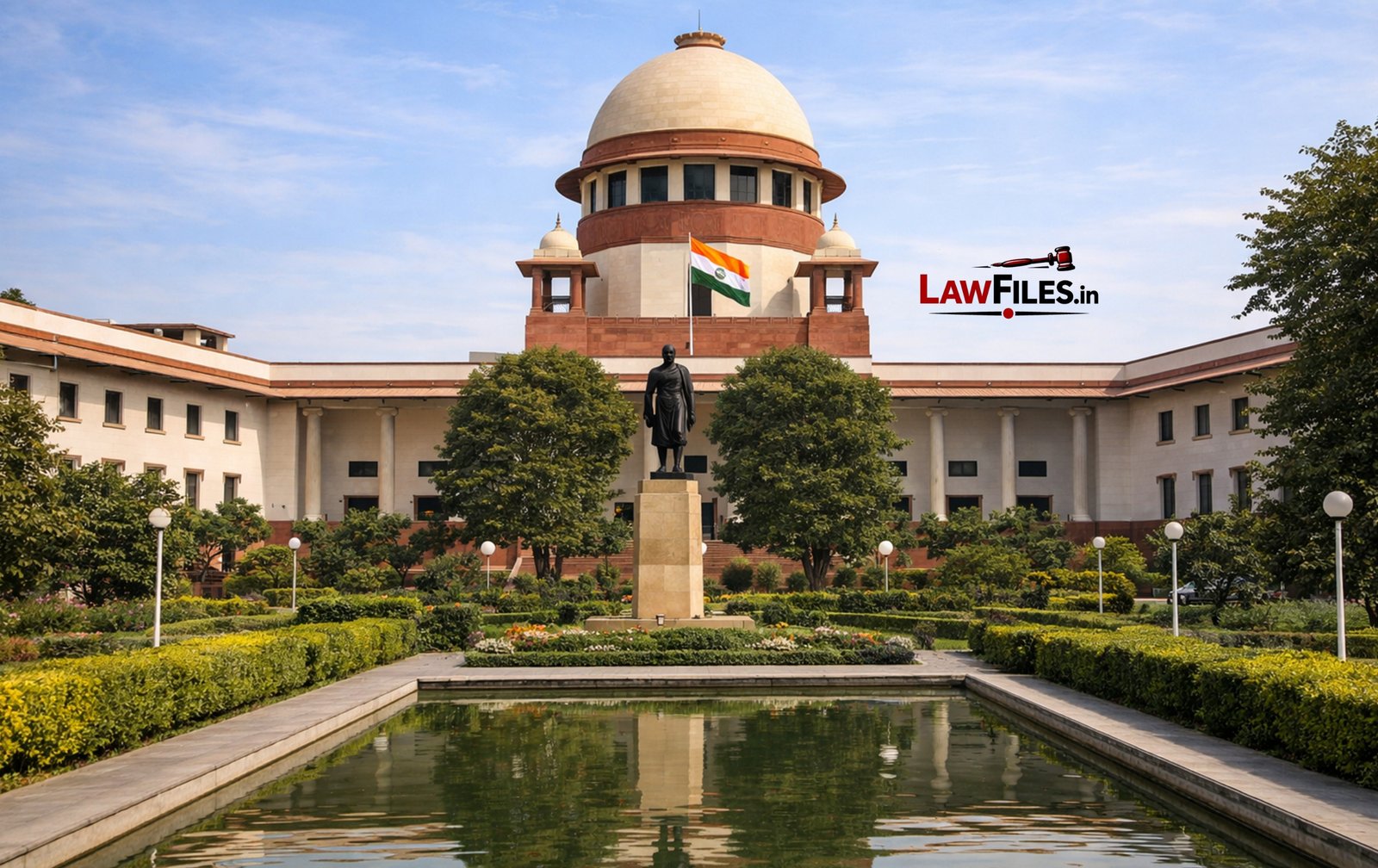
The Supreme Court has stayed the execution of death-row convict Ahmed Bawa alias Abbu Abubakar Barelvi, one of the 38 persons sentenced to death in the 2008 Ahmedabad serial blasts case, while issuing notice to the State of Gujarat on his challenge to the Gujarat High Court judgment upholding his conviction and capital sentence. A Bench comprising Justices Vikram Nath, Sandeep Mehta and Augustine George Masih passed the interim order on October 1, 2026, after counsel for Barelvi submitted that his conviction was founded entirely upon the allegation of conspiracy. The Court has also called for the trial court record. The order does not amount to an acquittal or a finding that the conviction is unsustainable; it preserves the appellant’s life while the Supreme Court examines the challenge.
The significance of the order lies in the fact that the Supreme Court has intervened at the most consequential stage of a criminal appeal: after a trial court has imposed capital punishment, after the High Court has independently examined the conviction and confirmed the death sentences, and when the matter has reached the final appellate forum before the executive can carry out the sentence. In a death-penalty case, an interim stay is therefore not a routine procedural indulgence. It reflects the settled judicial principle that where the highest court is seized of a challenge to a capital conviction, execution must remain suspended until the appellate scrutiny is meaningfully completed.
The present appeal arises from the Gujarat High Court’s extensive judgment of July 7, 2026, which upheld the convictions of the accused in the Ahmedabad serial blasts case and confirmed the death sentences imposed upon 38 of them. The High Court was exercising two distinct but connected jurisdictions: it considered the appeals filed by the convicted persons and the statutory confirmation proceedings concerning the death sentences. The High Court’s judgment itself records that a death sentence imposed by a Sessions Court cannot become executable merely upon pronouncement by the trial court; it requires confirmation by the High Court under the criminal procedure framework.
The underlying case concerns the coordinated bomb explosions that struck Ahmedabad on July 26, 2008. Twenty-two bombs exploded at different locations across the city, including public places, buses, vehicles and hospitals, while additional explosive devices were recovered without detonating. Fifty-six persons were killed and more than 200 were injured. The attack consequently became one of the most extensive terrorism prosecutions undertaken by the Gujarat criminal justice system, involving a large number of accused, multiple locations, several investigative agencies and an exceptionally voluminous evidentiary record.
The scale of the trial is relevant to understanding why the litigation has continued for so many years. The Gujarat High Court’s judgment runs into more than two thousand pages and records evidence concerning the deaths, injuries, recoveries, scenes of offence, identification of bodies, medical evidence and the alleged conspiracy. The High Court recorded, among other things, examination of relatives of deceased persons, medical officers who conducted post-mortems, panch witnesses connected with inquest proceedings, witnesses concerning recovery of articles from deceased and injured persons, and numerous eyewitnesses.
A special court in Ahmedabad delivered the trial judgment in February 2022. Of the accused who remained before the trial court, 49 were convicted; 38 were sentenced to death and 11 to imprisonment for life, while 29 others were acquitted. The case thereafter moved to the Gujarat High Court, where the convictions and sentences were subjected to appellate scrutiny and the death sentences were placed before the Court for confirmation. The High Court ultimately affirmed the death penalty imposed upon all 38 death-row convicts in July 2026.
The Supreme Court proceedings concerning Barelvi must therefore be appreciated as an appellate challenge to an already confirmed capital sentence. His counsel’s submission that the conviction rested entirely on conspiracy assumes significance in that context. Conspiracy prosecutions present a distinctive evidentiary problem because the alleged agreement to commit an offence is ordinarily formed and operated in circumstances that are not directly witnessed. Section 120A of the Indian Penal Code recognises criminal conspiracy as an agreement to do an illegal act, or to do a legal act by illegal means, while Section 120B prescribes punishment. In terrorism prosecutions, conspiracy may also interact with the special statutory offences invoked against the accused.
The law does not require the prosecution to produce a literal recording of the moment when conspirators reach an agreement. Conspiracy can be proved through circumstantial evidence, conduct, communications, association, preparation, subsequent acts and other circumstances which, when cumulatively assessed, establish the existence of the unlawful agreement. But the fact that conspiracy is capable of being proved circumstantially does not lower the prosecution’s ultimate burden of proof. Circumstances must form a coherent chain pointing towards the accused’s participation and must be assessed individually as well as cumulatively.
This distinction becomes particularly important when the sentence is death. A conviction may rest on circumstantial evidence, but a capital sentence requires the court to undertake a further and separate sentencing inquiry. Indian constitutional jurisprudence does not treat proof of guilt and determination of punishment as a single exercise. The Supreme Court’s Constitution Bench decision in Bachan Singh v. State of Punjab established that death penalty is constitutionally permissible but confined it to the “rarest of rare” category, after considering aggravating and mitigating circumstances and determining whether life imprisonment is unquestionably inadequate.
The Gujarat High Court expressly addressed this framework in its 2026 judgment. It noted that death penalty continues to be legally permissible in India but is controlled by the constitutional doctrine developed in Bachan Singh. The Court also examined the statutory requirement that a judgment imposing death must contain special reasons for such punishment and considered the distinction between the authority of a Sessions Court to impose the sentence and the High Court’s confirmation jurisdiction.
The High Court’s confirmation of the death sentences was influenced by the scale of the attack, the number of victims, the alleged magnitude of the conspiracy and the nature of the terrorist acts proved against the convicted persons. Reports of the judgment indicate that the High Court considered the widespread impact of the attack and the prosecution’s case regarding the intention to generate terror while assessing the appropriate punishment. At the same time, the Court considered the aggravating and mitigating circumstances placed before it.
The Supreme Court’s stay, however, means that those conclusions are not beyond further judicial scrutiny. An appellate court dealing with a death sentence must be particularly cautious because an error cannot subsequently be remedied after execution. This explains the special procedural safeguards surrounding capital punishment throughout Indian criminal law: trial court sentencing, mandatory High Court confirmation, appellate review, review jurisdiction, curative jurisdiction in appropriate circumstances, and the executive’s constitutional and statutory powers relating to mercy and remission.
There is another procedural aspect emerging from the Supreme Court hearing that deserves attention. Counsel for Barelvi sought a translated copy of the Gujarat High Court judgment and pointed out that the trial record was substantially in Gujarati. That request is not merely a logistical matter. In a criminal appeal involving capital punishment, effective assistance of counsel necessarily requires access to the material forming the basis of the conviction and sentence in a language that the accused and his legal team can meaningfully examine. The Supreme Court’s willingness to call for the trial record is therefore particularly important in ensuring that the appellate challenge is not reduced to a formal exercise.
The language issue also illustrates a broader principle of access to justice. A criminal trial may be conducted in a regional language in accordance with the applicable procedural framework, but an accused facing execution must nevertheless have a meaningful opportunity to understand the reasons for the conviction and the sentence when pursuing an appeal before a higher court. The right to counsel under Article 22(1), the fair-trial guarantee under Article 21 and the constitutional requirement of effective judicial review become particularly significant when the punishment is irreversible.
The Supreme Court’s decision to call for the trial record is equally significant from the perspective of appellate review. A capital appeal cannot be decided merely by examining isolated portions of the High Court judgment. The appellate court must be able to examine the evidence, the reasoning by which individual circumstances were linked to the accused, the treatment of defence submissions and the sentencing analysis. Calling for the original record ensures that the Supreme Court retains the ability to independently scrutinise the evidentiary foundation rather than treating the High Court’s conclusions as the end of the matter.
This is consistent with the special nature of death-penalty adjudication. The Supreme Court has repeatedly held that when life is at stake, the appellate court has a heightened responsibility to examine the evidence carefully. The confirmation jurisdiction of the High Court itself exists for this reason. A death sentence is not treated as an ordinary sentence merely requiring ordinary appellate deference; the legal system builds multiple levels of scrutiny precisely because the consequence is irreversible.
The case also brings the doctrine of individual criminal responsibility within a collective conspiracy into sharp focus. The Ahmedabad blasts prosecution involves a large number of accused persons, but a collective allegation of conspiracy does not eliminate the need to establish the individual connection of each accused with the unlawful agreement. Membership of a group, ideological association or even evidence of contact with other accused cannot by itself substitute for proof of the specific legal ingredients required to establish criminal liability. The prosecution must demonstrate how the evidence connects the particular accused with the conspiracy alleged.
This principle assumes even greater importance at the sentencing stage. Even where a court finds an accused guilty of an offence punishable with death, the question whether that individual should receive the death penalty requires a separate assessment. The Supreme Court’s death-penalty jurisprudence insists upon consideration of the accused’s individual circumstances alongside the nature of the crime. The scale of a terrorist attack may constitute an aggravating circumstance, but the sentencing inquiry cannot become entirely collective merely because the prosecution case itself is collective.
The High Court’s 2026 judgment dealt with the prosecution evidence at considerable length. It recorded the investigative and forensic evidence relating to the individual accused and the larger alleged conspiracy, while also considering the statutory framework governing terrorist offences and capital punishment. The Supreme Court’s present proceedings now give Barelvi an opportunity to challenge the manner in which that evidence was evaluated against him specifically.
The State’s position, naturally, is likely to be informed by the seriousness of the crime and the concurrent findings of the trial court and High Court. The Solicitor General, who appeared during the hearing, described the case as a serious one. But seriousness alone cannot determine the outcome of an appellate challenge. The legal question before the Supreme Court is whether the conviction and sentence withstand the applicable standards of criminal proof, statutory interpretation and constitutional sentencing law.
The present stay should therefore not be misread as a judicial dilution of the gravity of the Ahmedabad attacks. The victims’ deaths and injuries, and the devastation caused by the bombings, remain established historical facts. The stay concerns the legal process governing one individual’s capital sentence. The two propositions can coexist: the crime may be exceptionally grave, while the conviction of an individual accused remains subject to the full safeguards of appellate review.
This distinction is particularly important in terrorism cases, where the emotional and social consequences of the crime can create enormous pressure for swift finality. Constitutional criminal procedure operates precisely in such circumstances. The more serious the allegation and the more irreversible the punishment, the greater the need for courts to separate public outrage, the gravity of the offence and the legal proof required against the particular accused.
The Ahmedabad case also demonstrates the difference between confirmation of a death sentence and execution of a death sentence. The Gujarat High Court’s July decision confirmed the capital punishment imposed by the trial court, but the accused retained the right to approach the Supreme Court. Once an appeal challenging the conviction and sentence is properly before the Supreme Court, an execution cannot proceed while the Court is examining the challenge. The present stay therefore preserves the status quo necessary for meaningful appellate adjudication.
The procedural journey following the Gujarat High Court’s judgment also illustrates the importance of ensuring that death-row prisoners have practical access to legal remedies. In September, the Gujarat High Court had permitted another death-row convict in the same case, Abbas Umar Sameja, seven days of parole to consult counsel, prepare his Supreme Court challenge and arrange legal assistance, subject to stringent conditions and police escort. Similar applications were subsequently being considered.
That episode is significant because the right to appeal against a capital sentence is meaningful only if the condemned prisoner has a realistic opportunity to consult counsel and access the record. The legal system cannot simultaneously provide an appellate remedy and make the practical preparation of that remedy impossible. The parole proceedings and the present Supreme Court stay, although procedurally distinct, together illustrate the safeguards that surround capital litigation after a trial court has imposed death.
There is also a larger institutional lesson in the chronology. The blasts occurred in 2008. The trial court delivered its verdict in 2022. The Gujarat High Court decided the appeals in 2026. The Supreme Court has now entered the matter. The passage of 18 years between the crime and the present appellate stage is substantial. For victims and their families, prolonged litigation can delay finality and closure. For death-row prisoners, prolonged uncertainty can produce an entirely different form of psychological and constitutional concern. The justice system must therefore balance both dimensions without compromising the correctness of the final adjudication.
The Supreme Court has separately developed jurisprudence concerning excessive delay in the execution of death sentences, recognising that unexplained and prolonged delay after the judicial process has concluded can engage Article 21. The present case is at a different stage: the conviction and sentence are still under substantive appellate challenge before the Supreme Court. It would therefore be premature to characterise the present stay as an instance of delay-based relief. Its immediate basis is the pendency of the appeal and the Court’s decision to examine the challenge before allowing the irreversible consequence of execution.
The distinction matters. A stay of execution pending appeal protects the integrity of appellate review; commutation based upon prolonged delay concerns the constitutional consequences of an excessive period spent awaiting execution after the judicial process has substantially concluded. The two doctrines should not be conflated.
The present proceedings may also require the Supreme Court to revisit how circumstantial evidence and conspiracy allegations were applied to an individual accused in a mass-terrorism prosecution. The fact that Barelvi’s counsel specifically characterised the conviction as conspiracy-based suggests that the individual evidentiary chain may become a central issue. Whether the evidence independently establishes his participation, whether individual circumstances were properly connected to the alleged agreement, and whether the standard of proof was satisfied are matters that can be examined only after the complete record is before the Court.
For now, however, the Supreme Court has deliberately kept the question open. It has issued notice, called for the record and stayed execution. There has been no final observation that the Gujarat High Court’s conclusions are erroneous, nor has the Court expressed any concluded view on Barelvi’s guilt. The interim order performs a narrower but constitutionally essential function: it ensures that the Supreme Court can conduct its appellate examination without the case becoming irreversible before that examination is complete.
The case thus returns to a foundational principle of capital jurisprudence: where the State proposes to take a person’s life pursuant to a criminal conviction, procedural finality must be real, not merely formal. Every judicial level that examines the conviction must have an effective opportunity to correct an error before the sentence is carried out. This is not a privilege created for terrorism cases or death-row prisoners; it is an inherent requirement of a constitutional criminal justice system that treats life and personal liberty as matters of the highest legal significance.
The Supreme Court’s intervention should accordingly be viewed neither as a comment on the historical tragedy of the Ahmedabad blasts nor as a preliminary declaration regarding the correctness of Barelvi’s conviction. It is an exercise of appellate caution at a stage where caution is indispensable. The gravity of the allegations does not eliminate the requirement of proof, and the confirmation of a death sentence by a High Court does not extinguish the Supreme Court’s constitutional responsibility to examine the conviction when an appeal is properly before it.
What now lies before the Supreme Court is therefore a much more focused legal inquiry: whether the evidence and reasoning sustaining Ahmed Bawa Barelvi’s conviction and capital sentence meet the demanding standards applicable to a criminal case in which the ultimate punishment is at stake. Until that examination is completed, the execution remains stayed. The Court’s order reinforces a central proposition of criminal justice the seriousness of an offence may justify the most rigorous prosecution, but it cannot justify bypassing the most rigorous scrutiny before life is taken by the State.
