


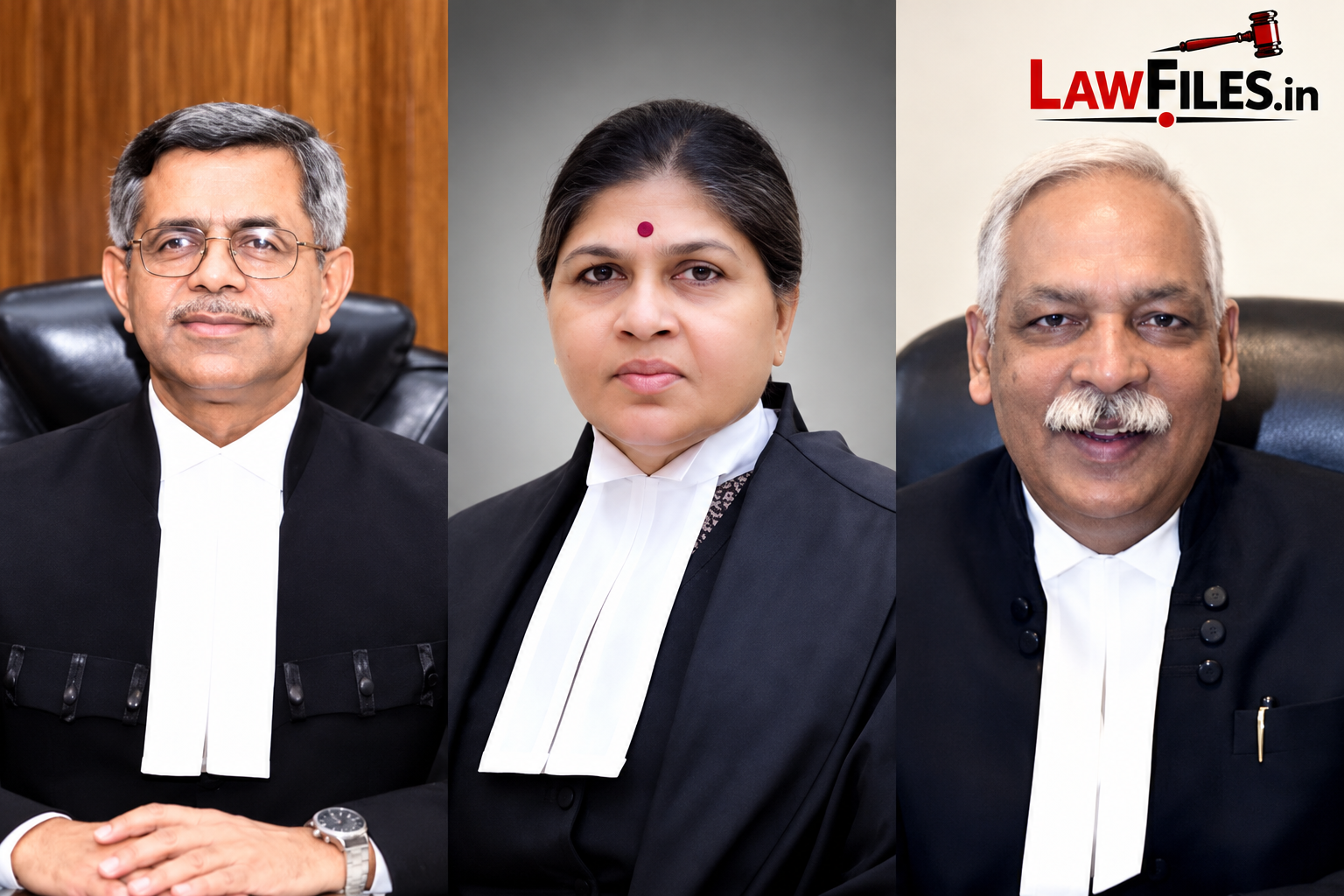
The Supreme Court Collegium headed by Chief Justice of India Surya Kant has recommended the elevation of three sitting High Court Chief Justices to the Supreme Court, bringing questions of judicial strength, institutional continuity, representation and the functioning of the Collegium once again to the centre of the judicial appointments debate. The recommendations, made at the Collegium meeting held on September 28, 2026, concern Justice Sunita Agarwal, Chief Justice of the Gujarat High Court; Justice Devendra Kumar Upadhyaya, Chief Justice of the Delhi High Court; and Justice Aparesh Kumar Singh, Chief Justice of the Telangana High Court. The official resolution identifies the Allahabad High Court as the parent High Court of Justices Agarwal and Upadhyaya, while Justice Singh has the Jharkhand High Court as his parent High Court.
The announcement is not, in legal terms, an appointment to the Supreme Court yet. It is a recommendation by the Supreme Court Collegium, which will now move through the constitutionally prescribed appointment process before the three judges can formally assume office at the apex court. That distinction is important because judicial reporting frequently treats a Collegium recommendation as an elevation already accomplished, whereas Articles 124 and 217 of the Constitution create a formal appointment structure in which the recommendation is an important but not final stage. The present development should therefore properly be understood as the initiation of the appointment process for three proposed Supreme Court judges.
The timing of the recommendation is also institutionally significant. The Supreme Court presently has 34 serving judges against a sanctioned strength of 38. If all three recommendations are accepted and the judges take oath, the working strength of the Court would rise to 37, leaving only one vacancy against the sanctioned strength. The proposed appointments would therefore substantially reduce the numerical gap between sanctioned and working strength at a time when the Supreme Court continues to deal with a very large and diverse docket spanning constitutional questions, criminal appeals, commercial disputes, service matters, taxation, arbitration, civil litigation and challenges involving governmental action.
The proposed elevation of Justice Sunita Agarwal carries an additional institutional dimension. If appointed, she would become the third woman serving on the Supreme Court. At present, the Court has Justices B.V. Nagarathna and V. Mohana as its serving women judges. The significance of another woman judge should not be reduced to numerical representation alone. The composition of a constitutional court has consequences for the breadth of professional and institutional experience represented on the Bench, although gender by itself cannot be treated as a substitute for judicial competence, constitutional understanding or suitability for the apex court.
Justice Sunita Agarwal comes from the Allahabad High Court and has served as Chief Justice of the Gujarat High Court since July 2023. She entered the legal profession in 1990 after completing her law degree from Awadh University and was elevated to the Allahabad High Court in November 2011. Her proposed elevation consequently represents the movement of a judge with substantial High Court experience into the apex judicial institution.
Justice Devendra Kumar Upadhyaya is presently the Chief Justice of the Delhi High Court and also belongs to the Allahabad High Court as his parent court. He enrolled as an advocate in May 1991 and served as Chief Standing Counsel for the State of Uttar Pradesh before being elevated as a judge of the Allahabad High Court in November 2011. He was subsequently appointed Chief Justice of the Bombay High Court in July 2023 and transferred as Chief Justice of the Delhi High Court in January 2025. His career has consequently included substantial experience both as a practising lawyer and as a judge exercising administrative and constitutional responsibilities as Chief Justice of major High Courts.
Justice Aparesh Kumar Singh, the third name in the recommendation, is Chief Justice of the Telangana High Court and has the Jharkhand High Court as his parent High Court. He enrolled as an advocate in 1990 and practised initially before the Patna High Court and subsequently before the Jharkhand High Court. He was appointed an additional judge of the Jharkhand High Court in January 2012 and became a permanent judge in January 2014. He later served as Chief Justice of the Tripura High Court before assuming office as Chief Justice of the Telangana High Court in July 2025.
The professional trajectories of the three recommended judges therefore reveal an important feature of appointments to the Supreme Court: elevation is not merely a movement based upon the present designation of a Chief Justice but reflects a judicial career accumulated over several years across different High Courts. Each of the three has served as a High Court Chief Justice, meaning that the Collegium’s recommendation involves judges who have had experience not only in adjudication but also in the administration of a constitutional court, allocation of judicial work, constitution of benches and management of institutional resources.
That administrative experience can be particularly relevant at the Supreme Court because the Chief Justice of India is not only a judicial authority but also the head of the institution responsible for the allocation of judicial business and constitution of benches. A Supreme Court judge must therefore operate within an institution where judicial reasoning and institutional administration are closely interconnected. The elevation of judges with Chief Justiceship experience can provide the apex court with familiarity with the administrative realities of High Court functioning, although ultimately the constitutional role of a Supreme Court judge remains adjudicatory rather than administrative.
The present recommendation must also be viewed against the backdrop of the Collegium’s earlier activity during 2026. In May, the Supreme Court Collegium had recommended five persons for elevation to the Supreme Court, comprising four High Court Chief Justices and Senior Advocate V. Mohana. The September recommendations therefore represent a further exercise by the present Collegium under CJI Surya Kant to fill vacancies and strengthen the apex Bench. The latest resolution follows a continuing series of Collegium decisions concerning appointments and transfers across the High Courts.
The constitutional framework for these appointments begins with Article 124. Under Article 124(2), every judge of the Supreme Court is appointed by the President after consultation with such judges of the Supreme Court and High Courts as the President may deem necessary, with the Chief Justice of India occupying the constitutionally specified position in that process. The meaning of “consultation” has, however, been substantially transformed through the Supreme Court’s constitutional jurisprudence on judicial appointments.
The modern Collegium system emerged through the Second Judges Case, Supreme Court Advocates-on-Record Association v. Union of India, decided in 1993, and was subsequently clarified through the Third Judges Case in 1998. Those decisions established judicial primacy in appointments to the higher judiciary and transformed the understanding of consultation under Articles 124 and 217. The mechanism is not expressly described as a “Collegium” in the constitutional text; rather, the system is a product of constitutional interpretation developed by the Supreme Court.
That history matters because every fresh Collegium recommendation inevitably revives the larger question of how judicial independence should coexist with institutional transparency and accountability. The Collegium model was developed principally to protect judicial appointments from excessive executive control. At the same time, the system has faced sustained criticism over opacity, limited disclosure of reasons, questions concerning representation and the absence of a statutory selection mechanism independently accountable to the public.
The Supreme Court has itself responded to some of these concerns by progressively publishing Collegium resolutions and recording reasons for certain recommendations, transfers and reconsiderations. The latest recommendation has again been formally published, but the resolution itself is extremely concise: it identifies the three Chief Justices and their parent High Courts without setting out a detailed comparative assessment of the candidates or the deliberations leading to their selection.
This brings into focus one of the enduring tensions in the Collegium system. Judicial independence requires that judges be able to deliberate candidly about prospective colleagues without external pressure. But judicial appointments are also exercises of public constitutional power. A system that provides no meaningful explanation can generate questions about consistency, institutional criteria and accountability. The challenge, therefore, is not simply whether the Collegium should disclose everything discussed in a confidential meeting; it is whether the public record should contain sufficient reasons to demonstrate that constitutionally relevant criteria were applied.
Confidentiality and transparency need not necessarily be treated as mutually exclusive concepts. Individual assessments concerning a prospective judge may legitimately require confidentiality, particularly where they involve professional reputation or information obtained through institutional channels. At the same time, the broader reasons for selecting a particular group of judges—such as seniority, representation, regional considerations, judicial performance, experience and suitability—can potentially be articulated without disclosing sensitive personal material.
The present recommendation is also notable because two of the three judges have the Allahabad High Court as their parent court. Justice Agarwal and Justice Upadhyaya were both elevated as judges of that High Court in November 2011. Their proposed elevation would therefore bring two judges from the same parent High Court into the Supreme Court at the same time. Justice Singh, by contrast, comes from the Jharkhand High Court.
Parent-High-Court representation has historically been one of several considerations discussed in judicial appointments because the Supreme Court draws judges from across the country’s High Courts. But it would be legally incorrect to treat geographical distribution as a rigid constitutional quota. The Constitution does not prescribe a regional formula for Supreme Court appointments. The question is instead one of institutional composition and suitability within the broader framework governing selection.
The proposed elevation of Justice Agarwal also brings the question of women’s representation into sharper focus. If she takes oath, the number of women judges on the Supreme Court would rise to three. The development is noteworthy in a judiciary where women remain significantly underrepresented, particularly at the highest levels. Yet the more enduring institutional question is whether women’s representation can become a sustained feature of appointments rather than being measured only through occasional increases in numbers.
The Supreme Court has previously had periods when there were no women judges and has more recently witnessed the appointment of multiple women judges. Justice B.V. Nagarathna is also in the line of succession to become the first woman Chief Justice of India, subject to the future course of appointments and retirements. The proposed elevation of Justice Agarwal would therefore contribute to an evolving composition of the apex Bench.
Another practical dimension concerns judicial workload. Increasing the sanctioned strength of the Supreme Court is meaningful only if vacancies are filled and judges remain available to hear matters. The Court’s docket includes a large number of appeals from every High Court and tribunal, alongside constitutionally significant cases that require larger benches. A fuller Bench can distribute the appellate workload more effectively, but numerical expansion alone cannot resolve structural questions surrounding listing practices, adjournments, case management and the enormous volume of special leave petitions.
The distinction between sanctioned strength and actual working strength is consequently important. A sanctioned strength of 38 provides the institutional ceiling, but justice delivery depends upon judges actually occupying those positions. The proposed appointments, if completed, would bring the Court to 37 judges, reducing the vacancy gap to one. That could provide additional judicial capacity, but the impact on pendency will also depend upon how the Court allocates its expanded judicial resources.
The appointment process itself also requires careful attention. After the Collegium’s recommendation, the proposal moves through the executive side of the appointment mechanism. The Union Government processes the recommendation and, under the established constitutional practice, the President ultimately makes the formal appointment. The Government may seek reconsideration of a recommendation. If the Collegium reiterates a recommendation after reconsideration, the established constitutional position requires the recommendation to be acted upon.
The Supreme Court has itself emphasised that recommendations should not remain pending indefinitely. In Lok Prahari v. Union of India and other proceedings concerning judicial vacancies and appointments, the Court has expressed concern over delays in processing recommendations. The institutional rationale is straightforward: judicial vacancies are not merely administrative vacancies. Each unfilled position affects the capacity of a constitutional court to discharge its adjudicatory function.
This becomes even more important when viewed against the present year’s judicial appointments. The Collegium has been recommending judges for several High Courts in September itself, including judicial officers and advocates. The simultaneous movement of appointments at different levels suggests that the problem of judicial vacancies requires a continuous pipeline rather than episodic intervention whenever a court’s working strength falls substantially below its sanctioned strength.
There is also a broader constitutional principle behind filling judicial vacancies promptly. Judicial independence is not merely freedom from external interference. It also requires that courts possess adequate institutional capacity to function. A court operating persistently below sanctioned strength may face heavier workloads, longer waiting periods and greater pressure on bench formation. Appointment delays can therefore indirectly affect access to justice.
At the same time, speed cannot replace scrutiny. Supreme Court judges hold office until the constitutionally prescribed retirement age and exercise powers affecting fundamental rights, statutory interpretation, taxation, criminal liberty, federal relations and the validity of legislation. Appointment therefore requires a careful balance between filling vacancies and ensuring that only persons found suitable through the constitutional process are recommended.
The latest recommendations also come against a particularly active constitutional environment. The Supreme Court is currently dealing with questions concerning the independence of constitutional institutions, judicial appointments, electoral administration, tribunal functioning, criminal procedure and the limits of executive power. The composition of the Court consequently has significance not merely for docket management but for the future adjudication of major constitutional controversies.
That does not mean that the elevation of a particular judge should be interpreted as signalling a predetermined approach to any future case. Judicial office carries an independent constitutional responsibility, and a judge’s earlier decisions do not mechanically determine how that judge will decide a future controversy. It would therefore be inappropriate to reduce an appointment to assumptions about “judicial ideology” based on selected judgments.
A more meaningful way to assess the recommendation is through the institutional experience each judge brings to the Supreme Court. Justice Agarwal’s long judicial tenure and current leadership of the Gujarat High Court, Justice Upadhyaya’s experience as Chief Justice of the Delhi High Court following his tenure in Bombay, and Justice Singh’s experience across Jharkhand, Tripura and Telangana collectively bring substantial exposure to different legal systems, regional issues and administrative environments.
Justice Singh’s trajectory is particularly illustrative of the mobility that has become an established feature of the higher judiciary. He served in Jharkhand, became Chief Justice of Tripura and was later transferred to Telangana. Such transfers have historically been used within the judicial system as part of the institutional architecture of High Court administration and are also relevant when considering how judges acquire experience beyond their parent jurisdictions.
Justice Upadhyaya’s movement from Allahabad to Bombay and subsequently Delhi similarly reflects the interconnected character of the higher judiciary. The Chief Justice of a High Court is required to administer a constitutional court whose litigation profile can differ significantly from that of another High Court. Delhi, for example, has a particularly heavy constitutional, commercial, administrative and public-law docket, while also dealing with matters involving the Union Government and central institutions.
Justice Agarwal’s tenure in Gujarat has likewise placed her at the head of a major High Court with extensive commercial, constitutional, criminal and administrative litigation. If elevated, the three judges would therefore arrive at the Supreme Court not simply as senior High Court judges but as judges who have recently held the highest administrative office within different High Courts.
The latest Collegium decision consequently illustrates the dual role of judicial appointments: they are simultaneously a response to institutional vacancies and an exercise in shaping the composition of the constitutional court. The Court requires enough judges to handle its workload, but it also requires a Bench that reflects the breadth of judicial experience necessary to decide increasingly complex legal disputes.
The Collegium system itself remains a subject of constitutional debate. Its defenders view judicial primacy as indispensable to protecting adjudicatory independence from executive influence. Its critics argue that a self-selecting body of judges exercising decisive control over appointments requires stronger transparency and objective accountability. The Supreme Court’s rejection of the National Judicial Appointments Commission in 2015 rested on the constitutional principle that judicial independence forms part of the basic structure. But that judgment did not mean that every aspect of the Collegium system was beyond institutional improvement.
Indeed, the debate after the NJAC judgment has increasingly shifted from whether judicial independence is necessary to how that independence should be institutionally maintained while ensuring transparency and public confidence. The publication of Collegium resolutions is one response. The formulation of clearer procedural criteria and timely disclosure of reasons in appropriate cases are other areas that continue to receive attention within legal discourse.
The September 28 recommendation therefore has significance on two levels. At the immediate level, it proposes three experienced Chief Justices for the Supreme Court and, if approved, would bring the Court’s working strength to 37. At the institutional level, it again places the Collegium’s decision-making process under public observation, including the questions of representation, seniority, suitability and transparency that inevitably accompany appointments to the country’s highest court.
What remains particularly important now is the speed and transparency with which the recommendation proceeds through the remaining stages. The Constitution envisages appointment through consultation and formal appointment by the President; the contemporary Collegium system supplies the judicial recommendation that initiates the process. The constitutional architecture works effectively only when each institutional actor performs its designated role without allowing procedural delay to undermine the functioning of the judiciary.
The recommendation should therefore be viewed neither as the conclusion of the appointments process nor merely as a routine administrative announcement. It is an institutional decision concerning the future composition of the Supreme Court. If the three recommendations are accepted, the apex court will acquire three judges with extensive experience as High Court Chief Justices, its working strength will move close to the sanctioned limit, and the number of women on the Bench will increase.
More fundamentally, the development again brings into focus the constitutional proposition that judicial appointments are ultimately about institutional capacity and judicial independence at the same time. A court cannot deliver constitutional justice without adequate strength, but strength without a credible appointments process cannot by itself sustain public confidence. The challenge for the judicial appointments system is therefore to ensure that efficiency, merit, institutional diversity, transparency and independence operate together rather than being treated as competing objectives.
The September 28 recommendations are the latest expression of that continuing constitutional exercise. The formal appointments are yet to follow, but the Collegium has now placed three names before the executive side of the constitutional process. The next stage will determine how quickly the recommendations are acted upon. The more enduring question, however, will remain whether India’s system for constituting its highest court can continue to combine judicial independence with a level of transparency and institutional accountability commensurate with the enormous constitutional power exercised by the Supreme Court.
