


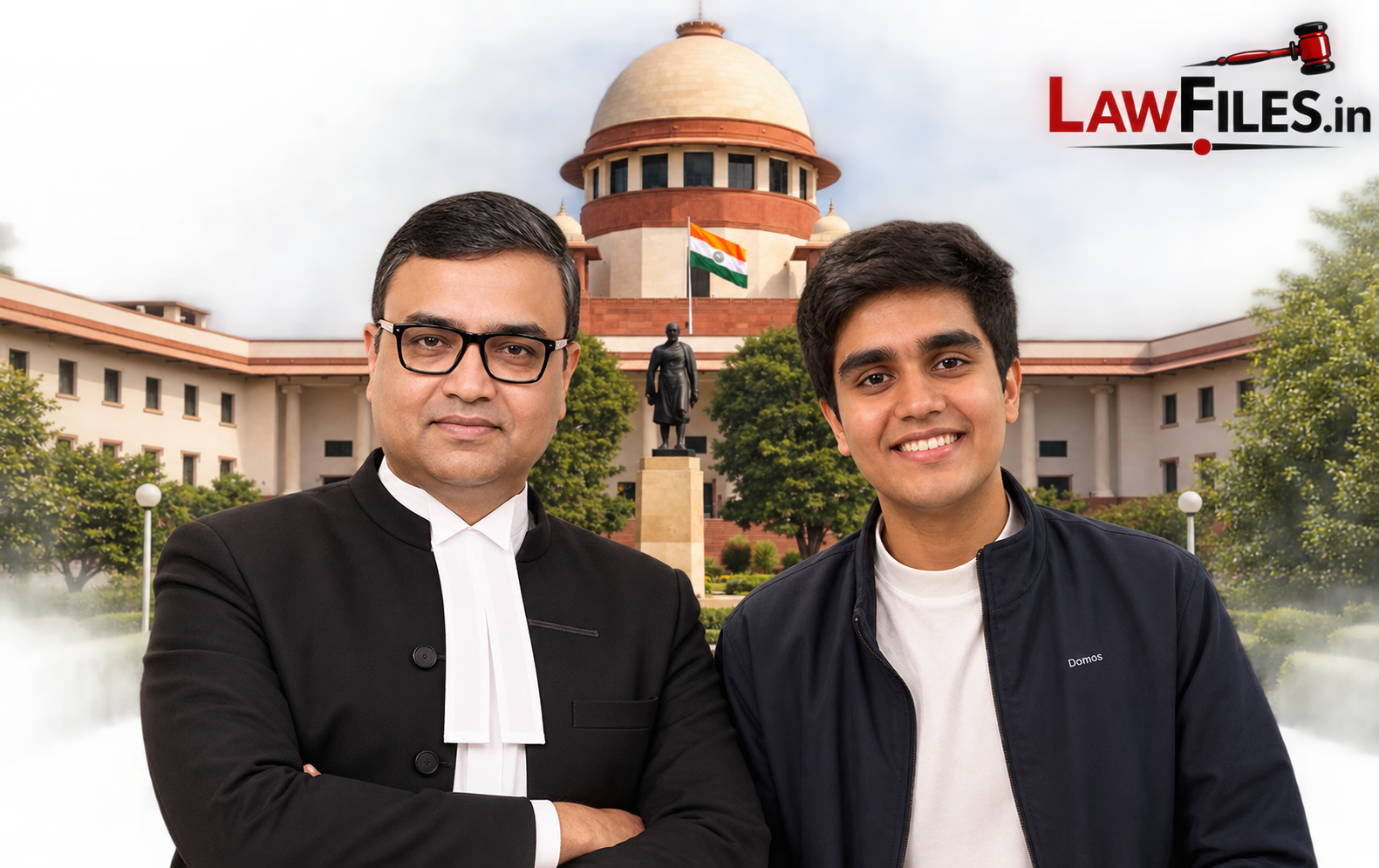
The Supreme Court witnessed an unusual and deeply personal moment on September 29 when Justice Dipankar Datta, while pronouncing a judgment along with Justice Sheel Nagu, began the decision by remembering a young law clerk who had worked in his chambers and died only days before his 27th birthday. Law Clerk-cum-Research Associate Ritwik Deswal had contributed to the preparation of the judgment, and Justice Datta chose to formally acknowledge that contribution by placing the words “in memoriam” at the beginning of the judicial decision.
The tribute, however, acquired a significance beyond the personal grief expressed from the Bench. The judgment in which Deswal’s contribution was acknowledged concerned preventive detention under the National Security Act, 1980, and resulted in the Supreme Court holding the detention illegal, quashing the detention order and directing payment of ₹10 lakh in costs by the State of Uttar Pradesh. The juxtaposition is striking: the final professional work of a young researcher associated with the Court became part of a judgment dealing with one of the Constitution’s most sensitive questions—the circumstances in which the State may deprive an individual of liberty without a criminal conviction.
Justice Datta’s opening remarks were not part of the legal ratio in the conventional sense. They were an acknowledgment of the human labour that exists behind a judgment before it appears as a polished judicial document. The Judge recorded that Deswal had remained engaged with the pursuit of truth and the service of justice even during his final hours and described the young research associate’s integrity, commitment to law and interest in academia. By dedicating the final collaboration to his memory, the Court effectively brought into public view an aspect of judicial work that ordinarily remains invisible—the extensive research, reading, discussion and drafting that precede the pronouncement of a judgment.
The reference to a law clerk is particularly meaningful within the institutional functioning of constitutional courts. Law clerks-cum-research associates are not decision-makers, nor do they participate in the judicial act itself. Their role is fundamentally research-oriented: examining precedents, tracing statutory developments, analysing records and assisting the judge in organising legal questions. Their work is ultimately subject to the independent assessment and responsibility of the judge. Yet complex constitutional litigation frequently involves enormous records and decades of precedent, making high-quality research an important component of the judicial process.
The Court’s acknowledgment therefore also provides a rare public recognition of the intellectual ecosystem supporting judicial decision-making. A judgment bears the name and responsibility of the judge who pronounces it, but the process by which difficult questions are researched and refined is often collaborative. That collaboration does not dilute judicial independence; rather, it allows the judge to test propositions, examine authorities and engage with competing legal positions before arriving at an independent conclusion.
The personal circumstances made the moment particularly poignant. Deswal died four days before his 27th birthday, which fell on the day the judgment was pronounced. Justice Datta said the judgment carried the “quiet and indelible” imprint of the young clerk’s final work. The language used by the Bench was consequently less a ceremonial acknowledgment and more an attempt to preserve, within an institutional document, the memory of someone whose professional contribution ended before his career had meaningfully begun.
The judgment itself concerned Mulla Afroz, who had challenged preventive detention proceedings arising from the November 2024 violence in Sambhal following the court-ordered survey of the Shahi Jama Masjid. The incident had resulted in four deaths and triggered criminal investigations. Afroz was subsequently subjected to preventive detention under the National Security Act. The Allahabad High Court had declined to interfere with the detention order, leading him to approach the Supreme Court.
The Supreme Court’s proceedings had already revealed the central difficulty with the detention order. During the September 8 hearing, the Bench had questioned whether a confession allegedly made by Afroz while in police custody could legitimately constitute the basis of the “subjective satisfaction” required for preventive detention under the National Security Act. The Court reserved judgment after hearing the parties.
That question goes to the conceptual distinction between ordinary criminal prosecution and preventive detention. Criminal law ordinarily proceeds on the basis of proving an offence that has already been committed. Preventive detention operates differently: its statutory justification lies in preventing a person from engaging in specified future conduct considered prejudicial to public order, security or other protected interests. Because the detention is preventive rather than punitive, the executive authority does not have to establish guilt in the manner required at a criminal trial. But that does not mean that the constitutional safeguards surrounding preventive detention disappear.
Article 22 of the Constitution expressly recognises preventive detention while simultaneously placing procedural limitations upon it. Article 22(5) requires that the grounds of detention be communicated to the detainee and that the detainee be afforded the earliest opportunity of making a representation against the order. The National Security Act incorporates corresponding procedural safeguards through provisions dealing with communication of grounds, reference to the Advisory Board and consideration of representations.
The jurisprudence surrounding preventive detention has therefore developed a careful balance. The courts do not ordinarily substitute their assessment of “subjective satisfaction” for that of the detaining authority. But they do examine whether the statutory requirements were complied with, whether relevant material was considered, whether irrelevant considerations entered the decision-making process and whether the detention order suffers from non-application of mind or other constitutional infirmity.
This distinction is particularly important because preventive detention involves a departure from the ordinary criminal justice model. A person may be detained not because a court has convicted him of an offence, but because the competent authority considers preventive intervention necessary. The extraordinary nature of that power makes procedural discipline especially important.
The Supreme Court’s earlier hearing in Afroz’s case illustrated precisely this concern. The Bench questioned whether a confession allegedly made during police custody could legitimately be relied upon for the purpose of forming the subjective satisfaction necessary for preventive detention. The issue was not simply whether the statement existed. The deeper question was whether material that may face serious restrictions in ordinary criminal adjudication could nevertheless be used as a foundational basis for preventive executive detention.
This question has broader implications because preventive detention cannot become an indirect substitute for ordinary criminal prosecution. If the State possesses admissible evidence establishing that a person committed an offence, the ordinary criminal process remains available. Preventive detention is intended to address a distinct preventive necessity. The jurisprudence has consequently cautioned against using preventive detention merely as an additional form of punishment or as a device to circumvent deficiencies in an ordinary criminal case.
The Court’s intervention also needs to be viewed against the constitutional principle that personal liberty under Article 21 remains the starting point even in cases involving serious allegations. The existence of an allegation concerning public disorder does not extinguish the constitutional status of the individual. What changes is the statutory framework through which liberty may be restricted.
The significance of the judgment is therefore not limited to the outcome in Afroz’s case. By quashing the detention and imposing costs, the Supreme Court has reinforced the proposition that executive satisfaction under preventive detention legislation remains subject to constitutional and judicial scrutiny. The extraordinary character of preventive detention does not create an area immune from judicial review.
The imposition of ₹10 lakh in costs is also institutionally noteworthy. A court may quash an illegal detention merely to restore the individual’s liberty, but costs can serve a distinct purpose where the Court considers that governmental action warrants a financial consequence. Such an order communicates that constitutional compliance is not merely a procedural aspiration; violations can carry institutional consequences for the authority responsible.
At the same time, costs in such a case should not be understood as a judicial declaration concerning every aspect of the underlying criminal investigation. The Supreme Court’s conclusion regarding the legality of preventive detention operates within the statutory and constitutional framework governing detention. Criminal allegations arising from the Sambhal violence remain a separate matter governed by the ordinary criminal process.
The judgment consequently illustrates why preventive detention cases require careful separation of three different questions: whether the person is alleged to have committed a crime; whether sufficient material exists to prosecute that allegation through the ordinary criminal process; and whether the statutory conditions for preventive detention have independently been satisfied. Conflating these questions can result in preventive detention becoming punitive in substance even though it remains preventive in legal form.
It is against this legal background that Justice Datta’s tribute to Deswal assumes an additional intellectual dimension. The young law clerk’s final professional contribution was connected with a judgment concerning the protection of liberty from executive detention. The dedication consequently does not merely sit alongside the judgment; it introduces a human reminder of the purpose underlying constitutional adjudication. Behind the abstract language of Articles 21 and 22 is an individual life, and behind every detention order is a person whose freedom is being curtailed.
There is a tendency in legal reporting to treat judgments exclusively through their ratio, precedent and operative directions. Those elements remain central, but the judicial institution is also populated by people—judges, lawyers, clerks, researchers, registry officials and court staff—whose work collectively produces the administration of justice. Justice Datta’s decision to publicly recognise a law clerk’s contribution provides an unusual glimpse into that otherwise largely invisible institutional labour.
For young lawyers and law students, the moment also carries a professional lesson. Judicial clerkships are sometimes regarded merely as stepping stones to litigation, academia or judicial examinations. In reality, the research performed by a law clerk can directly contribute to the intellectual architecture of important judgments. The fact that a Supreme Court Bench chose to record a young research associate’s contribution in the judgment itself demonstrates the professional value that careful legal research can carry, even when the researcher is not visible in the courtroom.
The episode also invites a broader reflection on the relationship between legal scholarship and judicial decision-making. Constitutional adjudication rarely develops from isolated courtroom submissions alone. It depends upon historical research, comparative analysis, precedent mapping and careful examination of statutory language. Law clerks frequently perform much of this preparatory intellectual labour. Their contribution may never be apparent from the final citation to a precedent, yet it can shape the way an issue is presented to the judge.
There is also something institutionally appropriate about memorialising a young legal researcher through a judgment dealing with personal liberty. Judicial writing can outlast the people who participate in its creation. A judgment may be read decades after its authors and researchers have left the courtroom. By placing Deswal’s memory at the beginning of the decision, the Court has allowed his final professional contribution to become part of that enduring institutional record.
Justice Datta’s words also demonstrate that judicial institutions need not become impersonal in order to remain rigorous. The conventional image of judging emphasises restraint, formality and detachment. Those qualities remain essential to adjudication. But recognising grief, acknowledging professional contribution and remembering a colleague do not compromise judicial objectivity. In fact, they can remind the institution of the human consequences underlying legal doctrines.
The present judgment offers an especially compelling illustration of that point because preventive detention is an area where legal abstraction can easily conceal the seriousness of the power being exercised. “Subjective satisfaction”, “public order”, “grounds of detention” and “procedural safeguards” are doctrinal terms, but each ultimately determines whether a human being remains free or confined. Judicial scrutiny gives those concepts practical meaning.
The Supreme Court’s approach therefore reinforces a larger constitutional proposition: executive power is at its strongest when it remains accountable to law. Preventive detention may be constitutionally permissible, but it cannot become constitutionally unreviewable. The State’s power to anticipate threats to public order must coexist with the individual’s right to challenge the legality of the deprivation of liberty.
The judgment’s ₹10 lakh costs order further underlines that constitutional remedies are not merely symbolic. Where the Court finds that preventive detention has crossed the limits imposed by law, the remedy can include not only release but also financial consequences. This strengthens the principle that Article 21 protection must have meaningful institutional enforcement.
Yet perhaps the most lasting aspect of the day’s proceedings was not the operative portion of the order but the unusual opening through which Justice Datta chose to enter the judgment. The phrase “in memoriam” transformed what would ordinarily have been another formal judicial pronouncement into a record of professional memory. Ritwik Deswal’s name will now remain attached to a judgment concerning the limits of preventive detention, not because he was a party to the litigation, but because his final research contribution formed part of the intellectual journey that produced it.
There is an understated symbolism in that. A young researcher whose life ended prematurely contributed to a judgment examining the State’s power to take away liberty. The Court, while recognising that contribution, simultaneously reaffirmed that liberty cannot be curtailed merely through executive assertion; statutory authority and constitutional safeguards remain indispensable.
For the legal community, the episode therefore carries two distinct but connected messages. The first concerns the substance of constitutional law: preventive detention, although expressly contemplated by the Constitution, remains subject to strict procedural and judicial safeguards. The second concerns the profession itself: justice is not produced only through the visible exchanges between Bench and Bar. It is also built through the quieter work of research, reading, drafting and intellectual preparation performed by people who may never themselves occupy the courtroom’s centre.
Justice Datta’s tribute has consequently given an unusually human dimension to a judgment on a deeply technical constitutional subject. It reminds the legal profession that judgments are ultimately human documents—not only because they determine the rights and liberties of human beings, but also because they are produced by people whose own lives, aspirations and contributions form part of the institution of justice.
Ritwik Deswal’s final work has thus found its place where legal research ultimately hopes to find its most meaningful expression: in a judgment that engages with the constitutional protection of liberty. The Court’s tribute preserves his memory, while the judgment itself preserves the more enduring proposition that even the State’s preventive powers must remain answerable to law, reason and the Constitution.
