


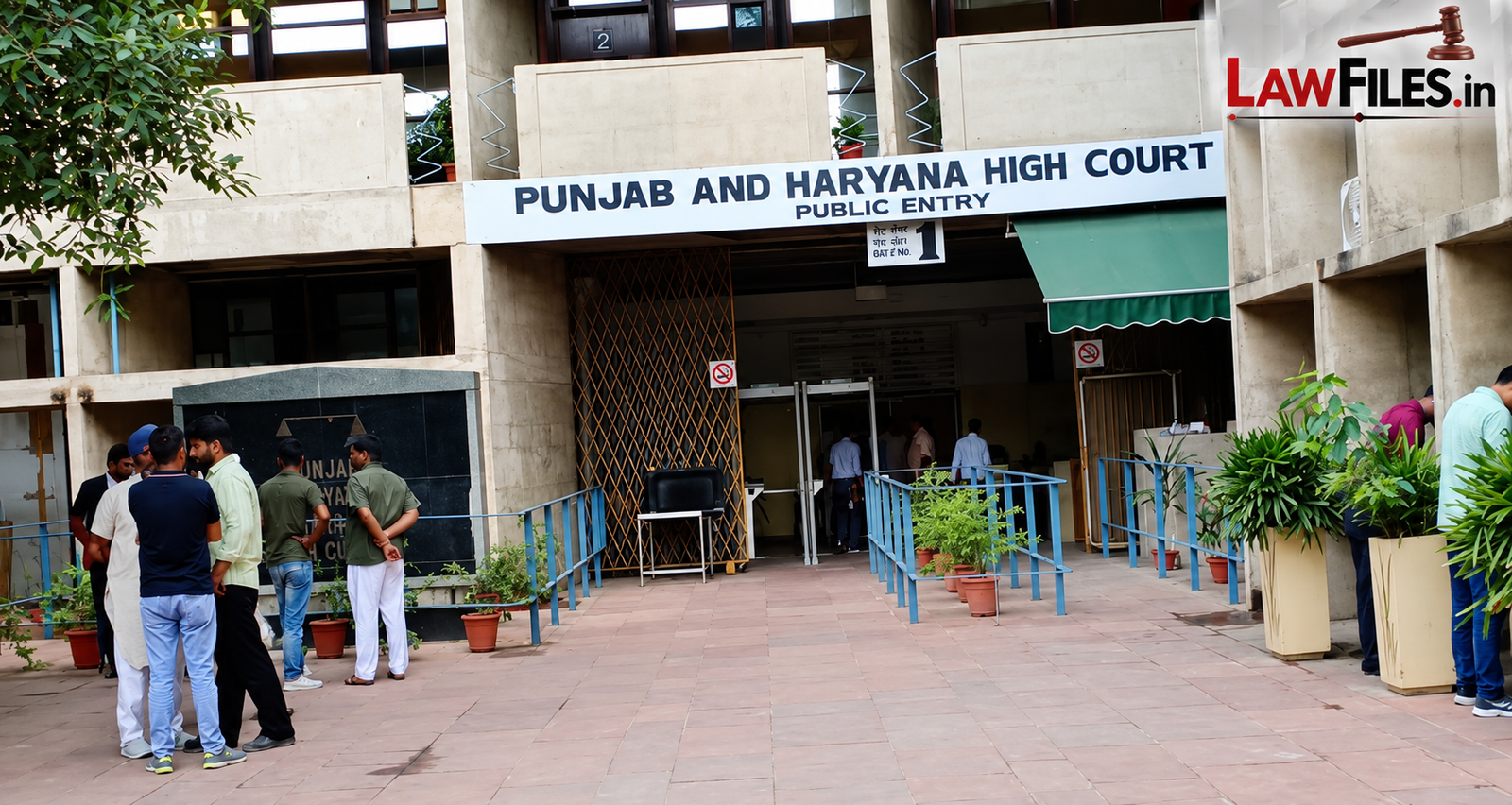
The Punjab and Haryana High Court was called upon to exercise one of the most immediate forms of constitutional judicial protection late on September 23, when the Punjab Government approached the Court alleging that senior government officers had effectively been detained during an ongoing Enforcement Directorate search at the premises of the Greater Mohali Area Development Authority (GMADA). The unusual urgency of the proceedings resulted in a late-night hearing conducted through a WhatsApp video call, with the Court eventually directing the appointment of a Warrant Officer to physically ascertain what was happening at the premises.
Justice Sanjay Vashisht took up the matter at approximately 10:42 p.m. after the State invoked the extraordinary jurisdiction of the High Court through a habeas corpus proceeding. The proceeding was not an ordinary challenge to an investigation, summons or search warrant. The immediate concern placed before the Court was substantially narrower and constitutionally more serious: whether persons who were not shown to be formally arrested could nevertheless be kept within investigative premises in circumstances amounting to unlawful restraint. The distinction between a lawful investigative presence and physical confinement was therefore at the heart of the emergency hearing.
The Punjab Government alleged that IAS officers Vikas Garg and Sandeep Reshi, along with other senior GMADA officials, had not been permitted to leave the premises since September 22 while the ED’s search and seizure operation continued. The State’s case, as reported from the proceedings, was that the investigation had effectively immobilised senior officers and that the situation had consequences beyond the individual liberty of those officials because the functioning of the State machinery was allegedly being affected. The ED’s investigation was stated to concern a money-laundering probe connected with activities surrounding GMADA.
The Court’s response is significant precisely because it did not, at this stage, determine the truth of the competing allegations. Instead of treating the State’s assertion as established fact or accepting the investigating agency’s position without verification, the Court created an immediate mechanism for factual verification. It directed the Registry to appoint a Warrant Officer who could visit the GMADA premises and the office of Vikas Garg, the Principal Secretary in the Department of Housing and Urban Development, and examine the situation on the ground. A report was directed to be submitted by 2 p.m. on September 24.
That approach goes to the very nature of habeas corpus jurisdiction. The writ is historically concerned with the legality of detention, but its constitutional significance in India is considerably broader. Article 226 empowers High Courts to issue writs not only for enforcement of fundamental rights but “for any other purpose” as well. Habeas corpus consequently functions as an urgent judicial mechanism through which the Court can require the State or another authority exercising coercive power to justify the restraint of an individual’s liberty.
The expression “detention”, however, cannot be reduced to a formal arrest memo. A person may be technically described as free while circumstances surrounding him make departure practically impossible. Whether such circumstances amount to detention is necessarily a question of fact and degree. The Court’s decision to send a Warrant Officer to the premises rather than decide the factual controversy solely on oral submissions therefore assumes considerable procedural importance. It allows the constitutional court to verify the factual foundation before deciding what legal consequences, if any, should follow.
The distinction is especially relevant in the context of the Enforcement Directorate. The Directorate possesses extensive statutory powers under the Prevention of Money Laundering Act, 2002, including powers relating to search, seizure, summons and arrest in circumstances prescribed by the statute. Those powers are not constitutionally unbounded. The exercise of investigative authority remains subject to the requirements of legality, procedural safeguards and the fundamental rights guaranteed by Part III of the Constitution.
A search of premises does not, by itself, create an unrestricted power to confine every person who happens to be present there. Likewise, the fact that officers may be required to remain available for questioning does not automatically answer the separate question whether their physical movement can lawfully be restricted for an extended period. That distinction becomes even more important where the persons concerned are government officials performing public functions.
The legal architecture surrounding arrest under the PMLA must therefore be distinguished from the broader investigative power to search premises. If the agency formally arrests an individual, the constitutional and statutory safeguards governing arrest become directly applicable. Article 22 requires that an arrested person be informed of the grounds of arrest and produced before a magistrate within the constitutionally prescribed period, subject to the statutory framework. Article 21, after the development of Indian due-process jurisprudence, demands that any deprivation of personal liberty must be authorised by law and satisfy standards of fairness and reasonableness.
The Supreme Court’s jurisprudence has repeatedly emphasised that the power to investigate does not become a licence for arbitrary deprivation of liberty. In Maneka Gandhi v. Union of India, the Court transformed Article 21 from a narrow procedural guarantee into a substantive constitutional protection against arbitrary State action. Later decisions concerning arrest, custodial interrogation and personal liberty have continued to insist that statutory power must be exercised within constitutional limits.
At the same time, the legal position cannot be framed as though every prolonged search amounts to illegal detention. Investigating agencies are entitled to conduct searches, examine records, secure electronic devices and question persons connected with an investigation within the authority conferred by law. The fact that a search continues for several hours, or even across more than one day, does not by itself establish unlawful confinement. The crucial legal question is what was actually happening to the individuals concerned and under what statutory authority.
This is precisely why the Warrant Officer’s role assumes significance. The High Court did not substitute an immediate judicial conclusion for evidence. It ordered an independent factual inspection of the premises. Such a mechanism is particularly appropriate in habeas corpus proceedings because the central constitutional question may sometimes turn upon facts that cannot be satisfactorily resolved from pleadings filed after the event.
The Court also paid particular attention to the position of female officials. It directed that if any female official was found to be confined at the premises, appropriate arrangements should be made either for her adjustment at a place convenient to her or for her release after recording her statement, wherever considered appropriate. The direction was accompanied by instructions concerning food and other basic arrangements during the presence of the Warrant Officer.
These directions are constitutionally significant because personal liberty does not become less valuable merely because the individual is caught within an investigative operation. Nor does the identity of the person—whether a private citizen, government employee or senior bureaucrat—alter the basic constitutional proposition that restraint must have a legal foundation. At the same time, the constitutional court must be careful not to transform protective jurisdiction into an instrument for obstructing a lawful investigation.
The reported proceedings also acquire context from the wider money-laundering investigation surrounding alleged irregularities in land-use permissions and related governmental processes in Punjab. Earlier proceedings before the High Court had seen the ED place allegations concerning an alleged network involving private intermediaries and government-related contacts. The agency had previously filed extensive material, including WhatsApp communications, and sought registration of criminal cases by the Punjab Police. Those allegations have been disputed by persons named in the investigation and remain matters for investigation and adjudication rather than established findings of guilt.
The broader background is important because it demonstrates why the Court had to maintain a careful institutional balance. On one side lies the statutory obligation of an investigating agency to pursue suspected proceeds of crime and associated offences. On the other stands the constitutional obligation of the judiciary to ensure that investigative power does not become indistinguishable from coercive detention without legal sanction. Neither proposition cancels the other.
The case consequently raises a subtle question concerning the constitutional relationship between investigation and administration. The State’s counsel reportedly argued that the alleged confinement of senior officials was affecting the functioning of government itself. If established, such a circumstance could make the controversy institutionally wider than an ordinary individual habeas corpus petition. Government departments cannot be rendered incapable of functioning merely because investigative agencies are conducting lawful searches. Equally, the administrative status of an officer cannot confer immunity from a lawful investigation.
The correct constitutional approach therefore lies neither in treating senior bureaucrats as beyond investigation nor in assuming that an investigating agency may exercise unlimited control over them because it is investigating a serious offence. The operative principle must remain legality: what power was being exercised, against whom, for what purpose, for how long, and under which statutory provision?
The High Court’s decision to issue notice to the ED, returnable on September 24, reinforces this restrained approach. The Court was not, at the late-night stage, adjudicating upon the merits of the money-laundering investigation. Nor was it determining whether the officers were witnesses, suspects or persons against whom coercive measures were legally available. The immediate judicial intervention was directed towards securing factual clarity concerning the alleged deprivation of liberty.
There is another important institutional feature in the proceedings: the Court was prepared to sit outside conventional working hours when an allegation concerning immediate personal liberty was placed before it. The WhatsApp video hearing, facilitated through a mobile phone belonging to a Senior Assistant of the Court, illustrates how constitutional courts can employ technological means where delay itself may defeat the purpose of the remedy. The fact that the proceedings continued into the night and the Warrant Officer subsequently visited the premises demonstrates that judicial protection of liberty cannot always be confined to the ordinary court calendar.
The episode also illustrates the difference between judicial intervention and judicial interference. A constitutional court intervening to ascertain whether a person is unlawfully confined does not necessarily interfere with investigation. Indeed, properly understood, judicial supervision can strengthen the legitimacy of an investigation by ensuring that its coercive dimensions remain within the law. An agency acting within its statutory authority should ordinarily have little difficulty demonstrating that authority when its exercise is questioned.
Conversely, the existence of a money-laundering investigation cannot itself answer a habeas corpus allegation. The seriousness of the underlying offence and the legality of the immediate restraint are separate legal questions. A serious investigation may justify serious investigative measures, but every such measure must still trace its authority to law.
This distinction is particularly important under the PMLA because the legislation has repeatedly been subjected to constitutional scrutiny owing to the breadth of its investigative powers. The Supreme Court’s decision in Vijay Madanlal Choudhary v. Union of India upheld substantial portions of the statutory framework while recognising the importance of safeguards embedded in the statute and constitutional review. Subsequent judgments have continued to clarify arrest, disclosure of grounds and procedural protections under the PMLA. The present controversy adds another practical dimension: the line between questioning a person and effectively preventing that person from leaving.
The constitutional principle can therefore be stated simply, even though its application to facts may be difficult: investigative necessity must be translated into legally authorised action. If an individual must remain available for questioning, the investigating agency must identify the statutory basis for requiring that presence. If an arrest is necessary, the law prescribes the consequences and safeguards. If neither exists, informal restraint cannot become a substitute for formal legal authority.
The use of a Warrant Officer is also a reminder that habeas corpus is not merely a remedy that operates after unlawful detention has already been conclusively established. Its preventive dimension can be equally important. Where credible information suggests that liberty is presently being restricted, the constitutional court may need to act quickly enough to ensure that the alleged detention does not become irreversible before the matter reaches judicial scrutiny.
At the same time, constitutional courts have historically exercised restraint where habeas corpus is invoked in circumstances where lawful investigation or criminal proceedings are already underway. The writ is not ordinarily intended to provide an alternative forum for deciding disputed questions concerning the merits of a criminal case. Its immediate concern is the legality of custody or restraint. The High Court’s present approach—verification first, adjudication thereafter fits within that institutional limitation.
The episode thus presents an interesting example of constitutional adjudication operating in real time. The Court was not confronted with a completed record from which it could calmly determine whether an officer had been unlawfully detained. It was confronted with competing assertions during an ongoing operation. Instead of choosing one narrative, it created a mechanism for obtaining independent facts. That is arguably the most important legal lesson emerging from the late-night proceedings.
There is also a larger constitutional principle at stake concerning the relationship between different organs of government. Investigating agencies are part of the executive framework and require operational autonomy to investigate offences. State governments, meanwhile, cannot claim that their officials are immune from federal investigation merely because they hold public office. But neither central investigative authority nor State administrative authority exists outside constitutional control. The High Court, in such circumstances, performs its traditional constitutional function as an institutional check on the legality of coercive State action.
The developments surrounding the GMADA search should therefore not be reduced to a political contest between the Punjab Government and the Enforcement Directorate. The more enduring legal issue is whether Indian constitutional governance can maintain both effective investigation and meaningful protection of personal liberty at the same time. The answer cannot lie in weakening either principle. It must lie in ensuring that every exercise of coercive power remains traceable to statute, procedurally fair and capable of immediate judicial scrutiny.
The High Court’s late-night intervention is consequently significant not because it has, at this stage, declared the ED’s conduct unlawful, but because it has demonstrated the constitutional court’s willingness to verify an allegation of restraint while an investigative operation is still underway. The forthcoming status report of the Warrant Officer is therefore likely to be central to determining what actually occurred at the GMADA premises and whether the circumstances complained of amounted to detention in the legal sense. Until those facts are judicially established, allegations of unlawful confinement and allegations of investigative necessity must remain precisely that—competing assertions requiring adjudication.
The deeper constitutional message is perhaps found in the unusual timing of the hearing itself. Personal liberty is not a right that becomes operational only during court hours. Habeas corpus exists because, in matters of physical freedom, a remedy delayed can become a remedy diminished. The High Court’s decision to convene at night and send an officer to the premises reflects that foundational idea: where the legality of restraint is placed before a constitutional court with sufficient urgency, judicial scrutiny must be capable of responding with equal urgency.
At the same time, the incident reinforces an equally important proposition for investigative governance. Strong investigative powers derive their legitimacy not from their ability to overpower institutional resistance but from their disciplined exercise within the limits prescribed by law. A lawful search, lawful summons and lawful arrest are powerful tools; none requires the law to be placed in the background. The ultimate test for both the investigator and the constitutional court remains the same whether the exercise of power can withstand scrutiny under the Constitution and the governing statute.
The Punjab and Haryana High Court’s intervention therefore represents a constitutional balancing exercise in its most immediate form. It does not determine the guilt or innocence of anyone connected with the underlying money-laundering investigation, nor does it decide the merits of the allegations concerning GMADA. Its immediate concern is more foundational: when the State alleges that another arm of the State has physically restricted the liberty of public officials, the constitutional court must be able to ask, at any hour, a simple but indispensable question under what authority has that liberty been curtailed?
