


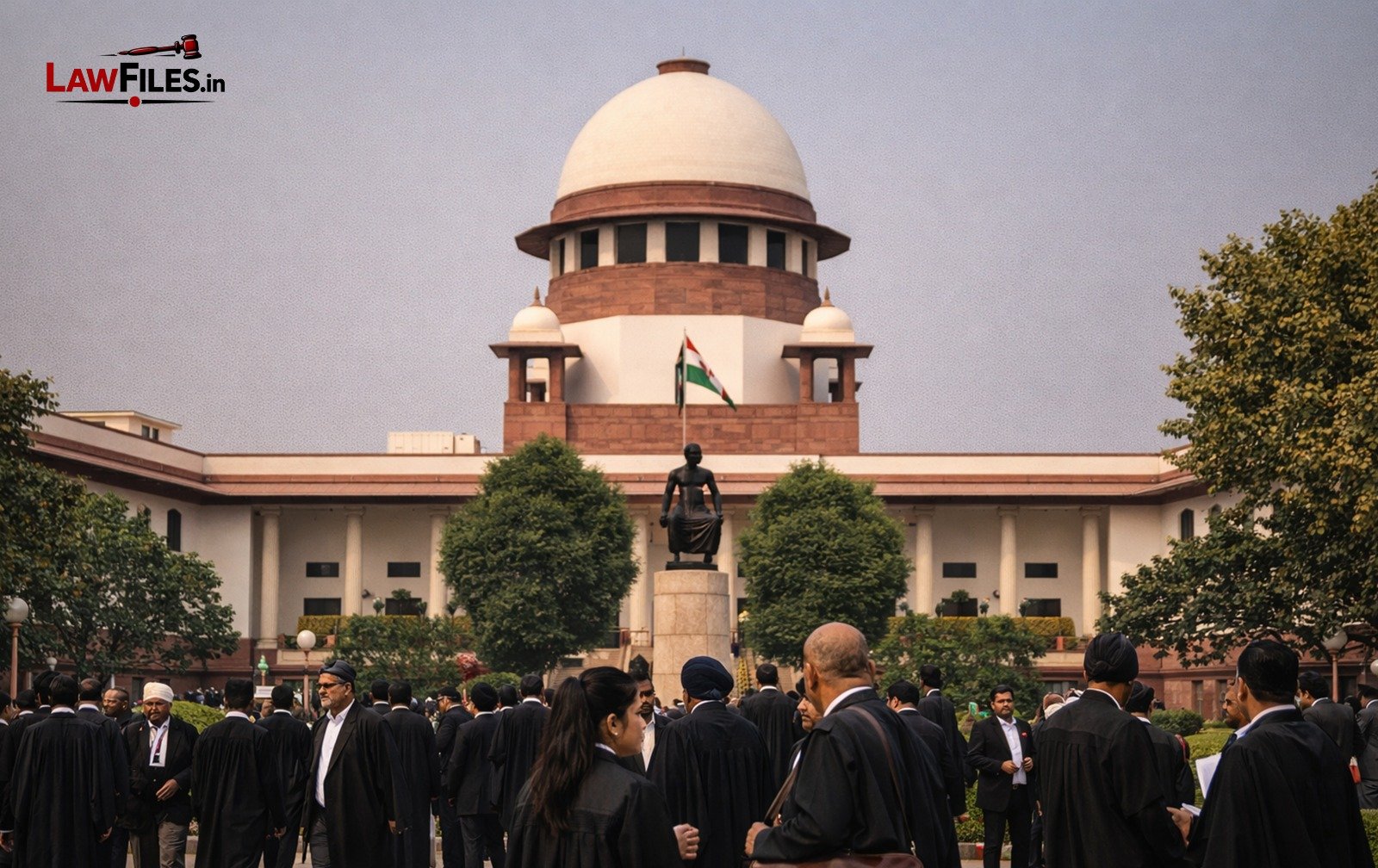
The Supreme Court has acquitted former Railway Protection Force officer Bharat Raj Meena in corruption proceedings arising from allegations that subordinate personnel collected illegal gratification on his behalf, holding that the mere fact that money changed hands between a complainant and an intermediary who invoked the name of a public servant cannot, without more, establish that the public servant accepted or obtained a bribe. A Bench of Justices Dipankar Datta and Nongmeikapam Kotiswar Singh emphasised that in a prosecution under the Prevention of Corruption Act, the evidentiary chain cannot stop at the intermediary. The prosecution must reliably connect the alleged demand and payment to the accused public servant and establish, beyond reasonable doubt, that the gratification was accepted, obtained or intended for the accused.
The judgment in Bharat Raj Meena v. Central Bureau of Investigation, 2026 INSC 999, is important because it deals with a recurring difficulty in corruption prosecutions: public servants accused of receiving bribes do not always receive money personally. Payments may allegedly be routed through subordinates, personal staff, agents or other intermediaries. In such cases, the prosecution necessarily relies upon circumstantial evidence to connect the intermediary’s conduct with the public servant. The Supreme Court has not held that such an arrangement can never establish guilt. What it has insisted upon is that the evidentiary bridge between the intermediary and the accused must actually be built through reliable evidence; the mere existence of the bridge in the prosecution narrative is not enough.
The case arose from an investigation conducted by the Central Bureau of Investigation pursuant to an FIR registered in August 2005. At the relevant time, Meena was serving as Divisional Security Commissioner of the Railway Protection Force at Palakkad. The prosecution alleged that personnel seeking favourable transfers, postings and other service-related benefits were required to pay illegal gratification and that Meena allegedly used subordinate RPF personnel as intermediaries for collecting the money. Two such intermediaries, Constable Anantha Narayanan and Head Constable Abdul Gafoor, subsequently became important prosecution witnesses after being granted pardon under Section 306 of the Code of Criminal Procedure.
The investigation eventually attributed around a dozen alleged transactions to this arrangement, involving payments ranging from approximately ₹5,000 to ₹13,000. According to the prosecution, the money was collected from RPF personnel seeking transfers or postings and was ultimately meant for Meena. Several separate prosecutions followed from the common investigation. The Supreme Court was concerned with two of those prosecutions, arising from Criminal Appeal Nos. 4732 and 4733 of 2024.
The first case was triggered by the complaint of P.P. Nandakumar, an RPF employee who allegedly sought a posting at Palakkad. According to the prosecution, ₹10,000 was demanded and the demand was conveyed through Anantha Narayanan. A CBI trap was arranged on August 4, 2005. The crucial event, however, was that the trap did not catch Meena accepting money. Instead, Anantha Narayanan was apprehended while receiving ₹5,000 from Nandakumar. The prosecution treated this receipt as acceptance on behalf of Meena.
The Supreme Court found that the distinction between those two facts was decisive. There was evidence, at least according to the prosecution case, that money had been handed over to the intermediary. But criminal liability against Meena required another proposition to be established: that the intermediary was acting under Meena’s authority, direction or for his benefit and that the money received was in fact intended for, or would ultimately reach, Meena. The Court found that the evidence did not establish that proposition with the degree of certainty required in a criminal prosecution.
This is where the judgment’s treatment of intermediary liability becomes particularly significant. In ordinary commercial transactions, an agent’s receipt may readily be attributed to the principal where agency is established. A corruption prosecution, however, cannot simply assume agency because the prosecution alleges it. The prosecution must prove the relevant relationship through admissible and reliable evidence. Where a person independently collects money while invoking the name of a public servant, the fact that the public servant’s name was used does not automatically establish that the public servant authorised the collection or knew of it.
The Court expressly held that before criminal liability can be fastened upon the public servant, the prosecution must establish by reliable evidence that the intermediary acted under the accused’s authority, direction or for his benefit and that the alleged demand itself was attributable to the accused. Merely showing that a third person received money cannot automatically result in the public servant being treated as the recipient.
The distinction may appear elementary, but it carries considerable practical importance in corruption trials. Public servants often operate within hierarchical institutions where subordinates interact with citizens on matters involving transfers, postings, licences, approvals and administrative benefits. If every payment made to a subordinate after the subordinate invokes the name of a superior were treated as proof of the superior’s acceptance, the evidentiary threshold for criminal conviction would effectively be lowered from proof to association.
The Supreme Court refused to make that leap.
The Court’s reasoning was also influenced by the peculiar circumstances surrounding the trap. Nandakumar had allegedly informed the CBI about the demand on August 3, and the trap was organised the following day. The Court noticed that the formal FIR was registered on the day of the trap and that the trap operation was arranged within a very short period. While the Court did not hold that a rapidly organised trap is inherently defective, it considered the surrounding circumstances relevant while evaluating whether the prosecution’s version had been proved beyond reasonable doubt.
More importantly, the evidence concerning the actual handover contained gaps. The prosecution alleged that Anantha Narayanan was acting for Meena, but the money recovered during the trap was from the intermediary rather than from Meena. No comparable recovery from Meena connected him physically with the currency. The Court therefore refused to treat the intermediary’s possession as an automatic substitute for proof of the appellant’s acceptance or obtainment.
The Court drew heavily upon its earlier decision in R.P.S. Yadav v. CBI, where it had examined a similar situation involving alleged payment through an intermediary. The principle emerging from that decision is that the prosecution must establish the sequence of demand, acceptance and recovery in a manner traceable to the accused. If the evidence becomes uncertain after the money reaches the intermediary, the missing portion cannot simply be supplied by conjecture.
The phrase “chain of evidence” is particularly appropriate in corruption cases. A prosecution under the Prevention of Corruption Act is not proved merely because three isolated facts are individually suspicious. The facts must connect. A demand must be linked to the accused; the payment must correspond to that demand; the acceptance or obtainment must be attributable to the accused; and where an intermediary is involved, there must be reliable evidence explaining the intermediary’s role and connecting the money to the public servant.
The Supreme Court’s approach also fits within its recent insistence that proof of demand cannot be replaced by recovery alone. In State of Lokayuktha Police, Davanagere v. C.B. Nagaraj, the Court had reiterated that recovery of tainted money does not automatically establish the offence when the prosecution fails to prove the demand that preceded it. The Court has similarly stressed that the presumption under Section 20 of the Prevention of Corruption Act does not arise merely because currency is recovered; the prosecution must first establish the foundational facts required to invoke the presumption.
The present judgment adds another layer to that principle. Even where the prosecution proves a demand and a payment to an intermediary, it must still establish the accused’s acceptance or obtainment. Section 20 cannot be used to fill that evidentiary gap.
This is an important point because Section 20 creates a statutory presumption in favour of the prosecution once its foundational requirements are satisfied. But a presumption is not a substitute for proof of the foundational fact. The Court made clear that the prosecution cannot invoke Section 20 by starting with the conclusion that the public servant must have accepted the money and then using the presumption to prove that very acceptance.
The structure is therefore sequential. First, the prosecution must establish the foundational fact that the accused accepted or obtained gratification. Only after the statutory threshold is crossed can the presumption operate in the manner contemplated by the legislation. In Meena’s case, the Court concluded that the prosecution had not crossed that threshold.
The second transaction considered by the Supreme Court involved N.P. Gopi Kumar. This case presented a somewhat different factual situation because the prosecution alleged a direct interaction involving Meena and the intermediary Abdul Gafoor. Gopi Kumar claimed that he had been summoned to Meena’s residence and that ₹3,000 was accepted through Abdul Gafoor. The Kerala High Court had ultimately upheld the conviction relating to this transaction.
Yet even here, the Supreme Court found the evidence insufficient to sustain the conviction. The Court scrutinised what exactly was said during the interaction, the circumstances surrounding the alleged payment and whether the evidence sufficiently established that the money received by the intermediary was actually accepted for Meena. The Court found lingering reasonable doubt and held that the prosecution had not proved the charge with the definitiveness required for a criminal conviction.
This part of the judgment is significant because the Court did not formulate a rule that an intermediary can never be relied upon to establish acceptance. Such a rule would be unrealistic and would potentially make sophisticated corruption arrangements almost impossible to prosecute. The Court instead adopted an evidence-sensitive approach: an intermediary can provide the connecting evidence, but that evidence must be credible, corroborated where necessary and sufficiently persuasive to establish the accused’s involvement.
The Court paid particular attention to the fact that Anantha Narayanan and Abdul Gafoor had themselves initially been accused and were subsequently granted pardon under Section 306 CrPC. Their evidence was therefore that of approvers. Under Section 133 of the Indian Evidence Act, an accomplice is a competent witness and a conviction is not legally impermissible merely because it rests upon accomplice evidence. However, Illustration (b) to Section 114 embodies the well-established rule of prudence that an accomplice’s testimony ordinarily requires corroboration in material particulars.
The Supreme Court’s treatment of the approver evidence is a useful reminder that competency and credibility are separate questions. The fact that the law permits an accomplice to testify does not mean that every statement made by an accomplice must be accepted. Courts must examine the circumstances in which the witness became an approver, the extent of his own involvement, whether his testimony is internally consistent and whether independent evidence supports the material portions of his account.
This is particularly important where the approver’s testimony is the principal mechanism through which the prosecution seeks to connect a public servant with money that was never recovered from the public servant. In such circumstances, corroboration is not merely a technical preference. It can be the evidentiary link that distinguishes a proved agency relationship from a speculative inference.
The Court’s reasoning also highlights a fundamental difference between administrative influence and criminal acceptance of illegal gratification. The prosecution had sought to establish that Meena had practical influence over transfers and postings. Evidence was relied upon to suggest that he had recommended certain postings and that his position could affect the personnel concerned. But even if a public servant possesses the ability to influence an administrative decision, that fact alone does not establish that he demanded or accepted money in exchange for exercising that influence.
The criminal law requires a more precise connection.
A public servant may have considerable administrative authority and may nevertheless be innocent of a particular bribery allegation. Conversely, a public servant may use an intermediary precisely because direct receipt would expose the transaction. The challenge for a court is therefore to distinguish legitimate inference from impermissible speculation. The former is permissible circumstantial reasoning; the latter cannot sustain a conviction.
The Supreme Court’s formulation is especially important in this context: the prosecution established, at its highest, that money changed hands between the complainant and an intermediary who invoked the appellant’s name. That circumstance was insufficient, by itself, to prove that Meena accepted the bribe.
The judgment therefore does not weaken the Prevention of Corruption Act. Rather, it reinforces the requirement that anti-corruption prosecutions must be evidence-driven. A strong anti-corruption statute does not mean that ordinary criminal-law safeguards disappear. Public servants accused of corruption remain entitled to the presumption of innocence until guilt is established according to law.
This distinction matters because corruption cases frequently generate strong moral reactions. The very allegation of bribery can damage institutional reputation and public confidence. Courts, however, cannot permit the seriousness of the alleged offence to alter the standard of proof. The more serious the allegation, the greater the need for disciplined examination of the evidence rather than a relaxation of evidentiary requirements.
The judgment also illustrates why the Supreme Court repeatedly distinguishes “suspicion” from “proof”. Circumstantial evidence can unquestionably establish a corruption offence. Direct evidence of a public servant physically receiving money is not always necessary. But the circumstances must form a coherent and reliable chain pointing towards guilt and excluding reasonable alternative explanations.
The present case, in the Court’s assessment, did not satisfy that standard.
The prosecution’s theory was that Meena operated through intermediaries. That theory was possible. But criminal conviction requires more than demonstrating that a theory is possible or even plausible. The prosecution must demonstrate that the accused’s guilt is established beyond reasonable doubt. Where two competing inferences remain reasonably possible and the evidence does not decisively connect the money to the accused, the criminal law requires the benefit of doubt to operate in favour of the accused.
This principle is not unique to corruption law. It is an expression of the foundational criminal-law rule that the prosecution bears the burden of establishing guilt. Section 20 of the Prevention of Corruption Act modifies the evidentiary landscape only within the limits prescribed by the statute; it does not reverse the entire burden of proof from the beginning of the prosecution.
The Court’s approach also has implications for the design of future trap operations. A trap in which an intermediary is apprehended may be valuable evidence, but investigators must consider whether the operation can also establish the intermediary’s connection with the accused. Where circumstances permit, investigators may need to collect contemporaneous communications, instructions, meeting records, surveillance evidence, call records, recovery evidence or other material that demonstrates the intermediary’s agency and the accused’s knowledge or direction.
This is particularly relevant in modern corruption investigations. Digital communications can potentially provide a stronger evidentiary bridge than oral allegations alone. A message directing an intermediary to collect money, a recorded conversation establishing the demand, a communication confirming receipt, or other independent evidence may substantially strengthen the prosecution case. The judgment does not require direct physical recovery from the public servant in every case; it requires reliable evidence connecting the accused to the transaction.
That distinction should not be overlooked.
The Court expressly recognised that circumstantial evidence may, in principle, establish acceptance. What it rejected was an inference that crossed from reasonable circumstantial reasoning into speculation. The evidentiary gap in Meena’s case could not be closed merely by assuming that because the intermediary invoked his name and accepted money, the money must necessarily have been intended for him.
The ruling also has significance for the use of Section 306 CrPC approvers in corruption investigations. Turning an intermediary from accused into approver can provide the prosecution with valuable insider testimony. But it simultaneously creates a need for careful corroboration because the witness may have an incentive to minimise his own role or secure the benefit of pardon. The judgment therefore reinforces the importance of independently testing approver evidence rather than treating it as inherently conclusive.
The Court did not find it necessary to finally determine every challenge raised by Meena, including the broader challenge to the sanction for prosecution. Nor did it examine the appellant’s allegation of a conspiracy against him, noting that its conclusions on the evidence made such examination unnecessary. The acquittal therefore rests principally upon the failure of the prosecution to establish the relevant charges beyond reasonable doubt.
The decision consequently should not be read as a finding that the underlying allegations were necessarily fabricated. The Court’s conclusion is narrower and more fundamental: whatever suspicion may have surrounded the transactions, the evidence placed before the Court did not establish Meena’s guilt to the required criminal standard. This distinction is essential to understanding an acquittal in a criminal case.
The judgment also fits into a developing line of Supreme Court decisions insisting that corruption prosecutions must establish the essential elements of the offence rather than rely upon recovery or surrounding circumstances alone. Recent decisions have repeatedly stressed the significance of demand, acceptance and the evidentiary foundation necessary before statutory presumptions can operate.
From the perspective of public administration, the ruling presents a difficult but necessary balance. Corruption involving intermediaries is inherently difficult to investigate because the intermediary may deliberately create distance between the public servant and the bribe transaction. A legal standard that demanded direct physical receipt in every case would potentially make indirect corruption practically immune from prosecution. But the opposite extreme—treating any payment to a person who mentions a public servant’s name as proof against that public servant—would create an equally serious risk of wrongful conviction.
The Court’s answer lies between these extremes: prove the agency, prove the demand, prove the connection, and prove the acceptance or obtainment through evidence capable of satisfying the criminal standard.
This is also why the judgment is not merely about the technical meaning of “acceptance”. It is about attribution. When one person receives money and another person is accused of benefiting from it, the prosecution must establish why the receipt should legally be attributed to the accused. Attribution may arise from direct instructions, communications, conduct, corroborating witnesses, recovery, subsequent conduct or a combination of circumstances. But attribution must be demonstrated rather than presumed.
The principle has wider relevance in corruption law because modern bribery arrangements may involve several layers. Money may pass through a subordinate, consultant, intermediary, relative or private facilitator. The farther the money travels from the accused, the greater the need for reliable evidence explaining the relationship between the recipient and the alleged beneficiary. Criminal liability cannot be imposed merely because the accused occupied a position from which the desired official favour could theoretically have been obtained.
The judgment therefore reinforces a valuable distinction between capacity to commit an act and proof that the act was committed. A public servant’s position may establish that he could have influenced a transfer or posting. It does not establish that he demanded money to exercise that influence.
Similarly, the fact that an intermediary had access to the public servant may establish opportunity. It does not necessarily establish authorisation.
And the fact that money was handed over after the intermediary invoked the public servant’s name may establish a suspicious transaction. It does not, without further evidence, establish acceptance by the public servant.
These distinctions are the essence of criminal adjudication.
The Supreme Court’s final order consequently allowed both appeals, set aside the convictions arising from the two cases and acquitted Meena of the charges. His bail bonds were discharged and any fine deposited was directed to be refunded.
The larger lesson from Bharat Raj Meena is therefore not that intermediary-based bribery is incapable of proof. It is that intermediary-based bribery requires a carefully constructed evidentiary chain. The law recognises that corruption may be concealed through indirect channels, but concealment cannot become a reason for lowering the threshold of criminal proof.
For investigating agencies, the judgment underscores the importance of corroborating the intermediary’s account with independent evidence. For prosecutors, it highlights the need to establish the foundational facts before relying upon statutory presumptions. For trial courts, it reinforces the necessity of separating proved facts from plausible inferences. And for public servants facing prosecution, it reaffirms that criminal liability cannot be imposed merely because another person claimed to be acting on their behalf.
Ultimately, the Supreme Court has preserved a central principle of the Prevention of Corruption Act jurisprudence: the fight against corruption must remain a fight conducted through law and evidence. The seriousness of bribery as a public wrong cannot justify replacing proof with presumption. A public servant may be convicted where an intermediary’s conduct is convincingly connected to the public servant’s demand and acceptance. But where the chain breaks at the intermediary, the court cannot supply the missing link through conjecture.
The judgment thus places evidentiary discipline at the heart of anti-corruption adjudication. The law must be sufficiently strong to reach sophisticated forms of indirect bribery, but sufficiently principled to ensure that a person’s liberty is not taken away merely because money changed hands in circumstances that generate suspicion. In Bharat Raj Meena, the Supreme Court found that the prosecution had proved the transaction only up to the intermediary and had not carried the evidence to the point of establishing Meena’s acceptance or obtainment. That evidentiary gap, the Court held, was fatal.
The enduring proposition from the ruling is therefore clear: a bribe cannot become the public servant’s bribe merely because an intermediary received the money in his name. The prosecution must prove the connection, and where that connection remains a matter of inference rather than evidence, the criminal law requires acquittal.
