


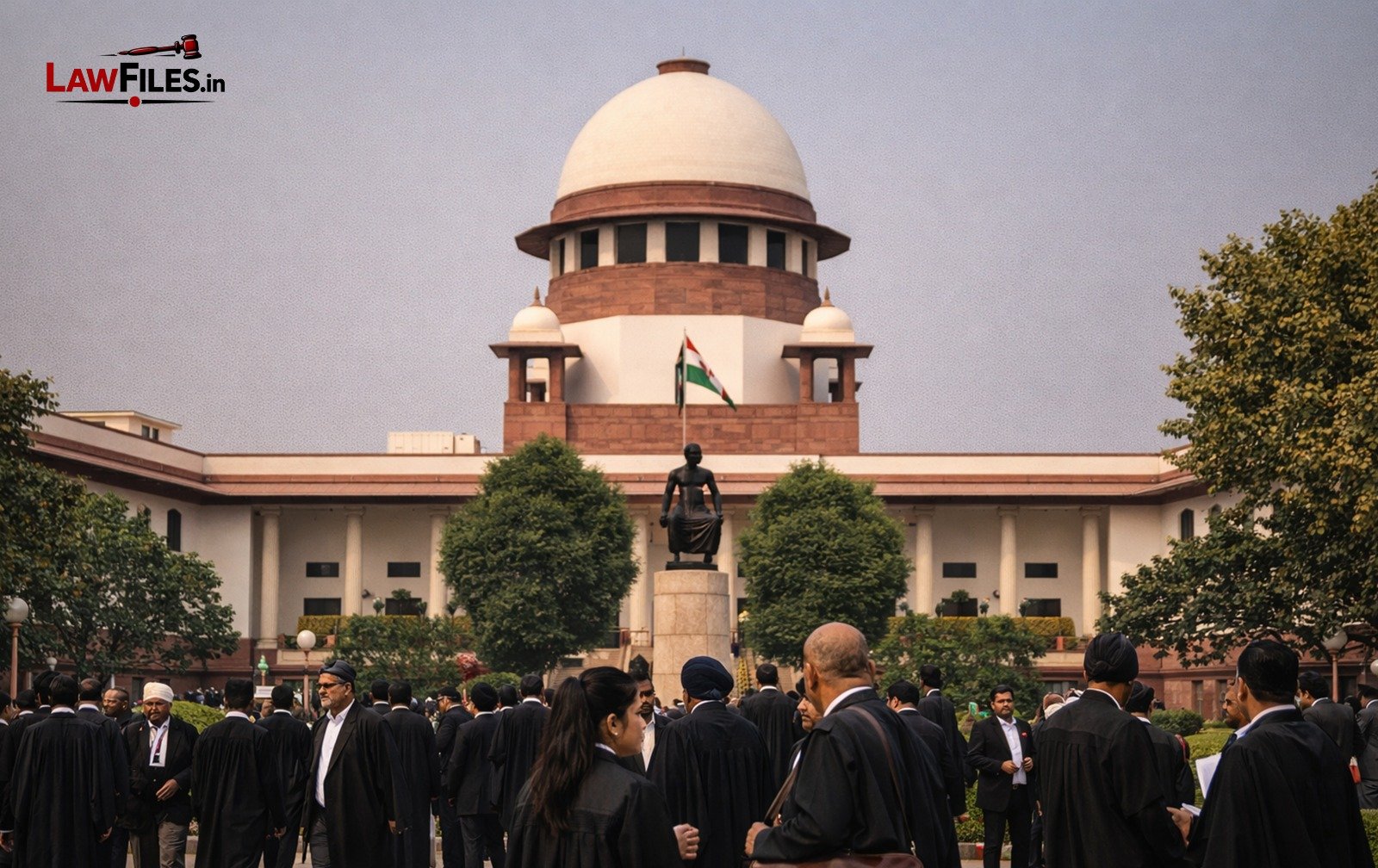
On Hindi Diwas, the Supreme Court of India announced a new public information initiative intended to take judicial communication beyond the conventional boundaries of legal documents. The Court will soon provide simple Hindi summaries of selected important judgments and orders and will also introduce a daily Hindi audio and video bulletin of approximately 15 to 30 minutes explaining significant judicial decisions, their implications and the further course of action arising from them. The initiative is intended particularly to make the work of the Supreme Court more accessible to ordinary citizens, litigants and persons with disabilities, with the Court indicating that other Indian languages will subsequently be brought within the framework in a phased manner.
The announcement, made on September 14, is significant not merely because the Supreme Court has chosen Hindi as the first additional language for communicating its decisions. Its deeper importance lies in the Court recognising that access to justice does not end with the formal pronouncement or publication of a judgment. A judgment may be publicly available and yet remain effectively inaccessible if the language, structure and technical vocabulary make its contents incomprehensible to the very citizens whose rights and obligations it determines. The new service therefore raises a larger constitutional question: whether judicial accessibility should be understood only as physical or procedural access to a court, or also as the ability of an ordinary person to understand what the court has decided and why.
The Supreme Court’s announcement comes against the background of an initiative it had already undertaken in September 2024, when it launched a dedicated “Landmark Judgment Summaries” facility. That initiative sought to explain important judgments in clear language and provide citizens with an easier means of understanding decisions affecting public life. The Court’s Centre for Research and Planning prepares those summaries, which explain both the outcome and the reasoning and are accompanied by access to the underlying judgments and, where available, hearing recordings and transcripts.
The new Hindi service can therefore be understood as an expansion of an existing judicial-access philosophy rather than an isolated Hindi Diwas gesture. The earlier initiative addressed the complexity and length of judgments; the latest initiative adds the dimension of language and audio-visual accessibility. In constitutional terms, the movement is from merely publishing judicial information towards actively communicating it.
This distinction is important. The Supreme Court’s judgments are ordinarily drafted in English, which remains the language of the higher judiciary under the constitutional and statutory framework governing court proceedings. English has also developed as a common professional language enabling lawyers and judges from different parts of India to participate in national litigation. But the existence of a common legal language does not necessarily mean that the ordinary litigant understands the judgment affecting his or her life.
For a litigant who has spent years contesting a property dispute, a service matter, a criminal prosecution, a matrimonial proceeding or a constitutional challenge, the final judgment is not merely a legal text. It determines what happens next. Whether an order must be complied with, whether an appeal is possible, whether a statutory remedy remains available, whether a benefit becomes enforceable or whether a conviction or sentence is affected may depend upon an understanding of the decision. A system in which the judgment is technically available but practically incomprehensible leaves an important part of the justice process unfinished.
The Supreme Court’s decision to provide simple summaries attempts to address precisely this communication gap. The stated objective is to explain important decisions, their effect and the next course of action in language that ordinary citizens can understand. The addition of audio and video is equally significant because accessibility cannot be treated as synonymous with literacy or the ability to navigate lengthy written documents. The Court has specifically identified persons with disabilities among those who may benefit from the service.
The initiative consequently intersects with the constitutional principle of equal access to justice. Article 14 guarantees equality before law and equal protection of laws, while Article 21 has been interpreted by the Supreme Court to encompass a substantive guarantee of fair procedure and meaningful access to justice. Article 39A, although located among the Directive Principles, expressly directs the State to ensure that the operation of the legal system promotes justice on the basis of equal opportunity and to provide free legal aid so that economic or other disabilities do not prevent access to justice.
Language can itself become one such disability. A citizen may possess the formal right to approach a court but remain dependent upon intermediaries to understand what the court has ultimately said. Lawyers are indispensable to the justice system, but meaningful public access cannot be reduced to permanent dependence upon professional interpretation. The law belongs to the public as much as it belongs to the legal profession. When courts explain their decisions in accessible language, they strengthen rather than diminish the authority of the formal judgment.
There is, however, an important distinction that must be maintained. A summary is not the judgment. The Supreme Court’s existing judgment-summary facility expressly recognises that its summaries do not form part of the judicial decision or the reasons of the Court and are not intended for use in legal proceedings.
That distinction will become even more important as the Hindi audio-video service develops. A simplified explanation necessarily compresses complex legal reasoning. A judgment may contain qualifications, exceptions, factual distinctions, statutory provisos and carefully limited findings that cannot always be reproduced in a short bulletin. If the summary becomes detached from the original judgment, there is a risk that a nuanced judicial holding may be reduced to a headline or slogan.
The Court’s proposed model appears to address this concern by ensuring that the relevant official judgment will accompany the summary. This creates an important two-layer structure: the accessible summary serves as the entry point, while the authoritative judicial document remains the source for the legal position.
Such an approach is particularly valuable in an era in which judicial decisions increasingly enter public discourse through short social-media posts and simplified news reports. A judgment concerning fundamental rights, taxation, criminal law, reservations, environmental regulation, personal liberty or commercial disputes can rapidly become the subject of public debate without the participants having read the actual decision. A court-created summary, if carefully prepared, can provide an authoritative bridge between the technical judgment and public understanding.
The initiative therefore has an important relationship with judicial transparency. Judicial independence does not mean judicial isolation. Courts exercise public power, and their decisions have consequences extending far beyond the litigants who appear before them. Transparency requires not merely that decisions exist in the public domain, but that the public can meaningfully engage with the reasoning through which those decisions are reached.
This is particularly important for the Supreme Court because its judgments frequently settle questions affecting millions of people. A decision interpreting a constitutional provision, invalidating a statutory provision, determining the rights of workers, clarifying criminal procedure, defining environmental obligations or laying down rules for governmental authorities may become binding law across the country. The constitutional doctrine of precedent gives Supreme Court decisions an institutional significance far greater than an ordinary adjudication between two parties. If those decisions are difficult for citizens to understand, the distance between constitutional adjudication and constitutional citizenship becomes wider.
The Hindi initiative seeks to narrow that distance. The language question, however, requires constitutional sensitivity. Hindi is being introduced first, but India is a linguistically diverse constitutional democracy. A service designed to improve linguistic access cannot ultimately equate accessibility with the predominance of a single Indian language. The Court has therefore indicated that the initiative will eventually be extended to other Indian languages in phases. That aspect may prove as important as the initial Hindi rollout.
The constitutional value of linguistic inclusion lies precisely in recognising plurality rather than replacing one language barrier with another. A litigant from Tamil Nadu, Assam, Maharashtra, Kerala, West Bengal, Karnataka, Odisha or the North-East may have little practical benefit from a Hindi summary if his or her most accessible language is different. The eventual success of the initiative should therefore be measured not merely by the number of languages introduced, but by whether the Court can create a reliable multilingual architecture for judicial information.
That is a formidable institutional task. Legal terminology cannot always be translated literally. Constitutional concepts often acquire specialised meanings through decades of judicial precedent. A translation that is linguistically accurate may nevertheless be legally misleading if the terminology has a settled doctrinal meaning in the original judgment. The Court will consequently have to balance simplicity with precision.
The same problem exists with audio and video. A short bulletin is necessarily selective. The selection of which cases deserve inclusion, which portions of a judgment require explanation and which consequences should be highlighted will involve editorial judgment. The credibility of the service will therefore depend upon institutional safeguards ensuring that simplification does not become distortion.
This is where the Supreme Court’s existing experience with judgment summaries becomes relevant. The Court’s Centre for Research and Planning has already been preparing summaries of significant judgments, and the official platform describes the purpose of those summaries as helping citizens understand judicial decisions while making clear that the summaries themselves are not substitutes for the judgments.
The new service could build upon that institutional foundation. Rather than treating the Hindi bulletin merely as a translation exercise, the Court can develop it as a structured public legal-information service. Each explanation could identify the legal issue, the material facts, the Court’s conclusion, the principal reasoning and the practical consequence, while directing users to the complete judgment for authoritative details.
Such a structure would also have considerable legal-education value. Law students, young advocates, journalists, civil-society organisations and litigants could use the summaries to identify judgments relevant to their interests before moving to the full decision. In that sense, the service can function as an entry point into the constitutional jurisprudence of the Supreme Court.
There is also an important implication for rural and semi-urban litigants. India’s legal system frequently encounters citizens who are not accustomed to reading lengthy legal documents. A person may understand the facts of a dispute perfectly well but struggle to understand phrases such as “ratio decidendi,” “prospective overruling,” “proportionality,” “natural justice,” “constructive res judicata” or “prima facie satisfaction.” A carefully designed public information service can explain the consequences of such doctrines without requiring every citizen to become a trained lawyer. That is not dilution of law. It is democratisation of legal knowledge.
The distinction matters because simplification is sometimes mistakenly regarded as incompatible with legal seriousness. It is not. A judgment can remain technically rigorous while its central holding is explained in ordinary language. In fact, the ability to communicate complicated reasoning clearly is often a mark of judicial and institutional maturity.
The Court’s move also comes at a time when technology is rapidly changing how citizens consume legal information. Judicial websites, live-streaming, electronic filing, searchable judgments and digital cause lists have already transformed access to court proceedings. The Hindi audio-video bulletin adds another layer by recognising that the digital divide is not simply a question of whether a person has internet access. It is also about whether the information encountered online is comprehensible and usable.
The Supreme Court’s own website already provides Hindi-language access to several judicial services and information categories, demonstrating that multilingual digital access is becoming part of the Court’s institutional infrastructure. The move also has an important disability-access dimension. Audio and video communication can benefit persons who face difficulties in reading lengthy written documents. But accessibility should ideally extend further: captions, transcripts, accessible document formats, screen-reader compatibility and appropriate sign-language support could eventually make judicial communication accessible to a substantially wider section of society. The announcement therefore should be viewed as the beginning of an accessibility framework rather than its completion.
There is also a democratic dimension to the initiative. The legitimacy of judicial power rests not on electoral accountability but on constitutional authority, reasoned adjudication and institutional trust. When citizens understand why a court has reached a particular conclusion, disagreement with the decision can remain a constitutional disagreement rather than becoming distrust born of incomprehension.
Courts cannot and should not attempt to make every judgment popular. Nor should they simplify legal reasoning merely to satisfy public expectations. Judicial independence requires the ability to decide according to law even when the outcome is unpopular. But independence and accessibility are not contradictory. A court can preserve the complexity and integrity of its reasoning while making that reasoning intelligible to the public.
That may ultimately be the most important constitutional contribution of the new service.
The initiative also places responsibility upon the legal profession. Lawyers remain the primary interpreters of judgments for litigants, but improved public access to judicial information can help reduce asymmetry between the legal system and the people who use it. A litigant who can independently understand the basic outcome of a case is better placed to communicate with counsel, make informed decisions and understand the next procedural step.
In this sense, judicial communication can become part of legal empowerment.
The Supreme Court’s announcement on Hindi Diwas should therefore not be viewed simply through the cultural symbolism of the occasion. Hindi Diwas provided the setting, but the underlying project is constitutional and institutional. The question is how a court whose decisions govern a linguistically diverse population can communicate its work in a manner that is authoritative, accurate, accessible and inclusive. The answer cannot be translation alone. Translation changes the language; accessibility changes the relationship between the institution and the citizen.
The proposed Hindi summaries and daily audio-video bulletins have the potential to accomplish that second objective if they are developed with sufficient safeguards. The summary must never replace the judgment. The original judicial reasoning must remain authoritative. Simplification must not erase legal qualifications. Translation must preserve doctrinal accuracy. Selection of cases must be transparent enough to avoid creating an impression that only certain categories of judicial work deserve public attention. And the eventual multilingual expansion must reflect India’s constitutional commitment to linguistic diversity.
If these principles are maintained, the initiative can become much more than a Hindi-language information service. It can develop into a model for judicial communication in a constitutional democracy where courts increasingly operate at the intersection of complex law and mass public participation.
The Supreme Court has already acknowledged that its judgments affect diverse areas of public life and that the length and complexity of judicial decisions can create barriers to public understanding. Its earlier judgment-summary initiative was expressly conceived around informed citizenship and public engagement with law. The latest announcement takes that philosophy further by adding language, audio and video to the equation.
The larger message is consequently straightforward but constitutionally profound: access to justice should not end at the courtroom door, nor should it end when a judgment is uploaded on a website. It should extend to the citizen’s ability to understand what the court has decided.
For a constitutional court, explaining its work to the people is not an exercise in public relations. It is part of institutional accountability. When judicial reasoning becomes more accessible without losing its legal precision, the distance between the Constitution and the citizen becomes smaller.
The Supreme Court’s Hindi public information service, if implemented with that constitutional purpose, can therefore become an important step towards making judicial transparency genuinely participatory. Hindi is only the first stage. The larger destination is a justice system whose authoritative decisions remain legally rigorous, while their meaning is capable of reaching citizens across India’s linguistic and technological diversity.
