


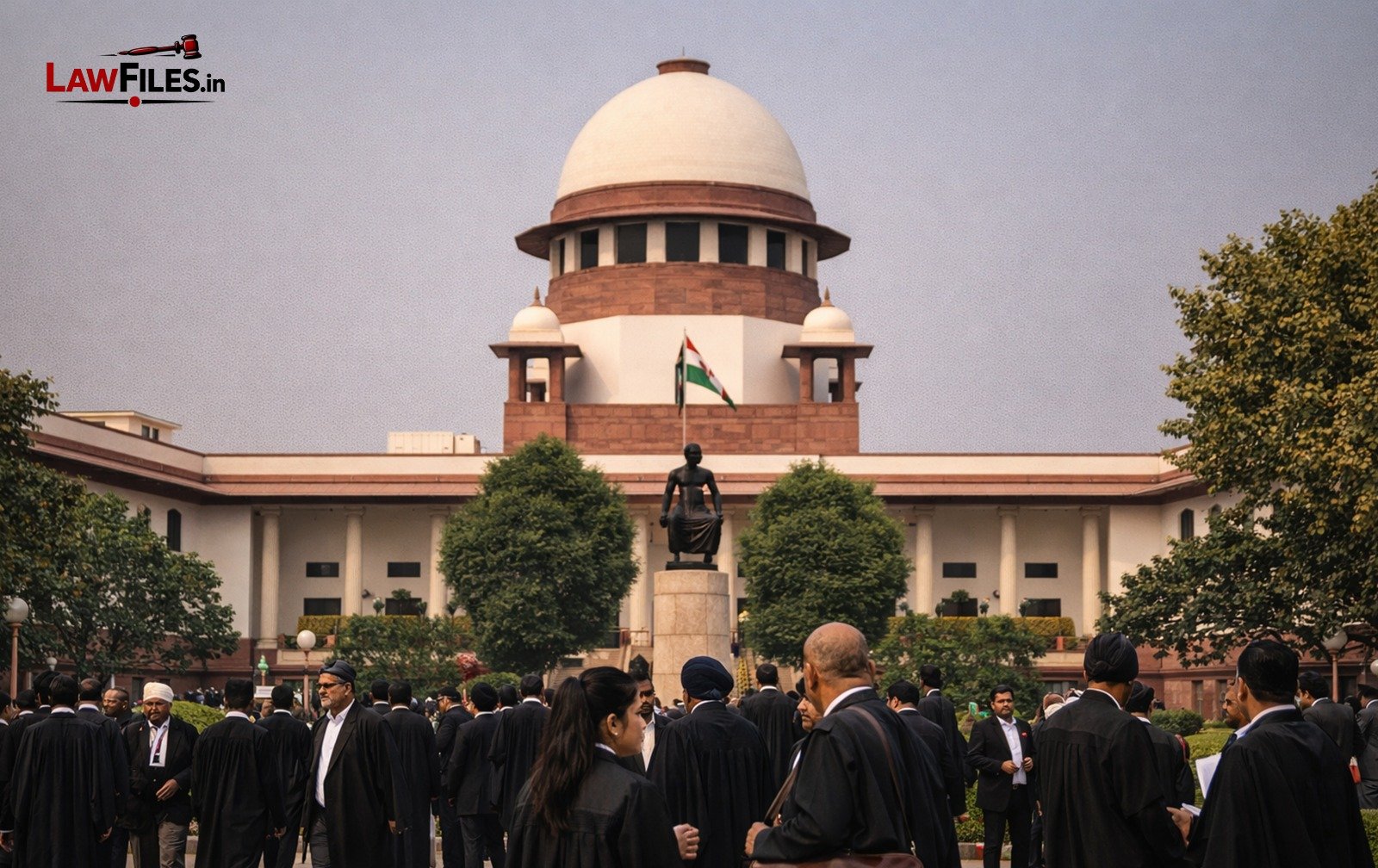
The Supreme Court has reaffirmed an important principle of pension and service jurisprudence: where employees have rendered long and continuous service on contract, ad hoc, daily-wage or work-charge terms and are subsequently regularized, the employer cannot, merely by relying upon the date of formal regularization, erase the period of service already rendered for the purpose of determining qualifying service and pensionary entitlement. In Punjab School Education Board and Another v. Satnam Singh and Others, a Bench comprising Justice Prashant Kumar Mishra and Justice Shree Chandrashekhar dismissed the Punjab School Education Board’s appeal and upheld the entitlement of the employees to have their pre-regularization service taken into account for retiral and pension benefits.
The judgment is particularly significant because the dispute arose against the background of the transition from the traditional pension framework to the Defined Contributory Pension Scheme. The respondents had entered service much before the new pension regime became applicable, but their formal regularization occurred in August 2004, after the January 1, 2004 cut-off. The Board therefore attempted to place them within the newer contributory regime on the ground that their regular appointments commenced only after the cut-off date. The employees, on the other hand, maintained that such an approach ignored the reality of their service and unfairly converted years of actual employment into a legal non-event.
The factual history explains why the Court was unwilling to accept a purely formal approach. The respondents had been engaged by the Punjab School Education Board between 1993 and 1996 as clerks and peons under different temporary arrangements, including contract, ad hoc, daily-wage and work-charge engagements. Their appointments were often structured for short periods, generally around 89 days, but their engagement with the institution continued over the years. Some subsequently progressed to the posts of Junior and Senior Assistants. Thus, while the nomenclature of their appointments suggested temporary employment, the duration and continuity of their association with the Board told a substantially different story.
Their service history was, however, not uninterrupted in the conventional administrative sense. In 1995, the services of 224 ad hoc clerks were terminated, following which 184 employees were re-engaged on contractual terms. The employees were thereafter caught in a prolonged cycle involving recruitment exercises, litigation, continuation of service and demands for regularization. A Punjab Government regularization policy was eventually issued on January 23, 2001. Although the Board initially retained its autonomy to decide whether the policy would be adopted, it ultimately resolved in July 2004 to adopt the policy mutatis mutandis. Public notice followed, and regular appointment letters were issued in August 2004.
The pension dispute consequently acquired a particularly important temporal dimension. The Defined Contributory Pension Scheme had been introduced with effect from January 1, 2004. Since the respondents received formal appointment letters only in August 2004, the Board contended that they were governed by the new pension framework. The employees argued that such a conclusion treated formal regularization as the beginning of their service, even though they had already been working for the Board for several years before the cut-off date.
The controversy thus went beyond a simple question of pension calculation. At its core was the question of what constitutes service for the purposes of pensionary rights. Is service legally born only when an employee receives a regular appointment letter, or can the law recognise the reality of long and continuous employment that preceded formal regularization? The Supreme Court’s answer was emphatically directed towards the latter approach where the facts demonstrate genuine and continuing service subsequently culminating in regularization.
The Board sought to rely upon its status as an autonomous body. Its argument was that government policies concerning service conditions could not automatically bind the Board and, consequently, the employees could not claim the benefit of a government regularization policy merely because it had been issued by the Punjab Government. The Supreme Court, however, found this argument insufficient in the circumstances of the case.
The Court noted that the High Court had already recognised that the Board was free to either accept or reject the government’s regularization policy. The important fact was that the Board eventually chose to adopt the policy itself. Having voluntarily incorporated the policy into its own service framework, the Board could not subsequently rely upon its autonomous character to selectively avoid the consequences flowing from that adoption. The Court therefore treated the Board’s autonomy not as a shield against the employees’ claim, but as evidence that the decision to adopt the policy was one consciously taken by the Board.
This aspect of the judgment reflects an important administrative-law principle. Institutional autonomy gives an authority discretion to make choices within the law; it does not permit the authority to accept a statutory or policy framework when it is advantageous and reject its consequences when those consequences become financially inconvenient. Once the Board adopted the regularization policy, the legal consequences of that decision had to be considered as part of the same framework.
The Supreme Court also placed considerable reliance on its earlier decision in Harbans Lal v. State of Punjab. In that case, an employee had worked as a Pump Operator on a daily-wage basis from 1988 and was subsequently regularized in 2005. The Court had held that the period of daily-wage service preceding regularization could not simply be excluded while determining pensionary entitlement. Regularization did not transform the employee into a completely new entrant for the purposes of pension. The present Bench considered that principle directly relevant to the controversy before it.
The Court’s reasoning is also consistent with the broader principle articulated in D.S. Nakara v. Union of India, where pension was understood not merely as a gratuitous payment made by the State after retirement, but as a social-welfare benefit arising from past service. Pension represents a deferred component of the employee’s service relationship. Consequently, the question cannot always be determined solely by examining the date on which an employee obtained a formal label of “regular” service. The substance of the employment relationship and the service actually rendered remain relevant.
The Court’s observation that denial of pensionary benefits on the basis of “technicalities or artificialities” is generally unjustified is particularly significant. The judgment does not suggest that every period of casual or temporary employment must automatically be counted towards pension. Rather, it responds to a particular factual situation in which employees had rendered long-standing service, were ultimately regularized by the employer and sought recognition of that service for retirement benefits.
That distinction is important in the context of the Supreme Court’s broader regularization jurisprudence. Decisions such as Secretary, State of Karnataka v. Umadevi have repeatedly cautioned against courts directing wholesale regularization merely because temporary employees have worked for a long period. Regularization cannot ordinarily become a substitute for constitutionally compliant recruitment. But the present case concerns a different legal question. The employees were already regularized by the employer. The controversy was about the consequences of that regularization for pension, rather than a judicial direction creating permanent employment where none existed.
The distinction prevents the present judgment from being misunderstood as an erosion of the constitutional rules governing recruitment. The Court has not declared that every daily-wage worker automatically acquires a right to permanent employment. Nor has it held that temporary service must invariably be treated as regular service for every purpose. What it has recognised is that once an employer has regularized long-serving employees, it cannot necessarily erase the service preceding regularization when determining retirement benefits, particularly where the applicable pension regulations recognise such qualifying service.
The statutory and regulatory framework was therefore crucial. The respondents’ claim was considered with reference to the Punjab School Education Board (Employees’ Pension, Provident Fund and Gratuity) Regulations, 1991. The relevant provisions concerning qualifying service had to be interpreted in the context of the employees’ actual service history. The Supreme Court consequently rejected the Board’s attempt to reduce the pension question to the date printed on the later appointment letters.
The judgment is particularly instructive in understanding the difference between regularization as an employment event and pension as a consequence of accumulated service. Regularization may determine status, seniority or the point from which certain service benefits become available, depending upon the governing rules. But it does not necessarily follow that every legal consequence of the employee’s earlier service disappears. Pension legislation frequently uses the concept of “qualifying service”, which is a statutory construct capable of extending beyond the date of formal confirmation or regular appointment.
The Court’s approach is therefore fundamentally substance-oriented. If an employee had actually worked for the institution, had continued to discharge duties, had been retained through successive temporary arrangements and was eventually regularized, the employer cannot rely upon the temporary nomenclature alone to deny recognition of that service where the governing pension framework permits it.
The Board’s argument concerning the January 1, 2004 cut-off also illustrates the potential injustice of treating regularization as an artificial reset button. Had the respondents been formally regularized shortly before the cut-off date, they could have fallen within the old pension regime. Because their regularization occurred several months later after years of litigation and administrative delay, the Board sought to place them within a fundamentally different retirement framework. The Court’s reasoning prevents the consequences of administrative delay from being automatically transferred onto employees who had already been serving the institution for years.
This is particularly important because temporary employment in public institutions has historically existed in a legally uncomfortable space. Employees may perform the same institutional functions as regular staff for years while formally remaining on short-term contracts. The repeated renewal of 89-day arrangements, for example, may create a distinction on paper that becomes increasingly difficult to justify when viewed against the continuity of actual work. The present judgment does not abolish the distinction between temporary and regular service, but it cautions against allowing nomenclature to become conclusive when the law is determining pensionary consequences.
There is also a broader constitutional dimension. Article 14 does not require every category of employee to be treated identically; classification based on legitimate distinctions is permissible. But once the factual distinction between two categories becomes artificial, its continued use may produce arbitrary consequences. An employee who has worked continuously for years cannot necessarily be treated as though he or she entered the institution for the first time merely because the employer chose to formalize the relationship at a later date.
The Court’s approach resonates with the social-welfare character of pension legislation. Pension is not simply a financial benefit arising after retirement; it is connected with the employee’s accumulated service and the State’s obligation to provide security after the end of working life. The Supreme Court’s reliance on D.S. Nakara reinforces this conceptual understanding. The objective is not to confer an undeserved windfall, but to ensure that genuine service is not disregarded through an excessively technical construction of employment records.
At the same time, the ruling should not be read as establishing an unrestricted principle that every contractual engagement must count for pension. The factual and statutory foundations remain important. The employees in the present case had ultimately been regularized pursuant to a policy adopted by the Board, and the applicable pension regulations supported the recognition of qualifying service. The Court’s reasoning is therefore strongest in situations where temporary service forms part of a continuous employment relationship culminating in regular appointment.
The decision also demonstrates why pension disputes cannot be resolved in isolation from the history of an employee’s appointment. A pension authority examining only the final regular appointment order may arrive at a superficially straightforward conclusion. But service jurisprudence often requires examination of the entire chain of engagement, including initial appointment, continuity, termination and re-engagement, regularization policy, subsequent appointment and the governing pension regulations.
In the present case, that historical approach was particularly important because the respondents’ service had passed through several administrative stages. The 1995 termination and subsequent re-engagement, the government’s regularization policy, the Board’s eventual adoption of that policy and the August 2004 appointment letters could not reasonably be examined as isolated events. They formed part of a longer employment history which ultimately culminated in regular service.
The ruling also has implications for employees caught between old and new pension regimes. The transition from defined-benefit pensions to contributory pension structures has generated significant litigation because eligibility frequently turns upon dates of appointment, regularization, absorption or commencement of service. The present decision indicates that courts may scrutinise such cut-off disputes more carefully where the employee had already rendered substantial service before the transition and later regularization was the product of the employer’s own policy.
There is an important policy lesson here for public authorities as well. Governments and public bodies often resolve long-pending temporary employment disputes through regularization schemes. Once such schemes are implemented, authorities must consider their downstream consequences for pension, gratuity, seniority and other retirement benefits. Regularization cannot be treated as merely an administrative device for converting temporary posts into permanent ones while simultaneously ignoring the service history that made regularization necessary.
The judgment therefore reinforces the principle that service jurisprudence must examine the reality of employment rather than merely the chronology of paperwork. An appointment letter is undoubtedly important, but it cannot invariably be treated as the sole document capable of determining every service consequence. Where the record demonstrates long and continuous engagement followed by regularization, pensionary rights may have to reflect the entire qualifying period recognised by the applicable rules.
The Supreme Court’s dismissal of the Board’s appeal consequently carries significance beyond the individual employees involved. It affirms that the State and its instrumentalities must administer pension schemes in a manner consistent with the statutory concept of qualifying service and cannot defeat accrued service-based entitlements by relying solely upon formal dates or labels.
The larger principle emerging from Punjab School Education Board v. Satnam Singh is that regularization should not become a legal eraser. Where an employee has rendered genuine, prolonged service and is ultimately absorbed into regular employment, the intervening formalities cannot automatically extinguish the value of the service already rendered. Pension, being a deferred service benefit, must be examined through the lens of the employee’s actual qualifying service and the statutory framework governing retirement benefits.
At the same time, the judgment maintains an important boundary. It does not create a general constitutional right to regularization merely on the basis of long service. Nor does it suggest that temporary employment and regular employment are interchangeable for all purposes. Its significance lies in a narrower but powerful proposition: once regularization has occurred and the applicable pension rules recognise qualifying service, the employer cannot artificially sever the employee’s past merely because the formal act of regularization occurred after a pension cut-off date.
In that sense, the judgment represents a careful application of social-welfare principles to service law. It places substance above nomenclature, continuity above artificial breaks and accrued service above administrative formalism, while leaving intact the constitutional limitations governing regular recruitment. For thousands of employees whose careers began in the uncertain territory of ad hoc, contractual or daily-wage employment before ultimately becoming regular, the decision provides an important judicial reminder that the absence of permanent status at the beginning of service does not necessarily mean the absence of legal value in the service rendered during that period.
