


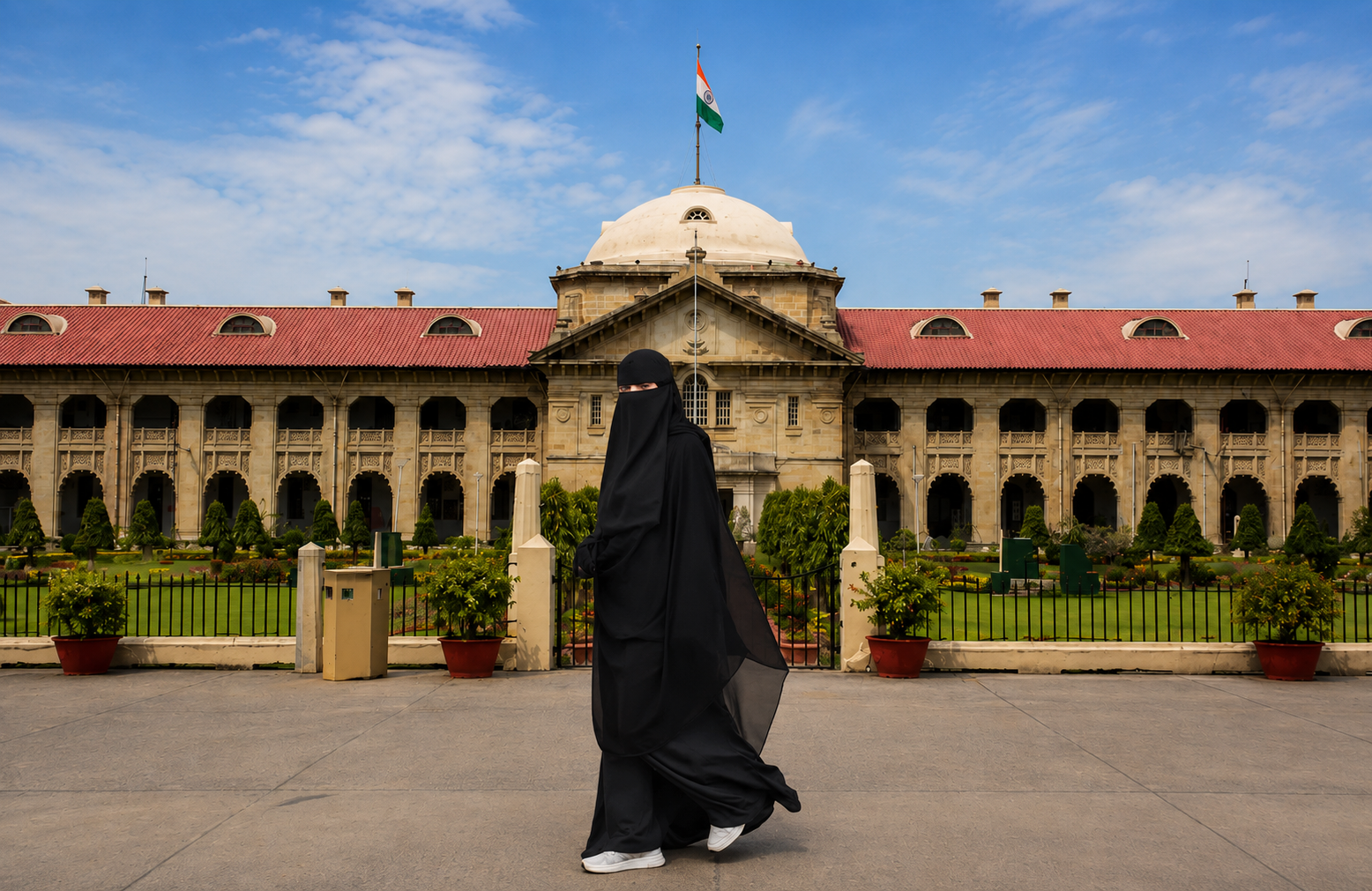
The Allahabad High Court has dismissed a petition filed by a minor Muslim student seeking permission to wear a hijab or headscarf along with the uniform prescribed by her school, holding that the petitioner failed to establish that wearing a headscarf constituted an essential religious practice of Islam whose observance was constitutionally protected in the circumstances of the case. A Division Bench comprising Justice J.J. Munir and Justice Indrajeet Shukla was dealing with the challenge brought by the student through her mother against the refusal of Tagore Public School, Attarsuiya, Prayagraj, to permit her to continue wearing the headscarf with the prescribed school uniform. The judgment places the dispute at the intersection of religious freedom, institutional discipline, individual autonomy and the constitutional limits of school dress codes, while also revisiting the unsettled judicial debate surrounding the wearing of hijab in educational institutions.
The petitioner had studied at the school from Class VI to Class X and had, according to her case, worn a headscarf during her earlier years without facing an objection from the institution. After completing Class X, she sought admission to Class XI in the same school. The difficulty arose when the school insisted that she comply with its prescribed uniform without adding a headscarf. The petitioner approached the High Court through her mother, seeking a direction that she be permitted to wear the headscarf in addition to the uniform. Her case was that wearing the scarf was not merely a matter of personal preference but an essential religious practice and that preventing her from doing so infringed her constitutional rights.
The petitioner relied principally upon Articles 14 and 19(1)(a) of the Constitution. Her argument was that the decision preventing her from wearing the headscarf amounted to an unreasonable restriction upon her freedom of expression and treated her religious identity differently from other students. The case therefore required the Court to examine not simply whether a school can prescribe a uniform, but whether a uniform rule can constitutionally override a student’s asserted religious practice when the student seeks only to add an item of religious attire rather than replace the prescribed uniform altogether.
The school adopted a substantially different position. It maintained that it was a private, unaided, co-educational institution affiliated with the Central Board of Secondary Education and that its uniform requirement applied equally to all students. The school authorities argued that permitting an individual student to add an item to the prescribed uniform would undermine the very purpose of having a common dress code. The school also pointed out that other female students belonging to the same religious community were following the prescribed uniform without wearing a headscarf. According to the institution, the issue was therefore not discrimination against a particular faith but the enforcement of a uniform rule intended to apply without religious distinction.
The State authorities similarly supported the institutional position that prescription of a school uniform falls primarily within the domain of educational administration. The State argued that a uniform serves a broader disciplinary and organisational purpose and that courts should be slow to interfere with such institutional decisions unless the rule is shown to be discriminatory, arbitrary or otherwise contrary to law. The dispute consequently presented the Court with two competing conceptions of equality: one centred on accommodating individual religious expression, and the other based upon treating every student identically through a common institutional rule.
The Bench first addressed an argument arising from the student’s previous experience at the school. The petitioner contended that she had been allowed to wear the headscarf throughout her earlier classes and that the school could not subsequently object to the same practice when she sought admission to Class XI. The Court rejected the suggestion that the school’s earlier non-enforcement of its uniform policy created a legally enforceable right in her favour. The Bench reasoned that the institution’s previous failure to object could have resulted from several circumstances, including tolerance, inaction, administrative oversight or courtesy, but such conduct could not permanently prevent the school from enforcing its uniform policy in the future.
This aspect of the judgment engages the administrative-law principle of legitimate expectation, although the Court’s reasoning makes clear that a student’s past accommodation does not automatically crystallise into a legal entitlement to continue receiving the same exception. An expectation arising from previous conduct may have relevance in public-law review where an authority has made a representation or established a consistent practice, but it cannot necessarily override an otherwise lawful institutional policy. The Court’s approach therefore distinguishes between a temporary accommodation and a legally binding alteration of the school’s dress-code rules.
The Bench also emphasised that the school had not altered its prescribed uniform in a discriminatory manner. Instead, the controversy arose because the petitioner wanted to supplement the common uniform with an additional item. This distinction became central to the Court’s reasoning. According to the judgment, where an educational institution adopts a uniform dress code that is applied consistently, made in good faith, does not discriminate between students and is connected with legitimate institutional objectives, the formulation and enforcement of that uniform ordinarily falls within the school’s administrative domain.
The Court identified several purposes served by a uniform. Apart from creating a common appearance, a uniform can promote discipline, reduce visible distinctions between students, reinforce institutional identity and create an environment in which students from different social and religious backgrounds participate on broadly identical terms. The Bench considered that such a dress code can also contribute to what it described as a religion-neutral atmosphere within the institution because the same basic clothing requirements apply irrespective of the student’s faith.
The reasoning raises an important constitutional distinction between formal equality and substantive accommodation. Formal equality would suggest that if every student is required to comply with the same dress code, the rule is non-discriminatory. Substantive equality, however, sometimes requires differential accommodation where an apparently neutral rule imposes a particular burden upon persons belonging to a protected group. Religious freedom jurisprudence frequently encounters precisely this tension. A rule may be neutral in its wording yet affect different communities differently. The question for the Court therefore becomes whether the Constitution requires an exemption from an otherwise neutral institutional rule in order to accommodate a religious practice.
The Allahabad High Court answered that question against the petitioner in the circumstances before it. But it did so after examining whether the claimed religious practice fell within the category of an essential religious practice. This doctrine has long played a role in Indian constitutional adjudication concerning Article 25. The Court therefore did not treat the petitioner’s assertion that hijab was religiously obligatory as sufficient by itself. It required material capable of establishing that the practice was essential to the faith in the constitutional sense relied upon by the petitioner.
The Bench found that the petition contained essentially an assertion that wearing the headscarf was an essential religious practice, without sufficient authoritative material demonstrating that a Muslim woman would compromise the fundamental character of her faith by not wearing it in the school environment. The Court consequently concluded that the petitioner had not discharged the evidentiary burden necessary to establish the particular constitutional claim advanced before it.
This part of the judgment is legally significant because Article 25 protects freedom of conscience and the freedom to profess, practise and propagate religion, subject to the constitutional limitations contained in that provision. The right is not unlimited. It operates alongside public order, morality and health and remains subject to other provisions of Part III. Further, Indian constitutional jurisprudence has historically distinguished between practices regarded as essential to a religion and those which may be religiously associated but are not constitutionally indispensable. The precise scope and methodology of this “essential religious practice” doctrine has itself been the subject of considerable judicial criticism and debate.
The Allahabad High Court’s approach cannot therefore be understood as declaring that hijab has no religious significance for Muslims. The Court was dealing with a much narrower legal question: whether the petitioner had established that wearing a headscarf was an essential religious practice in such a manner that the school was constitutionally required to make an exception to its uniform policy. The Court answered that question in the negative. This distinction is important because religious significance and constitutional essentiality are not necessarily identical concepts.
The Bench examined earlier judicial decisions dealing with hijab and school or college dress codes. Particular importance was attached to the Full Bench decision of the Karnataka High Court in the proceedings arising from the hijab controversy in that State. The Karnataka Full Bench had concluded that wearing hijab could not be treated as an essential religious practice of Islam for the purposes of the constitutional claim before it. The Allahabad High Court considered that judgment to be persuasive authority of considerable weight.
However, the Bench also acknowledged that the legal position at the level of the Supreme Court remains unsettled. The Karnataka decision was subsequently considered by the Supreme Court in the proceedings commonly associated with the hijab controversy, but the Bench hearing the matter delivered a split verdict. One judge upheld aspects of the State’s position while another took a different view, resulting in the matter being placed before the Chief Justice for constitution of an appropriate Bench. The Allahabad High Court therefore recognised that there is no final, authoritative Supreme Court pronouncement conclusively resolving the constitutional status of hijab in educational institutions.
This acknowledgement is crucial. The Allahabad High Court did not pretend that the Supreme Court had conclusively settled the matter. Instead, it reasoned that in the absence of a binding Supreme Court judgment resolving the precise issue, there was no sufficient reason for it to depart from the considered reasoning of the Karnataka Full Bench. The earlier judgment was consequently treated as persuasive rather than binding precedent.
The Court also examined decisions of other High Courts concerning religious headscarves and institutional dress codes. These included cases in which students sought permission to wear headscarves contrary to prescribed uniforms. The Bench noted what it considered to be a consistent judicial trend against treating the headscarf as an indispensable element of Islamic faith for purposes of overriding a neutral school uniform requirement. While High Court decisions outside the territorial jurisdiction of the Allahabad High Court do not possess binding force in the same manner as Supreme Court precedent, their reasoning may nevertheless have persuasive value, particularly where the constitutional issue remains unsettled at the national level.
The Court also considered a subsequent interim order of the Supreme Court in a Bombay High Court matter involving restrictions upon hijab and other forms of attire in an educational institution. The Allahabad Bench distinguished the interim order from a final reasoned judgment. An interim direction, particularly one passed without detailed reasons, does not ordinarily establish a binding precedent on the underlying constitutional issue. The distinction between an interim arrangement and a final declaration of law is fundamental to the doctrine of precedent because courts are bound by the ratio of authoritative decisions, not by every temporary direction made during pending litigation.
This aspect of the judgment reflects a cautious approach to precedent. The Court recognised the existence of conflicting developments but sought to identify the reasoned judgments that remained available for persuasive guidance. The result was not a claim that the constitutional controversy had been finally settled nationwide, but rather a conclusion that the existing legal landscape did not require the Allahabad High Court to adopt a contrary approach in the particular case.
The Bench also took note of photographs placed before it showing that the petitioner was apparently the only girl in her classes wearing a headscarf, including among students belonging to the same religious community. The Court considered this circumstance relevant to the petitioner’s assertion that wearing the headscarf was an indispensable religious requirement. If other Muslim students at the same institution were able to follow the uniform without wearing a headscarf, the Court considered that fact inconsistent with the claim that non-wearing necessarily jeopardised the fundamental character of the faith.
This reasoning, however, raises a nuanced legal question. The fact that other members of a religious community do not observe a particular practice does not necessarily establish that the practice is not religiously significant to an individual believer. Religious observance can vary among individuals, schools of interpretation and communities. A constitutional right cannot ordinarily be denied merely because other persons belonging to the same faith choose not to exercise it. The more precise question is whether the particular practice qualifies for constitutional protection under the legal test applicable to the claim. The photographs may therefore be relevant contextual evidence, but they cannot by themselves settle the theological or constitutional status of hijab.
This distinction becomes particularly important when dealing with religious freedom because the Constitution protects individual conscience as well as collective religious practice. Article 25 begins with the protection of “all persons”, rather than confining religious liberty to communities as institutional entities. Consequently, courts must be cautious about converting the behaviour of other members of a religious group into a conclusive test of an individual’s religious belief. The Allahabad High Court’s judgment nevertheless treated the evidence as one factor reinforcing its conclusion that the petitioner had not established the necessary essentiality of the practice.
The school-uniform issue also has an important autonomy dimension. Educational institutions require some degree of authority to establish rules concerning clothing, discipline, attendance and classroom conduct. If every student could individually determine which institutional rules should apply to them based upon personal preferences, the administrative coherence of the institution could become difficult to maintain. The Court therefore considered that allowing individual departures from a common uniform policy could shift the practical authority over school discipline from the institution to individual students.
However, this proposition also requires a constitutional qualification. Institutional autonomy is not absolute. A school cannot adopt a rule that is manifestly discriminatory or violates fundamental rights merely by describing the rule as part of its dress code. The legitimacy of a uniform policy depends upon its character and implementation. The Allahabad High Court’s reasoning expressly relied upon the condition that the uniform must be uniform in application, bona fide, non-discriminatory and connected with legitimate institutional objectives. The judgment should therefore not be read as granting educational institutions an unrestricted power to regulate every aspect of student appearance.
The private and unaided character of the school was also relevant. The school was not a government institution but a private institution affiliated with the CBSE. This raises interesting questions about the horizontal application of fundamental rights. Constitutional rights traditionally operate primarily against the State under Article 12, although modern constitutional jurisprudence has increasingly recognised that certain rights and statutory protections may have implications for private actors as well. In the present case, the Court did not treat the private character of the institution as automatically placing it beyond constitutional scrutiny. Rather, it considered the legality and character of the uniform policy and whether the petitioner had established an enforceable right requiring the institution to provide an exception.
The case consequently demonstrates that the debate surrounding religious attire in educational institutions cannot be reduced to a simple confrontation between “religious freedom” and “school discipline”. Several constitutional principles intersect simultaneously: equality under Article 14, freedom of expression under Article 19(1)(a), freedom of religion under Article 25, dignity and autonomy under Article 21, and the institutional interests of educational bodies in maintaining academic discipline and a common environment.
The reliance upon Article 19(1)(a) is itself significant because clothing can, in appropriate circumstances, constitute a form of expression. The freedom of speech and expression is not confined to spoken or written words. Symbolic conduct and appearance may communicate identity, belief or political and cultural positions. Yet expressive conduct remains subject to constitutionally permissible restrictions. The question in the present case was whether the student’s wearing of a headscarf could override a neutral dress code that the school claimed was necessary for discipline and institutional identity. The Court effectively concluded that the institutional rule prevailed on the facts and legal material before it.
The Article 14 argument similarly required more than showing that the petitioner was treated differently from students who did not wear a headscarf. A constitutional equality challenge would require examination of whether the classification was based upon an impermissible ground or whether the rule was arbitrary or irrational. If the same uniform requirement applied to all students regardless of religion, the school could argue that the classification was not based on religious identity at all. The petitioner, however, could potentially contend that a formally neutral rule has a disproportionate impact upon religious observance. The judgment resolves that tension in favour of the school’s uniform policy because the Court found no sufficient basis for treating the requested religious accommodation as constitutionally mandatory.
The decision also raises an important question about the limits of the essential religious practice test itself. Indian constitutional scholars and judges have, over the years, debated whether secular courts should determine what constitutes an essential component of a religion. The doctrine originated in a line of cases in which courts examined religious practices to determine whether they were entitled to constitutional protection. Critics argue that this can place judges in the difficult position of interpreting religious doctrine. Supporters contend that some judicial test is necessary where religious claims are invoked to challenge laws or institutional rules. The present judgment illustrates this continuing tension because the Court was required to determine whether a particular form of religious attire was constitutionally essential without turning the proceeding into a theological inquiry.
The fact that the petitioner was a minor adds another layer of complexity. A child or adolescent’s religious identity, parental guidance and individual autonomy may intersect in complicated ways. The petition was filed through the student’s mother, indicating that the claim involved both the student’s asserted religious practice and parental support for that practice. The Court nevertheless approached the matter through the constitutional framework applicable to the alleged right rather than treating the minor status of the petitioner as independently determinative.
The ruling should also be understood within the broader history of disputes over school uniforms. Courts have generally recognised that educational institutions may prescribe dress codes for reasons connected with discipline, equality and institutional identity. At the same time, courts have intervened where dress regulations are shown to be arbitrary, discriminatory or disproportionately burdensome. The legal question is therefore usually one of balancing institutional autonomy against individual rights rather than granting absolute priority to either side.
From this perspective, the most significant feature of the Allahabad High Court judgment may be its insistence upon a neutral and genuinely uniform dress code. The Court did not hold that schools can selectively prohibit religious attire while permitting comparable non-religious additions to uniforms. Its reasoning was premised on the existence of a common dress requirement. If an institution were to permit numerous forms of personal expression but single out one religious practice for prohibition, the Article 14 analysis could look substantially different.
The judgment therefore leaves open an important distinction between a genuinely uniform policy and selective enforcement. A school that consistently enforces a common uniform may possess a stronger justification for refusing individual additions. Conversely, inconsistent enforcement could undermine the claim that the rule exists for institutional discipline rather than as a mechanism directed at a particular community. The evidence concerning how the uniform policy is actually applied may therefore remain important in future cases.
The Court’s observation that the school could itself alter its uniform policy is also noteworthy. The judgment does not permanently prohibit the institution from permitting hijab or other religious attire. It recognises that the school administration retains the power to modify its dress code. The dispute arose because the petitioner sought a judicial command requiring the school to create an exception. The Court declined to impose such an exception through judicial direction.
This distinction between institutional permission and constitutional compulsion is perhaps the clearest way to understand the decision. A school may voluntarily accommodate religious attire without violating its institutional objectives. The question before the Court was whether the Constitution required it to do so in the circumstances of this case. The Bench concluded that the petitioner had not established such a constitutional entitlement.
The ruling is nevertheless unlikely to end the larger national debate over hijab and educational dress codes. The Supreme Court’s earlier split decision means that the constitutional position remains unresolved at the highest level. Until an appropriate Bench settles the matter, different High Courts may continue to encounter similar cases involving variations in school policies, institutional settings and factual circumstances. The legal landscape could therefore continue to develop through case-by-case adjudication.
There is also a significant distinction between school education and higher education. The autonomy of a minor student, the role of parents, the character of a school and the disciplinary objectives applicable to younger students may differ from those involved in universities or colleges attended by adults. Courts may consequently have to consider different factors depending upon the educational context. A precedent concerning a private school cannot automatically resolve every dispute involving a university, college or public educational institution.
The judgment also does not address every possible form of religious accommodation. A request to wear a headscarf as part of a uniform is different from a demand to replace the entire uniform or disregard safety requirements. The proportionality analysis could vary significantly depending upon the nature of the requested accommodation and its effect on institutional functioning. A narrowly tailored addition to a uniform may raise different questions from an exemption that substantially alters the prescribed attire.
The broader constitutional principle emerging from the decision is therefore one of reasonable institutional uniformity subject to constitutional limits. The Court has given considerable weight to the school’s autonomy to prescribe a common dress code, but that autonomy rests upon the rule being neutral, bona fide and non-discriminatory. At the same time, the petitioner was required to establish a sufficiently strong constitutional basis for demanding an exemption, which the Court found absent.
The judgment is also a reminder that religious freedom claims before constitutional courts must be supported by more than assertion. When a petitioner claims that a particular practice is constitutionally indispensable to the exercise of religion, the Court may require material demonstrating the nature and significance of that practice. This does not mean that courts should demand theological proof in every religious-freedom case, but it does mean that a bare assertion of essentiality may not be sufficient where the claim is being used to invalidate or override an otherwise neutral institutional rule.
Ultimately, the Allahabad High Court’s decision represents another significant development in India’s continuing constitutional debate over religious attire and educational autonomy. The Court has not held that Muslim students are prohibited from wearing hijab in every school in the country. Nor has it declared that religious expression has no place within educational institutions. Its decision is narrower: in the particular circumstances before it, the petitioner failed to establish that wearing the headscarf was an essential religious practice requiring constitutional accommodation, while the school had a uniform dress code that the Court found to be common, bona fide, non-discriminatory and connected with legitimate institutional objectives. The broader significance lies in the unresolved tension that remains after the judgment: Indian constitutional law must protect freedom of conscience and religious identity while also allowing educational institutions to maintain coherent, neutral and uniformly applicable rules. Until the Supreme Court finally settles the doctrinal questions left open by its earlier split verdict, that balance will continue to be worked out through individual cases, with courts required to distinguish carefully between genuine religious compulsion, personal preference, institutional discipline and constitutionally protected expression.
