


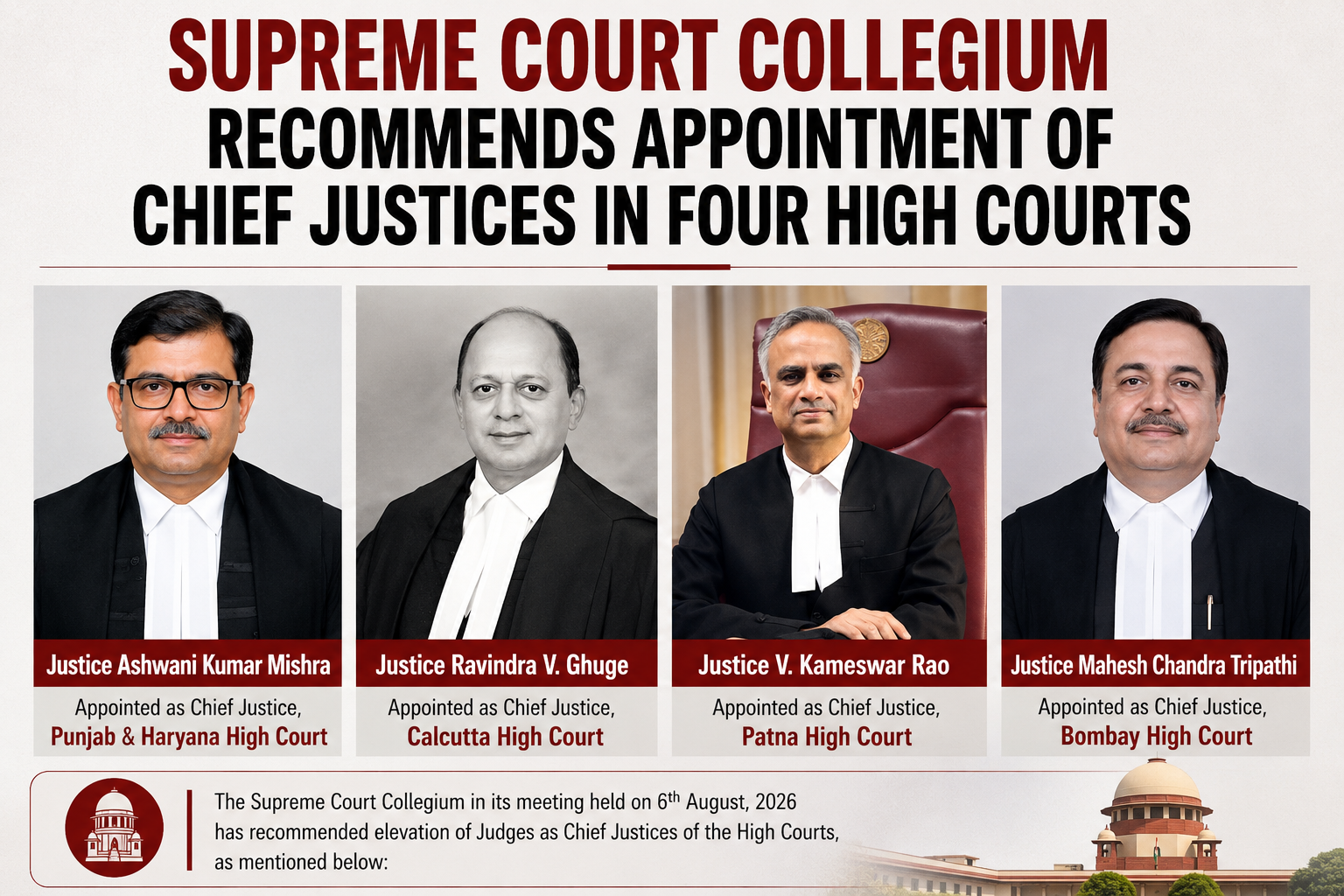
The Supreme Court Collegium has recommended the appointment of Chief Justices to four High Courts, setting in motion an important round of changes in the leadership of the higher judiciary. The recommendations assume significance not merely because they seek to fill vacancies in constitutional courts, but because the office of a High Court Chief Justice carries substantial responsibility for the judicial and administrative functioning of the institution. At a time when judicial vacancies and case pendency remain persistent concerns, the latest exercise reflects the Collegium’s attempt to ensure greater continuity and stability in the administration of the High Courts.
The recommendations involve Justice Valluri Kameswar Rao of the Delhi High Court for appointment as Chief Justice of the Patna High Court; Justice Ravindra Vithalrao Ghuge of the Bombay High Court for appointment as Chief Justice of the Calcutta High Court; Justice Mahesh Chandra Tripathi of the Allahabad High Court for appointment as Chief Justice of the Bombay High Court; and Justice Ashwani Kumar Mishra of the Allahabad High Court for appointment as Chief Justice of the Punjab and Haryana High Court. The recommendations will now have to undergo the prescribed executive process before formal appointments are notified.
The proposed appointments are particularly noteworthy because they demonstrate the Collegium’s continued reliance upon inter-High Court transfers for appointment to the office of Chief Justice. Rather than necessarily elevating the senior-most judge of the concerned High Court, the Collegium frequently selects judges from other jurisdictions for leadership positions. This practice has traditionally been associated with the objective of preserving institutional independence and ensuring that the Chief Justice is not overly influenced by local professional or institutional considerations.
Justice Ravindra Vithalrao Ghuge’s proposed move from Bombay to Calcutta is particularly significant. Justice Ghuge has been a judge of the Bombay High Court since 2013 and has substantial experience in adjudicating matters arising across the jurisdiction of that court. His proposed appointment as Chief Justice of the Calcutta High Court would therefore involve not merely an elevation in status but a substantial institutional transition into another High Court with its own administrative traditions, regional Bar and substantial case burden.
Similarly, the proposed appointment of Justice Mahesh Chandra Tripathi as Chief Justice of the Bombay High Court involves the movement of an Allahabad High Court judge into one of the country’s largest and most significant constitutional courts. The Bombay High Court exercises jurisdiction over Maharashtra and Goa and also has permanent benches outside Mumbai. The administrative responsibilities associated with its Chief Justice consequently extend well beyond the functioning of a single court complex.
Justice Ashwani Kumar Mishra’s recommendation presents a somewhat different situation. He is proposed to head the Punjab and Haryana High Court, having served in the Allahabad High Court. His appointment would place an experienced judge at the helm of a High Court whose jurisdiction covers both Punjab and Haryana, as well as the Union Territory of Chandigarh. The institutional complexity of this jurisdiction makes the role of its Chief Justice particularly important from an administrative standpoint.
Justice V. Kameswar Rao, whose name has been recommended for the Patna High Court, is a sitting judge of the Delhi High Court. His proposed elevation is significant in the context of the continuing need to ensure permanent leadership in High Courts where temporary arrangements have been operating. A permanent Chief Justice can provide greater continuity in matters concerning the roster, constitution of Benches, administrative allocation of work and institutional policy.
The recommendations therefore have to be understood against the larger problem of temporary judicial leadership. Although an Acting Chief Justice possesses substantial authority to discharge the functions of the office, prolonged reliance on acting arrangements is not necessarily ideal for institutional planning. The Chief Justice is not merely the senior-most judicial officer of the High Court; the office also involves extensive administrative functions that require long-term decision-making and institutional coordination.
This distinction becomes particularly important in the context of judicial pendency. High Courts across the country continue to face enormous caseloads, with a significant number of cases remaining pending for years. Recent data and reporting have highlighted the scale of long-pending litigation across India’s High Courts, underlining that judicial capacity cannot be measured solely by the number of judges appointed. Administrative leadership, case-management systems, roster arrangements and effective utilisation of judicial strength are equally important components of the justice-delivery system.
The latest Collegium recommendations therefore have an important administrative dimension. A Chief Justice determines the allocation of judicial work, constitutes Benches, oversees the functioning of the Registry and exercises significant authority over the overall institutional functioning of the court. While judicial decision-making remains a matter for individual Benches, the administrative architecture within which that adjudication takes place is substantially influenced by the Chief Justice.
The recommendations must also be viewed within the constitutional framework governing appointments to the higher judiciary. Under Articles 217 and 224 of the Constitution, High Court judges are formally appointed by the President. However, following the evolution of the Collegium system through the Second Judges Case and the Third Judges Case, the judiciary has acquired primacy in recommending appointments to constitutional courts.
The Collegium system itself remains one of the most debated aspects of India’s constitutional structure. The Supreme Court’s decision in the NJAC case in 2015 reaffirmed judicial primacy in appointments by striking down the constitutional amendment and legislation establishing the National Judicial Appointments Commission. The Court held that judicial independence constitutes part of the Constitution’s basic structure. The consequence is that the present appointment process continues to operate through the Collegium, even though questions regarding transparency, accountability and executive participation remain part of the broader constitutional debate.
The current recommendations also illustrate that the Collegium’s role does not end with selecting individual judges for elevation. Transfers and the allocation of Chief Justiceships form an important part of the institutional design of the higher judiciary. A judge’s appointment as Chief Justice of a High Court outside the parent jurisdiction can potentially provide greater institutional distance from local professional networks. This is one reason why cross-jurisdictional appointments have historically been an important feature of the system.
There is, however, another practical consideration. A judge moving to another High Court has to rapidly familiarise himself or herself with the functioning of a new institution. The Chief Justice must understand the administrative structure, pending workload, Registry functioning, judicial infrastructure and the professional environment of the new jurisdiction. In this context, the Collegium’s broader emphasis on advance planning in Chief Justice appointments assumes significance.
The latest exercise is also relevant to the question of timeliness in judicial appointments. A recommendation by the Collegium is not itself an appointment. The recommendation has to pass through the executive process before the President formally appoints the judge and the appointment is notified. Consequently, the effectiveness of the present exercise will ultimately depend upon how efficiently the recommendations are processed.
This distinction is particularly important because delays at the appointment stage can result in a situation where the judiciary has already identified a candidate for a constitutional office, but the institution continues to function without permanent leadership. The larger constitutional objective should therefore be not merely to make recommendations but to ensure that vacancies are filled within a reasonable institutional timeframe.
There is also a broader issue of judicial continuity. High Courts frequently experience changes in leadership because of retirement, transfer or elevation of Chief Justices to the Supreme Court. If such transitions are not planned sufficiently in advance, courts may repeatedly move between permanent and acting leadership. While an Acting Chief Justice can undoubtedly discharge the functions of the office, predictable succession is institutionally preferable for long-term administrative planning.
The recommendations assume added importance in the context of the judiciary’s continuing struggle with pendency. The recent increase in the sanctioned strength of the Supreme Court from 34 to 38 judges demonstrates that judicial capacity has become an explicit policy concern at the national level. But strengthening the apex court alone cannot resolve the structural problem of delay because a substantial proportion of litigation begins and ends within the High Courts and subordinate judiciary.
The High Courts, in particular, occupy a unique constitutional position. They exercise writ jurisdiction under Article 226, supervisory jurisdiction over subordinate courts and tribunals, appellate jurisdiction in civil and criminal matters and, in several instances, original jurisdiction over important categories of disputes. The effective functioning of High Courts is therefore indispensable to access to constitutional justice.
Against this background, the appointment of permanent Chief Justices assumes greater significance than a mere ceremonial change in judicial leadership. A Chief Justice capable of taking long-term administrative decisions can play an important role in rationalising case allocation, strengthening institutional coordination, improving Registry functioning and ensuring that judicial resources are deployed effectively.
At the same time, it would be incorrect to assume that the appointment of a permanent Chief Justice by itself will solve the problem of pendency. Judicial delay is a systemic problem involving vacancies at all levels, infrastructure constraints, procedural complexity, adjournment practices, inadequate support staff, litigation by government departments and the enormous volume of appeals and writ petitions. The Chief Justice can influence several of these factors administratively, but cannot independently resolve all of them.
The present recommendations nevertheless represent a step towards institutional stability. Four High Courts are poised to receive permanent leadership if the recommendations are approved and formally notified. The development also reflects the Collegium’s continuing effort to make strategic appointments rather than treating Chief Justiceships merely as sequential seniority-based elevations.
There is an additional constitutional consideration here: judicial independence requires functioning institutions. Independence is often discussed primarily in terms of freedom from executive interference. But an institution cannot be meaningfully independent if it lacks adequate judicial strength, stable leadership and effective administrative capacity. Timely appointment of Chief Justices is therefore part of the broader architecture through which judicial independence is translated into effective access to justice.
The recommendations should, however, not be confused with final appointments. Until the executive process is completed and formal notifications are issued, the four names remain recommendations of the Supreme Court Collegium. The constitutional distinction between recommendation and appointment remains important, particularly in reporting judicial appointments, because the executive continues to have a defined role in the formal appointment process.
The latest development also provides an opportunity to revisit the continuing debate over the Collegium system itself. While the system has been defended as essential to protecting judicial independence, it has also attracted criticism concerning opacity and the absence of a formally codified selection process. The Supreme Court has attempted to address some of these concerns by publishing Collegium resolutions and reasons for recommendations. Yet questions regarding the criteria for selecting Chief Justices, the role of seniority, regional representation, diversity and inter-High Court transfers remain subjects of continuing public and academic discussion.
Ultimately, the four recommendations are significant not simply because four judges are being considered for four important constitutional offices. They represent an attempt to address the more fundamental requirement that High Courts should have stable, experienced and institutionally independent leadership capable of managing increasingly complex judicial systems.
The next stage will lie with the Union Government and, ultimately, the formal constitutional appointment process. The speed with which the recommendations are processed will determine how quickly the proposed institutional changes take effect.
For the judiciary, however, the larger challenge remains unchanged. Appointing Chief Justices is only one component of judicial reform. The more difficult task is to ensure that stable leadership translates into better case management, stronger court administration, timely disposal and meaningful access to justice.
The latest Collegium exercise should therefore be seen as part of a larger institutional conversation. A constitutional court is not strengthened merely by occupying its Bench; it is strengthened when its judges, Registry, infrastructure and administrative systems function cohesively. In that sense, the proposed appointments are not merely about who will preside over four High Courts. They are about whether those institutions can acquire the continuity and administrative direction necessary to discharge their constitutional mandate effectively.
