


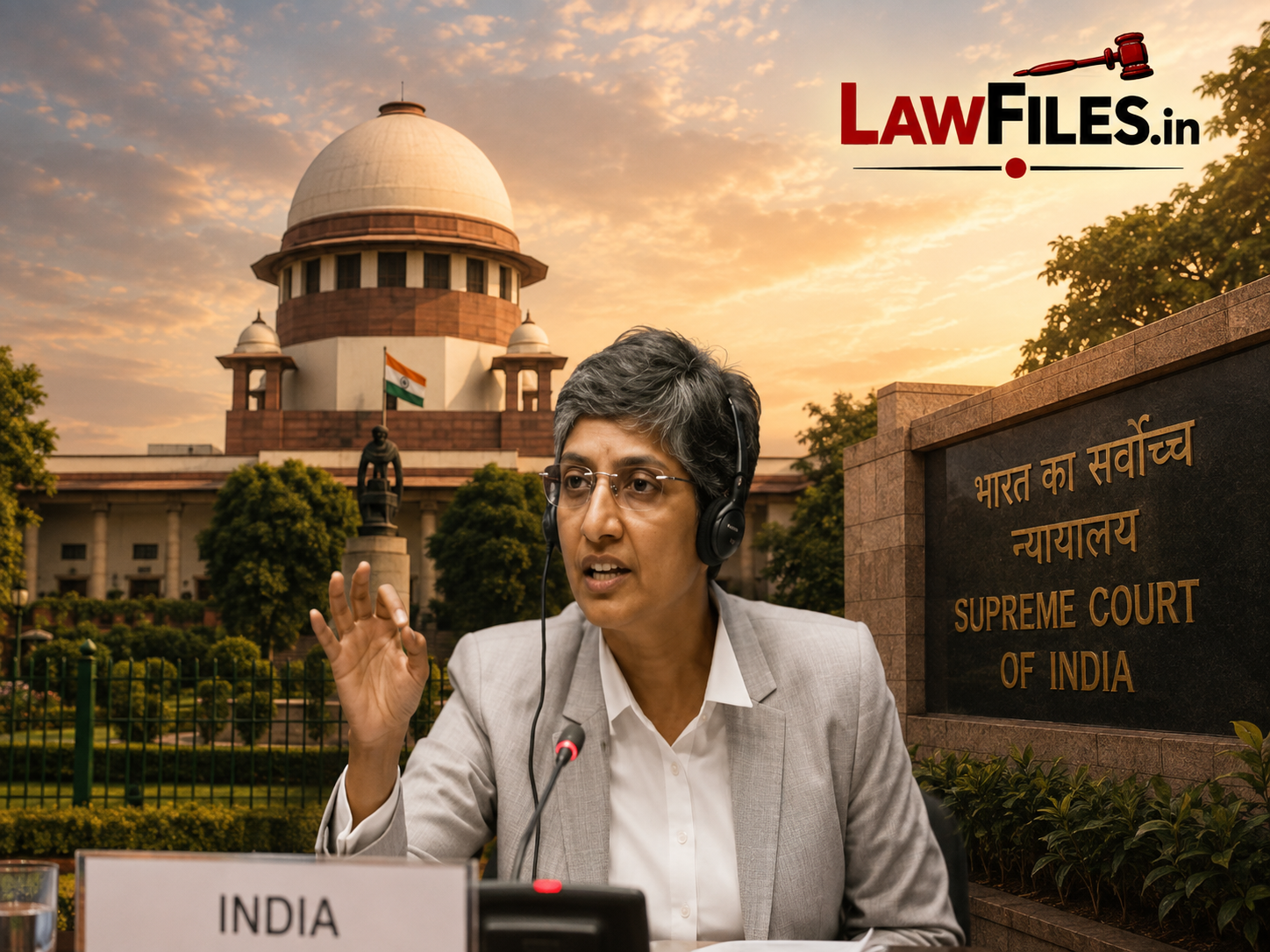
A vigorous constitutional debate unfolded in the Rajya Sabha after Senior Advocate and Member of Parliament Menaka Guruswamy alleged during parliamentary proceedings that the Union Government appoints only those judges who broadly align with its ideological preferences. The remarks, made while participating in a discussion concerning the functioning of constitutional institutions and the judiciary, have once again brought into public focus one of the most contested issues in Indian constitutional law the relationship between the executive and the judiciary in the process of judicial appointments. Although the observations were made in the course of parliamentary debate and do not constitute judicial findings, they have revived larger questions regarding the transparency, independence and institutional design of India’s judicial appointment process.
The comments assume significance because they emerge against the backdrop of a continuing national conversation concerning delays in judicial appointments, executive objections to Collegium recommendations, and repeated institutional exchanges between the judiciary and the Union Government over vacancies in constitutional courts. The issue is not merely political. It goes to the heart of the constitutional architecture governing the separation of powers, the independence of the judiciary, and the mechanism through which judges of the Supreme Court and High Courts are selected.
During the parliamentary discussion, Menaka Guruswamy reportedly argued that appointments to the constitutional courts increasingly reflect ideological compatibility with the executive rather than purely objective constitutional criteria. Her criticism centred upon the perceived influence exercised by the executive at different stages of the appointment process, particularly where Collegium recommendations remain pending for extended periods or are returned for reconsideration. The remarks immediately generated constitutional and political discussion because they touched upon an issue that has repeatedly surfaced in judicial as well as public discourse, namely whether delays or selective approvals may indirectly influence the composition of constitutional courts.
The present system of judicial appointments in India is fundamentally governed by the Collegium system, a judge-made constitutional mechanism evolved through the landmark Second Judges Case (Supreme Court Advocates-on-Record Association v. Union of India, 1993) and subsequently clarified in the Third Judges Case (1998 Presidential Reference). These decisions interpreted Articles 124 and 217 of the Constitution to hold that appointments to the higher judiciary should ordinarily be based upon the collective opinion of the senior-most judges, with the Chief Justice of India occupying a position of institutional primacy. Although the executive continues to play a constitutionally recognised role by processing recommendations, conducting intelligence verification and formally issuing appointments, the judiciary’s recommendation enjoys primacy under the existing constitutional framework.
The constitutional controversy surrounding judicial appointments intensified further after Parliament enacted the Ninety-Ninth Constitutional Amendment establishing the National Judicial Appointments Commission (NJAC). The legislation sought to replace the Collegium with a commission comprising members of the judiciary, executive and eminent persons. However, in Supreme Court Advocates-on-Record Association v. Union of India (2015), popularly known as the NJAC Judgment, a Constitution Bench struck down the constitutional amendment, holding that judicial primacy in appointments forms part of the basic structure of the Constitution because judicial independence constitutes an indispensable feature of constitutional governance. Although the Court retained the Collegium system, it simultaneously acknowledged concerns regarding transparency and invited suggestions for improving the appointment process.
It is against this constitutional background that Menaka Guruswamy’s parliamentary observations acquire broader significance. Her remarks do not challenge the existence of the Collegium itself. Instead, they raise questions regarding the practical functioning of the appointment process after the Collegium has made its recommendations. Under existing procedure, Collegium recommendations are forwarded to the Union Government, which may seek clarifications or, in appropriate cases, return a recommendation for reconsideration. If the Collegium reiterates its recommendation, constitutional convention and judicial precedent require the executive to ordinarily proceed with the appointment. However, debates have frequently arisen concerning delays between recommendation and notification, giving rise to allegations from different quarters regarding executive influence over the pace and outcome of appointments.
From a constitutional perspective, the issue engages the doctrine of judicial independence, a principle repeatedly recognised by the Supreme Court as forming part of the Constitution’s basic structure. Judicial independence is not designed to protect judges as individuals; rather, it protects litigants and citizens by ensuring that judges remain free from political pressure while adjudicating disputes involving governments and constitutional authorities. Consequently, any perception that judicial appointments may become susceptible to ideological considerations naturally attracts intense constitutional scrutiny.
At the same time, the constitutional position requires careful distinction between political allegation and judicial finding. The observations made in Parliament represent the opinion of an elected Member of Parliament participating in legislative debate. They do not amount to a judicial determination that appointments have, in fact, been influenced by ideological considerations. No constitutional court has delivered any finding supporting such a proposition in relation to the present appointment process. The significance of the remarks therefore lies less in their evidentiary value and more in the constitutional questions they raise concerning transparency and institutional accountability.
Another important legal dimension concerns the role of the executive within the appointment framework. The Constitution does not completely exclude the executive from judicial appointments. Background verification, intelligence inputs, service records, vigilance reports and administrative processing all remain important components of the appointment mechanism. Successive governments have defended this role by arguing that appointments to constitutional courts necessarily involve institutional consultation between different constitutional authorities. Conversely, critics argue that prolonged delays or selective objections may indirectly affect judicial independence by influencing which recommendations ultimately mature into appointments.
The debate also revives the continuing discussion regarding transparency within the Collegium system itself. Over the past decade, the Supreme Court has introduced several reforms, including publication of Collegium resolutions, recording of reasons for recommendations and greater public disclosure regarding appointments and transfers. Nevertheless, constitutional scholars continue to debate whether additional transparency measures should be introduced while simultaneously preserving the confidentiality necessary for evaluating judicial candidates.
From a comparative constitutional perspective, India is not unique in confronting this challenge. Democracies across the world have adopted widely differing judicial appointment models. The United States follows a system of presidential nomination and legislative confirmation, where ideological debate openly forms part of the appointment process. The United Kingdom relies primarily upon an independent Judicial Appointments Commission. Several European jurisdictions employ judicial councils comprising judges, executive representatives and members of civil society. India’s Collegium system represents a distinctive constitutional model placing primacy upon judicial opinion while preserving a limited consultative role for the executive.
The parliamentary discussion also reflects the larger constitutional concern regarding public confidence in judicial institutions. Judicial legitimacy depends not only upon actual independence but equally upon public perception that judges are appointed through processes insulated from political influence. Whether one supports the Collegium system or advocates institutional reform, confidence in constitutional courts ultimately rests upon widespread belief that judicial appointments are determined by competence, integrity and constitutional commitment rather than ideological preference.
Another noteworthy aspect is the relationship between constitutional morality and institutional dialogue. India’s constitutional framework anticipates occasional differences between the executive and the judiciary. Such disagreements do not necessarily indicate constitutional breakdown; rather, they often reflect the checks and balances deliberately incorporated into the constitutional design. Parliamentary debate concerning judicial appointments therefore constitutes a legitimate component of democratic discourse, provided it remains within the constitutional framework and respects the institutional independence of the judiciary.
The issue also raises broader questions concerning constitutional accountability. Judicial independence cannot imply institutional opacity, just as executive participation cannot become a vehicle for political control. The continuing constitutional challenge lies in constructing a system that simultaneously protects judicial autonomy, promotes transparency, ensures accountability and commands public confidence across the political spectrum.
Importantly, no judicial proceedings formed the basis of the parliamentary remarks, and no constitutional court has presently adjudicated upon the specific allegations articulated during the debate. The observations remain part of a broader legislative and political discussion concerning the functioning of constitutional institutions. Consequently, they should not be construed as established factual findings but as contributions to an ongoing constitutional conversation regarding institutional reform.
Ultimately, the Rajya Sabha debate underscores a constitutional reality that has persisted for decades: judicial appointments remain among the most sensitive issues in Indian constitutional governance. Whether viewed from the perspective of judicial independence, executive accountability, transparency or institutional legitimacy, the appointment process continues to occupy the centre of constitutional discourse. Menaka Guruswamy’s remarks have once again drawn national attention to this enduring debate, reminding constitutional institutions that public confidence in the judiciary depends not only upon the quality of judicial decisions but equally upon sustained confidence in the fairness, impartiality and constitutional integrity of the process through which judges themselves are appointed.
