


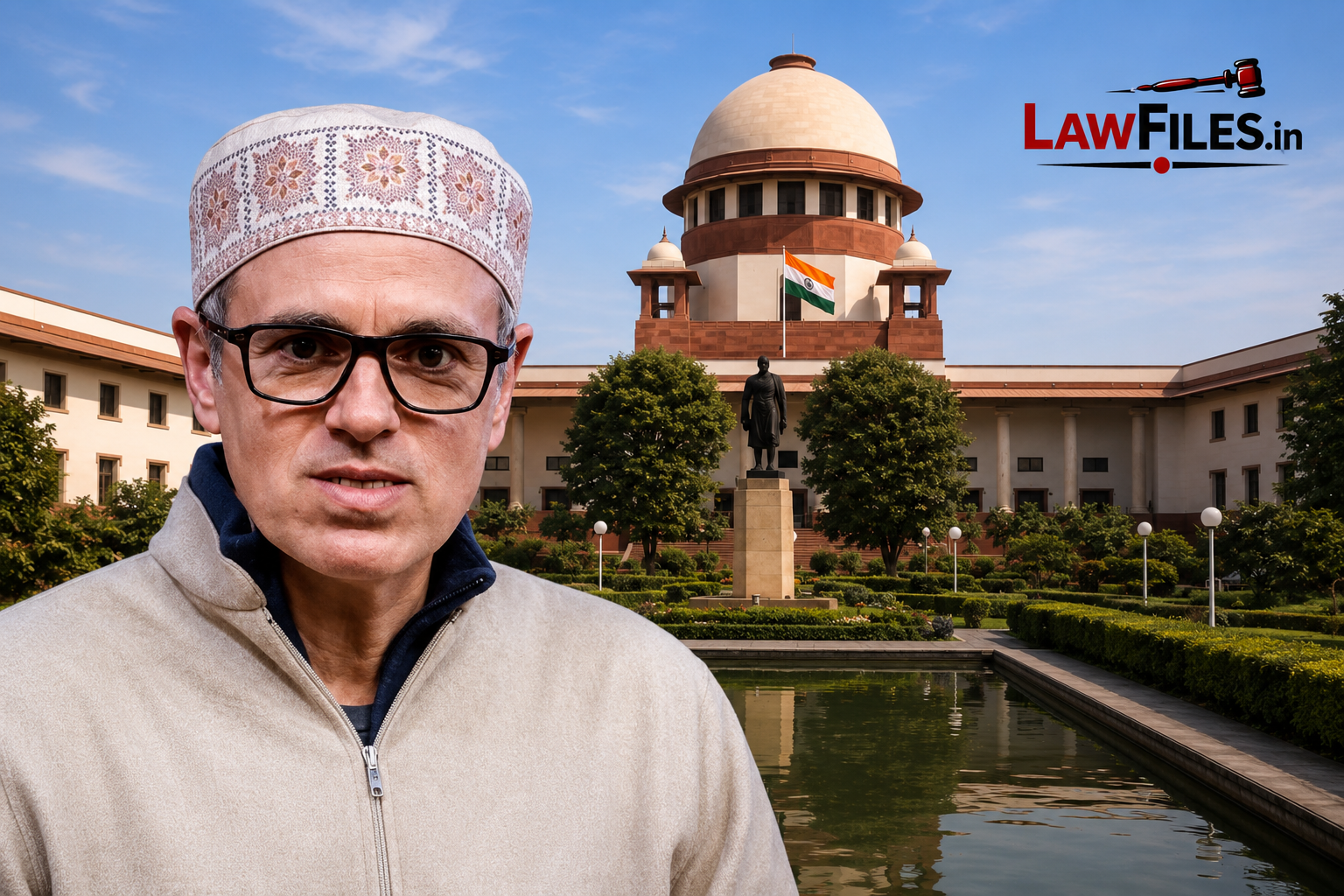
The Supreme Court of India has brought to a close one of the country’s most closely watched matrimonial disputes after Jammu and Kashmir Chief Minister Omar Abdullah and his estranged wife Payal Abdullah informed the Court that they had amicably resolved their differences through mediation and jointly sought dissolution of their marriage. Recording the settlement arrived at between the parties, the Supreme Court accepted their joint application and granted a decree of divorce, thereby concluding a long-pending matrimonial dispute that had remained the subject of litigation for several years. While the case inevitably attracted public attention because one of the litigants occupies high constitutional office, the proceedings before the Court ultimately revolved not around politics but around an increasingly significant feature of Indian family law the constitutional encouragement of negotiated settlements, mediation and dignified dissolution of irretrievably broken matrimonial relationships.
The dispute had travelled through multiple judicial forums before reaching the Supreme Court. Omar Abdullah had initially approached the Family Court seeking dissolution of marriage on statutory grounds under the Hindu Marriage Act, 1955. Although the litigation proceeded through the ordinary appellate process, the parties eventually expressed willingness to explore an amicable settlement under the supervision of the Supreme Court’s mediation mechanism. During the latest hearing, counsel appearing for both sides informed the Bench that the mediation process had successfully resolved all outstanding matrimonial issues and that both spouses had voluntarily agreed to terminate their marriage. Accepting the joint request, the Court disposed of the proceedings after recording the settlement and granting a decree of divorce.
The significance of the proceedings extends well beyond the identity of the parties. The case demonstrates the increasingly central role played by court-annexed mediation in matrimonial litigation. Unlike conventional adversarial proceedings, mediation seeks to facilitate dialogue rather than determine winners and losers. Matrimonial disputes frequently involve not merely legal rights but emotional, financial and familial relationships that cannot always be satisfactorily resolved through contested judicial findings alone. Recognising this reality, the Supreme Court has, over the past decade, consistently encouraged parties in appropriate matrimonial disputes to attempt consensual resolution before prolonged litigation deepens personal conflict. The present settlement exemplifies that evolving judicial philosophy.
At the heart of the proceedings lies the statutory framework governing divorce by mutual consent under Section 13-B of the Hindu Marriage Act, 1955. The provision enables spouses who have lived separately and mutually concluded that the marriage cannot continue to jointly seek dissolution. Ordinarily, the statute contemplates a two-stage process involving a cooling-off period intended to encourage reconciliation. However, the Supreme Court has repeatedly clarified that where the marriage has irretrievably broken down and all disputes stand amicably resolved, constitutional powers under Article 142 may be exercised to do complete justice between the parties. This constitutional jurisdiction has gradually transformed the manner in which complex matrimonial disputes are resolved before the apex court.
The proceedings also illustrate the practical importance of Article 142 of the Constitution, a unique constitutional provision empowering the Supreme Court to pass such orders as may be necessary for doing complete justice in any cause pending before it. Although the Hindu Marriage Act prescribes specific statutory grounds and procedures for divorce, Article 142 enables the Supreme Court, in exceptional situations, to bring comprehensive closure to disputes where continued litigation serves no meaningful purpose. Over the years, the Court has repeatedly exercised this extraordinary jurisdiction in cases involving irretrievable breakdown of marriage, particularly where prolonged separation, failed reconciliation efforts and comprehensive settlements demonstrate that restoration of matrimonial life is no longer realistically possible.
The concept of irretrievable breakdown of marriage occupies an increasingly important place in contemporary matrimonial jurisprudence despite not yet being an independent statutory ground for divorce under the Hindu Marriage Act. The Supreme Court has consistently observed that the law cannot compel spouses to continue a relationship that has ceased to exist in every practical sense. In several recent judgments, the Court has emphasised that maintaining a marriage solely as a legal fiction neither preserves the institution of marriage nor advances the interests of justice. Instead, where parties have remained separated for prolonged periods and reconciliation appears impossible, constitutional intervention may become necessary to permit both individuals to move forward with dignity.
Equally noteworthy is the Court’s continuing emphasis upon mediation as an instrument of restorative justice rather than merely an alternative dispute resolution mechanism. Matrimonial disputes differ fundamentally from ordinary commercial litigation. Financial claims, child custody, maintenance, property rights and emotional concerns frequently intersect in ways that adversarial adjudication cannot comprehensively address. Mediation allows parties to negotiate confidentially, identify mutually acceptable solutions and preserve personal dignity while avoiding the adversarial consequences of prolonged courtroom contests. The settlement recorded in the present case once again demonstrates the institutional confidence that the Supreme Court has placed in professionally supervised mediation for resolving family disputes.
Another important legal dimension concerns the evolving relationship between individual autonomy and judicial oversight. While matrimonial disputes often involve intensely personal decisions, courts retain an obligation to ensure that any settlement is voluntary, informed and free from coercion. Before recording a settlement and granting divorce, the Supreme Court ordinarily satisfies itself that both parties have consciously agreed to the terms, understood the legal consequences and voluntarily seek dissolution of the marriage. This judicial scrutiny preserves the integrity of mediated settlements while respecting the autonomy of consenting adults.
The proceedings also reflect the judiciary’s growing recognition that litigation should not become an instrument for prolonging matrimonial discord. Courts increasingly distinguish between disputes where reconciliation remains realistically possible and those where prolonged hostility has rendered continuation of the legal relationship meaningless. In the latter category, judicial insistence upon preserving the formal existence of marriage often produces further emotional distress without advancing any legitimate social objective. The Supreme Court has therefore repeatedly observed that the institution of marriage is strengthened not by compelling unwilling spouses to remain legally bound but by ensuring that dissolution, where genuinely unavoidable, occurs through a fair and dignified legal process.
From a broader constitutional perspective, the case illustrates the expanding role of consensual dispute resolution within India’s justice delivery system. Commercial disputes, family conflicts, service matters and even certain constitutional cases increasingly witness judicial encouragement of negotiated settlements where appropriate. The Mediation Act and the Supreme Court’s institutional mediation framework reflect a conscious policy shift towards reducing adversarial litigation while preserving substantive justice. Matrimonial disputes, given their deeply personal nature, have become one of the principal areas where this judicial philosophy has found practical expression.
The settlement also demonstrates the distinction between public office and private legal rights. Although Omar Abdullah presently occupies the office of Chief Minister of Jammu and Kashmir, the Supreme Court treated the proceedings strictly as a matrimonial dispute governed by ordinary principles of family law. Constitutional courts have consistently maintained that personal disputes involving public functionaries must be adjudicated according to the same legal standards applicable to every other citizen. The case therefore reaffirms the principle that equality before law extends equally to matrimonial litigation irrespective of the public stature of the parties.
The proceedings assume additional significance when viewed alongside the Supreme Court’s recent jurisprudence encouraging finality in matrimonial settlements. In several decisions delivered over the past year, the Court has underscored that once parties voluntarily arrive at a comprehensive settlement through mediation, courts should ordinarily facilitate its implementation rather than permit renewed rounds of litigation. The Court has also cautioned against attempts to resile from negotiated settlements without legally sustainable grounds, emphasising that mediation succeeds only when parties and courts alike respect the finality of consensual agreements.
At the policy level, the case contributes to the continuing evolution of Indian family law from a framework centred exclusively upon fault-based adjudication towards one increasingly recognising autonomy, negotiated resolution and constitutional dignity. Traditional matrimonial litigation frequently required courts to determine allegations of cruelty, desertion or adultery through prolonged adversarial trials. Contemporary jurisprudence, while preserving statutory safeguards, increasingly acknowledges that where spouses themselves agree that the marriage has irretrievably failed and have resolved all ancillary disputes, consensual termination often better serves both individual dignity and judicial economy.
The proceedings also reinforce an important constitutional message regarding the function of courts in family disputes. Judicial institutions do not exist merely to pronounce legal rights after exhaustive trials. They also perform the equally important function of facilitating peaceful resolution where litigation itself has ceased to serve any constructive purpose. By encouraging mediation and recording voluntary settlements, courts enable parties to conclude painful personal disputes with greater dignity than prolonged adversarial proceedings ordinarily permit.
Ultimately, the conclusion of the matrimonial dispute between Omar Abdullah and Payal Abdullah is legally significant not because of the public identities of the parties, but because it reflects the continuing transformation of Indian matrimonial jurisprudence. The case underscores the Supreme Court’s preference for mediation over confrontation, consensus over prolonged contest, and constitutional justice over procedural rigidity. It also reaffirms the Court’s willingness to exercise its extraordinary powers where necessary to bring complete and meaningful closure to disputes that have long ceased to serve the purposes for which matrimonial litigation exists. In doing so, the proceedings reinforce a broader constitutional philosophy that the law governing marriage is not concerned merely with preserving legal relationships at all costs, but with ensuring that where relationships genuinely come to an end, the legal system provides a process that is fair, dignified, humane and consistent with the constitutional values of autonomy, equality and justice.
