


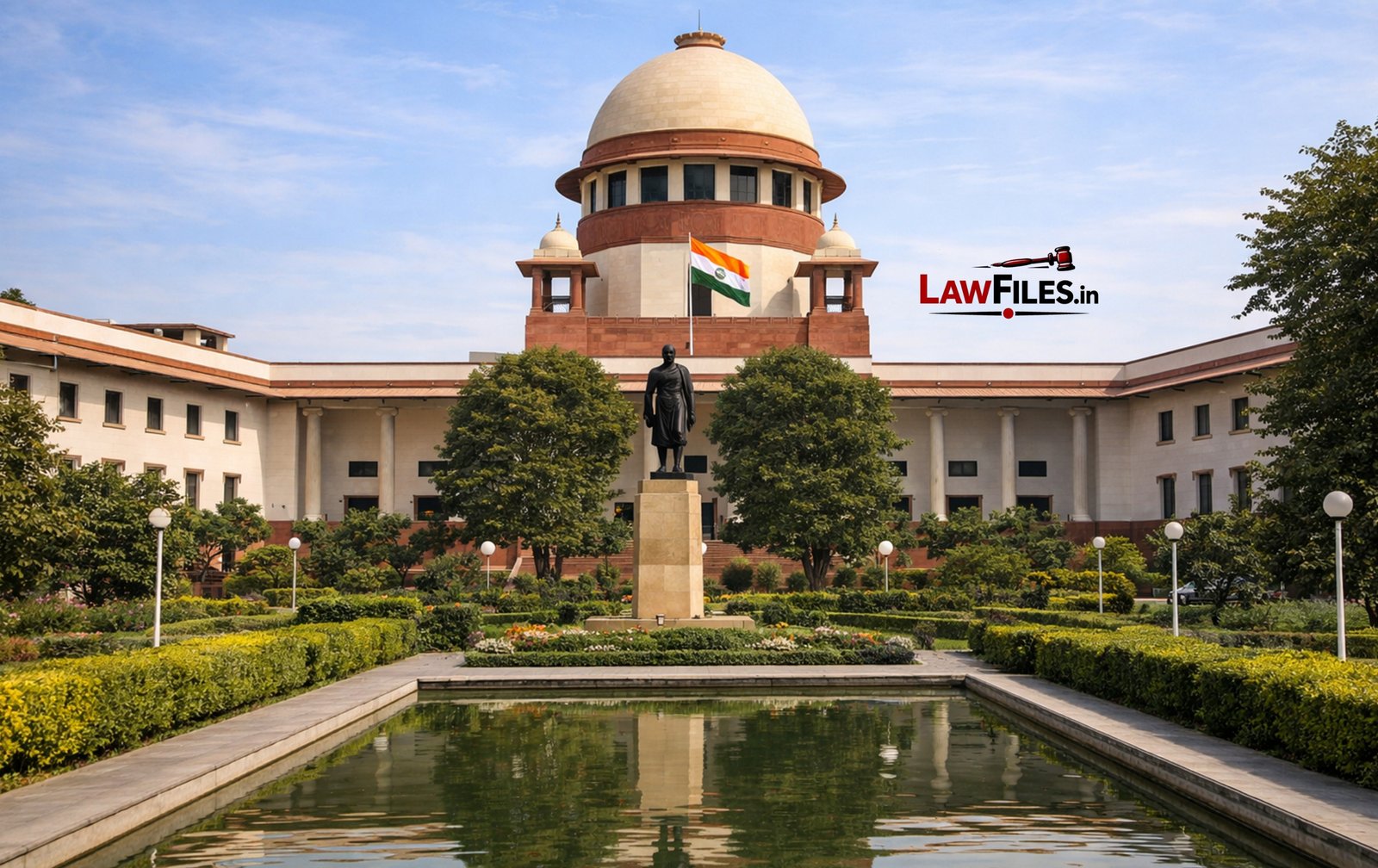
In a landmark decision with far-reaching consequences for India’s indirect tax regime, the Supreme Court of India has upheld the constitutional validity of Section 16(2)(c) of the Central Goods and Services Tax Act, 2017 (CGST Act), holding that a purchasing dealer is not entitled to claim Input Tax Credit (ITC) unless the supplier has actually deposited the corresponding tax with the Government. A Bench comprising Justice Sanjay Kumar and Justice Sanjeev Sachdeva, while dismissing a batch of Special Leave Petitions arising from the Gujarat High Court’s judgment, affirmed that the statutory condition linking ITC to actual payment of tax by the supplier is neither arbitrary nor unconstitutional. Rejecting the plea that bona fide purchasers should be insulated from the default of erring suppliers, the Court observed that Input Tax Credit is not a constitutional or vested right but a statutory concession, and therefore remains subject to the conditions expressly prescribed by Parliament. The ruling settles one of the most contentious issues under the GST regime and substantially strengthens the Government’s position that seamless credit under GST is conditional upon actual tax realisation by the exchequer rather than merely upon payment between contracting parties.
The controversy centred around Section 16(2)(c) of the CGST Act, which provides that a registered recipient is entitled to claim ITC only if the tax charged in respect of the supply has actually been paid to the Government, either in cash or through utilisation of admissible input tax credit by the supplier. Several purchasing dealers challenged the provision before the Gujarat High Court, contending that it imposed an impossible burden upon genuine buyers who had fulfilled every statutory obligation within their control. According to the petitioners, once the purchaser had paid the full invoice amount including GST, received the goods or services, possessed a valid tax invoice and complied with all filing requirements, denial of ITC merely because the supplier subsequently failed to remit tax to the Government amounted to punishing an innocent purchaser for the misconduct of another person. They argued that the provision violated Articles 14, 19(1)(g), 265 and 300A of the Constitution, and alternatively sought a reading down of the provision so that it would apply only where fraud, collusion or connivance between the purchaser and supplier was established.
The Gujarat High Court, however, rejected these constitutional challenges and upheld the validity of Section 16(2)(c), holding that the provision formed an integral part of the statutory architecture governing Input Tax Credit. It reasoned that ITC under GST is not an unconditional entitlement but a legislative benefit designed to operate only when every prescribed condition stands satisfied. The High Court further observed that the statutory framework, particularly when read alongside Sections 41, 53 and Rule 37A of the CGST Rules, contemplates reversal and subsequent re-availment of credit if the supplier later deposits the tax. The Court therefore concluded that the provision did not amount to unconstitutional double taxation and that the purchasing dealer retained remedies against the defaulting supplier. At the same time, recognising the genuine hardship faced by honest businesses, the High Court urged the Union Government to develop technology-driven mechanisms enabling real-time verification of supplier tax payments and to undertake prompt recovery proceedings against defaulting suppliers rather than leaving bona fide purchasers exposed to prolonged uncertainty.
When the matter reached the Supreme Court, the principal argument advanced by the petitioners remained that the law imposed an unrealistic obligation impossible for a purchaser to satisfy. Commercial purchasers ordinarily possess no statutory authority to compel suppliers to deposit collected GST into the Government treasury. They neither control the supplier’s tax compliance nor have access to internal accounting systems reflecting whether tax has actually been discharged. Consequently, the petitioners argued, denial of ITC despite complete compliance with every obligation resting upon the purchaser offended constitutional guarantees of equality and imposed a disproportionate burden upon honest businesses. They further relied upon earlier judicial decisions rendered under the Delhi Value Added Tax Act and the Tripura High Court’s judgment in Sahil Enterprises, which had sought to protect bona fide purchasing dealers from supplier defaults.
The Supreme Court, however, declined to accept these submissions. Endorsing the reasoning adopted by the Gujarat High Court in Maruti Enterprise v. Union of India, the Bench observed that the statutory scheme under the GST regime materially differs from the earlier VAT framework and therefore comparisons with Delhi VAT jurisprudence were misplaced. The Court emphasised that the architecture of the CGST Act specifically conditions the availability of Input Tax Credit upon actual tax payment to the Government and provides mechanisms permitting reversal and subsequent restoration of credit where compliance is eventually achieved. Finding itself in “complete and respectful agreement” with the Gujarat High Court, the Supreme Court affirmed that no grounds existed either to strike down Section 16(2)(c) or to judicially read it down in the manner suggested by the petitioners.
The judgment assumes considerable significance because it reaffirms a foundational principle of Indian tax jurisprudence—that Input Tax Credit is a creation of statute rather than an inherent constitutional entitlement. Unlike property rights or contractual rights, ITC does not arise independently of legislation. It exists solely because Parliament has chosen to grant it, and the legislature remains competent to prescribe the conditions upon which the concession may be availed. The Court’s reasoning follows a long line of judicial authority distinguishing between taxation itself and statutory concessions granted within a taxation framework. Once Parliament creates such a concession, courts ordinarily refrain from diluting the statutory conditions unless they transgress constitutional limitations. In the present case, the Supreme Court found no such constitutional infirmity.
The decision also reflects the judiciary’s recognition of the design philosophy underlying the GST system. GST was conceived as a destination-based value-added tax built upon seamless flow of credit across every stage of the supply chain. However, that seamless flow depends upon corresponding tax actually reaching the Government. If purchasing dealers were permitted to retain ITC despite suppliers never depositing tax collected from them, the public exchequer would effectively bear the financial loss while dishonest suppliers retained amounts collected as tax. Section 16(2)(c), according to the statutory scheme upheld by the Court, seeks to prevent precisely this situation by ensuring that credit flows only after corresponding tax reaches Government revenue.
At the same time, the controversy exposes one of the most difficult practical challenges confronting businesses under GST. Commercial purchasers frequently transact with hundreds or even thousands of vendors spread across multiple jurisdictions. While modern compliance tools such as GSTR-2B, invoice matching and return reconciliation provide increasing visibility into supplier compliance, purchasers still possess limited control over whether suppliers ultimately discharge their tax liability. Consequently, the commercial burden of vendor due diligence has grown substantially under GST. Businesses today are increasingly compelled to verify supplier filing behaviour, monitor return compliance, incorporate indemnity clauses into commercial contracts and continuously evaluate vendor risk before claiming Input Tax Credit. The Supreme Court’s ruling is likely to accelerate these compliance practices across industries.
Importantly, the Court did not disregard the hardship likely to be faced by genuine purchasing dealers. Rather, it accepted the Gujarat High Court’s observation that legislative and technological improvements remain desirable. The High Court had specifically recommended creation of a robust digital mechanism enabling purchasers to verify, in real time, whether suppliers had deposited GST corresponding to individual invoices. It also urged tax authorities to prioritise recovery from defaulting suppliers instead of leaving purchasers to pursue cumbersome civil remedies. These observations, though not forming the operative ratio of the judgment, underscore judicial awareness that efficient tax administration requires balancing revenue protection with commercial certainty.
The ruling also clarifies the relationship between constitutional review and fiscal policy. Tax statutes frequently involve complex economic considerations, balancing revenue collection against commercial convenience. Constitutional courts traditionally accord substantial deference to legislative judgment in fiscal matters unless a provision is manifestly arbitrary or directly infringes constitutional guarantees. In the present case, the Supreme Court concluded that Parliament’s decision to condition ITC upon actual tax payment by the supplier represented a legitimate legislative choice forming part of a coherent statutory framework rather than an arbitrary classification violating Article 14.
From the perspective of commercial law, the judgment is likely to reshape contractual drafting. Businesses may increasingly insist upon contractual warranties requiring suppliers to maintain GST compliance, furnish periodic tax payment confirmations, permit audit of compliance records and indemnify purchasers against denial of ITC resulting from supplier defaults. Vendor onboarding procedures may become more rigorous, particularly in sectors involving large volumes of input credit such as manufacturing, infrastructure, pharmaceuticals, automobile production and export-oriented industries. Financial institutions and investors may likewise scrutinise GST compliance practices more closely while evaluating commercial risk.
The decision also marks a departure from the more purchaser-friendly reasoning adopted by the Tripura High Court in Sahil Enterprises, which had suggested that Section 16(2)(c) should be interpreted so as to protect bona fide purchasers acting without fraud or collusion. By affirming the Gujarat High Court and distinguishing the statutory framework under GST from earlier VAT jurisprudence, the Supreme Court has effectively settled the conflict among High Courts and established a uniform national position. The Court observed that the detailed statutory analysis undertaken by the Gujarat High Court correctly reflected the structure and objectives of the CGST Act, leaving little scope for importing principles developed under materially different tax enactments.
The judgment is equally significant for tax administration. It reinforces that GST operates through an interconnected compliance ecosystem where the conduct of each participant in the supply chain directly affects others. While this architecture strengthens revenue protection, it simultaneously places greater emphasis upon compliance management rather than merely transactional documentation. Businesses can no longer regard possession of a tax invoice and proof of payment as sufficient safeguards. Instead, continuing vendor compliance becomes an integral component of preserving Input Tax Credit under the statutory scheme.
Ultimately, the Supreme Court’s decision in Bhandari Scrap Traders v. Union of India & Others represents one of the most consequential pronouncements on GST since the introduction of the indirect tax regime. By upholding the constitutional validity of Section 16(2)(c), the Court has reaffirmed that Input Tax Credit remains a conditional statutory concession and not an absolute commercial entitlement. While the ruling undoubtedly strengthens the Government’s ability to safeguard public revenue against fraudulent supplier defaults, it simultaneously highlights the pressing need for technological reforms capable of protecting genuine businesses from circumstances beyond their control. The judgment therefore settles the constitutional debate but leaves an important policy conversation alive: whether India’s GST architecture can evolve towards a compliance system that simultaneously secures the exchequer, penalises dishonest suppliers and shields bona fide purchasers from disproportionate commercial hardship. That balance may ultimately determine whether GST fulfils its foundational promise of being not merely a unified tax, but a fair and efficient one.
