


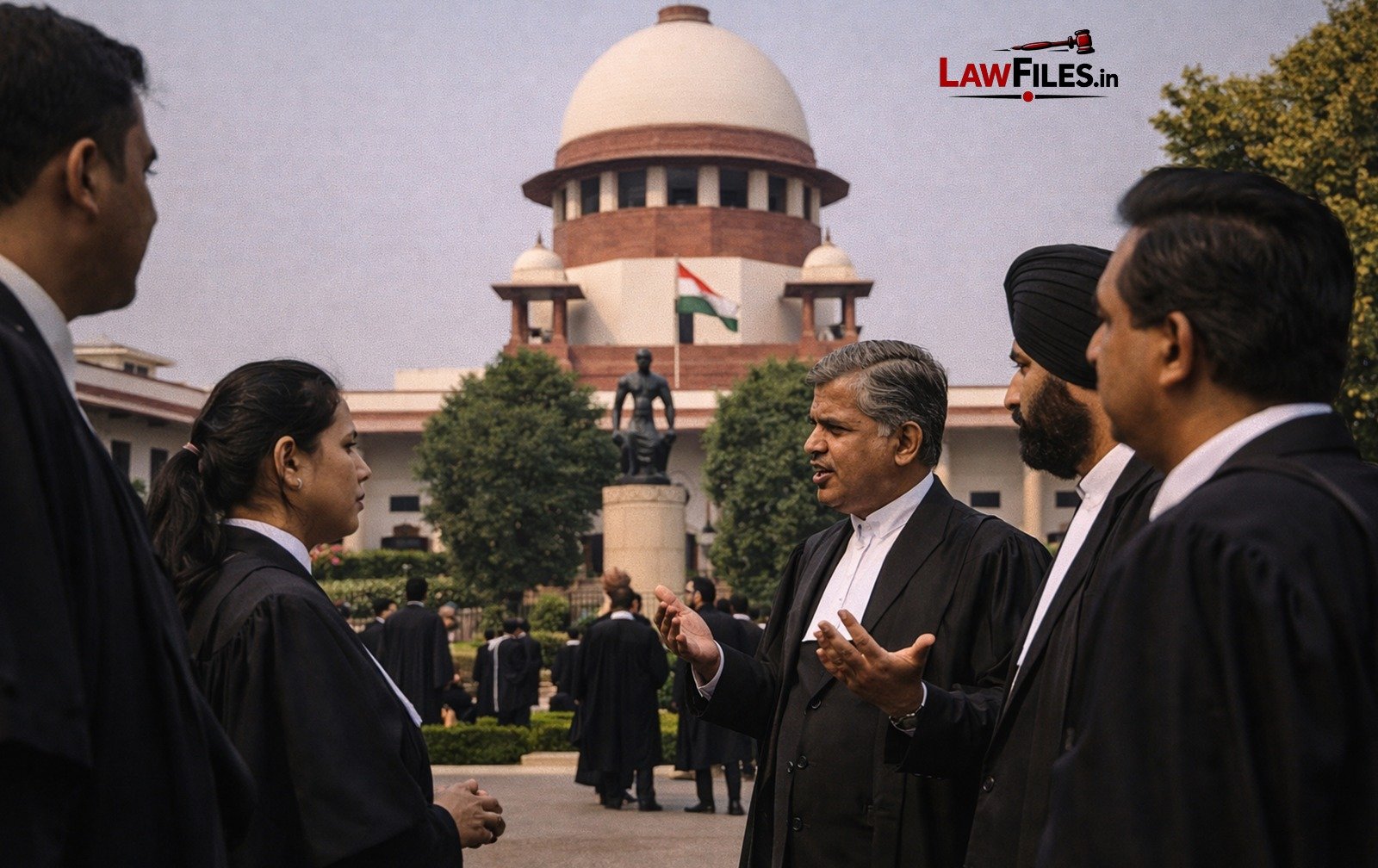
In a landmark interim order that is likely to shape the future of judicial transparency in the digital age, the Supreme Court of India has prohibited the extraction, editing, dissemination, posting, reposting, uploading and monetisation of audio and video recordings of judicial proceedings on social media and other digital platforms without prior permission from the competent judicial authority. The order was passed by a Bench comprising Chief Justice of India Surya Kant, Justice Joymalya Bagchi and Justice V. Mohan, while hearing a public interest litigation seeking comprehensive guidelines to regulate the clipping and circulation of live-streamed court proceedings. Clarifying that the direction would not affect fair and accurate news reporting of court proceedings, the Court drew an important constitutional distinction between legitimate reporting of judicial proceedings and the unauthorised digital exploitation of courtroom recordings. The interim directions, which apply until further orders, represent one of the most significant judicial responses to the rapidly expanding ecosystem of legal content creators, social media influencers and commercial platforms that routinely circulate edited courtroom clips to millions of viewers.
The Court directed that no person or digital platform shall extract, modify, disseminate, upload, repost or monetise audiovisual recordings of court proceedings without obtaining prior permission from the Registrar General of the concerned High Court or the Secretary General of the Supreme Court. Importantly, the Bench made it clear that the restriction is aimed at regulating the use of official courtroom recordings and does not curtail journalistic reporting of judicial proceedings, thereby preserving the long-established principle of open court reporting. The order was passed after the Court issued notice to the Union Government, all High Courts and major social media intermediaries, including Meta and X, while directing the Government to identify the appropriate nodal ministries that could formulate a regulatory framework governing judicial recordings.
The proceedings originated from a petition filed by journalist Harshita Grover under Article 32 of the Constitution, highlighting what she described as the increasing misuse of live-streamed judicial proceedings. According to the petition, courtroom exchanges are frequently extracted from lengthy hearings, edited without context, accompanied by sensational captions and uploaded across social media platforms to maximise online engagement and advertising revenue. The plea argued that this practice often transforms tentative oral observations into misleading public narratives, exposes judges, lawyers and litigants to online harassment and gradually erodes public confidence in the administration of justice. Rather than seeking to prohibit live-streaming itself, the petitioner requested the formulation of reasonable safeguards capable of preserving transparency while preventing distortion and commercial exploitation of judicial proceedings.
During the hearing, Chief Justice Surya Kant made a candid observation that reflected the growing concern within the judiciary regarding selective digital circulation of courtroom exchanges. Referring to his own experience, the Chief Justice remarked that statements never actually made by him had nevertheless been attributed to him through selectively edited social media content. The observation highlights a challenge increasingly confronting constitutional courts across democratic jurisdictions—judicial proceedings designed to promote openness are simultaneously becoming vulnerable to manipulation through short video clips, algorithm-driven engagement and sensational digital presentation. The Court therefore recognised that while technology has significantly improved public access to judicial functioning, it has also created unprecedented opportunities for misinformation and reputational harm.
The constitutional significance of the order lies in its attempt to reconcile two equally important constitutional values. On one hand stands the principle of open justice, which has long been recognised as an indispensable feature of democratic adjudication. On the other stands the equally compelling need to protect the integrity, dignity and fairness of judicial proceedings from technological misuse. The Court’s interim directions do not reject transparency; rather, they seek to ensure that transparency itself is not transformed into a mechanism for distortion. In constitutional terms, the order represents an effort to preserve openness while preventing the very openness of the judicial process from being weaponised against the institution it was intended to strengthen.
The doctrine of open justice occupies a central position within Indian constitutional jurisprudence. Although the Constitution does not expressly employ the phrase, the Supreme Court has consistently held that public hearings constitute an essential safeguard against arbitrary adjudication. Open courts ensure judicial accountability, promote public confidence and reinforce the legitimacy of constitutional institutions. The live-streaming of Constitution Bench proceedings, introduced following the Supreme Court’s decision in Swapnil Tripathi v. Supreme Court of India, was itself conceived as an extension of this constitutional philosophy. By enabling citizens across the country to observe judicial proceedings, live-streaming sought to democratise access to justice and deepen public understanding of constitutional adjudication. The present order, significantly, does not dilute that principle but seeks to regulate the secondary use of those recordings after the proceedings conclude.
The distinction between live access and digital redistribution is legally significant. Court proceedings are dynamic conversations in which judges frequently pose hypothetical questions, test legal propositions and make tentative oral observations before ultimately arriving at a final judgment. Such exchanges are often exploratory rather than determinative. When isolated snippets are extracted from several hours of hearing and circulated without surrounding context, they may convey an impression entirely different from what actually transpired inside the courtroom. The Court appears to have recognised that the architecture of social media rewards brevity, controversy and emotional engagement, whereas judicial reasoning depends upon context, nuance and deliberation. The constitutional challenge therefore is not the existence of public access but the fragmentation of judicial discourse into viral digital content.
The petition also raises important questions regarding commercial exploitation of judicial material. According to the pleadings placed before the Court, numerous social media channels and digital platforms generate advertising revenue by publishing edited courtroom clips accompanied by provocative headlines and sensational commentary. Such practices transform judicial proceedings—originally made publicly accessible to strengthen constitutional democracy—into monetisable digital commodities. The Court’s interim prohibition on monetisation therefore addresses not merely issues of copyright or unauthorised dissemination but also the larger concern that constitutional institutions should not become sources of commercial entertainment through selective editing and algorithm-driven amplification.
Equally noteworthy is the Court’s decision to issue notice to social media intermediaries. This reflects judicial recognition that contemporary information ecosystems operate through digital platforms whose recommendation algorithms significantly influence public perception. Even where the original recording remains authentic, algorithmic amplification of isolated clips accompanied by misleading captions can substantially distort public understanding of judicial proceedings. By bringing digital intermediaries within the scope of the proceedings, the Court has acknowledged that regulation of judicial recordings cannot be effectively achieved without considering the technological architecture through which such content is disseminated.
From the perspective of constitutional free speech, the order invites careful analysis. Article 19(1)(a) guarantees freedom of speech and expression, including press freedom and public discussion of judicial proceedings. However, that freedom has never extended to an unrestricted right to manipulate official judicial recordings or commercially exploit them in a manner capable of undermining the administration of justice. The Court therefore consciously clarified that news reporting remains unaffected. Journalists remain free to report hearings, analyse legal arguments and discuss judgments. The restriction applies only to the unauthorised extraction, editing and circulation of official audiovisual recordings. This distinction attempts to preserve the constitutional balance between freedom of expression and institutional integrity.
The proceedings also revisit the long-standing legal distinction between oral observations and binding judicial decisions. Courts have repeatedly clarified that oral remarks made during hearings do not constitute enforceable declarations of law. Judges frequently advance tentative propositions solely to test competing submissions. Yet in the age of short-form video content, such observations are increasingly circulated as though they represent final judicial pronouncements. This practice not only confuses the public but may also prejudice ongoing proceedings by creating distorted perceptions regarding the likely outcome of pending cases. The Court’s order therefore seeks to preserve the integrity of judicial deliberation by ensuring that fragmented exchanges are not presented as definitive statements of law.
Comparative constitutional practice also supports calibrated regulation of courtroom recordings. Several jurisdictions, including the United Kingdom Supreme Court, permit public access to audiovisual recordings while simultaneously imposing detailed conditions governing their reproduction, editing and commercial use. Such safeguards are designed to ensure that judicial transparency does not become vulnerable to manipulation or sensationalism. The petition specifically referred to international practices while requesting the Supreme Court to evolve a similar regulatory framework suited to Indian constitutional conditions.
Another significant aspect of the proceedings concerns the future relationship between technology and the judiciary. Over the last decade, Indian courts have increasingly embraced digital innovation through e-filing, hybrid hearings, virtual courts and live-streaming. These reforms have substantially enhanced accessibility and transparency. However, the present litigation demonstrates that every technological advance also generates new constitutional questions concerning authenticity, privacy, institutional dignity and responsible public communication. The Court’s interim order may therefore represent the beginning of a broader jurisprudence governing digital interaction with judicial institutions.
The implications of the order extend beyond judges and lawyers. Legal educators, digital publishers, content creators, law students and media organisations that regularly rely upon courtroom recordings will likely need to revisit their practices. While legal commentary and educational analysis remain entirely permissible, unauthorised extraction and redistribution of official recordings may increasingly require judicial approval once a comprehensive regulatory framework is finalised. The decision therefore encourages a more responsible culture of legal communication while preserving the public’s legitimate interest in understanding judicial proceedings.
Ultimately, the Supreme Court’s interim order is not a retreat from transparency but an attempt to rescue transparency from distortion. The Court has consciously preserved open justice by allowing continued news reporting and maintaining live-streaming itself, while simultaneously recognising that unrestricted digital clipping, selective editing and commercial exploitation threaten the very objectives that live-streaming was introduced to achieve. The challenge before constitutional democracies is no longer whether courts should be transparent; it is how transparency should be protected in an age where digital technologies can transform nuanced constitutional dialogue into viral fragments divorced from legal context. By drawing that distinction, the Supreme Court has initiated an important constitutional conversation—one that will likely shape the future of judicial communication, digital media regulation and the evolving relationship between technology and the administration of justice in India.
