


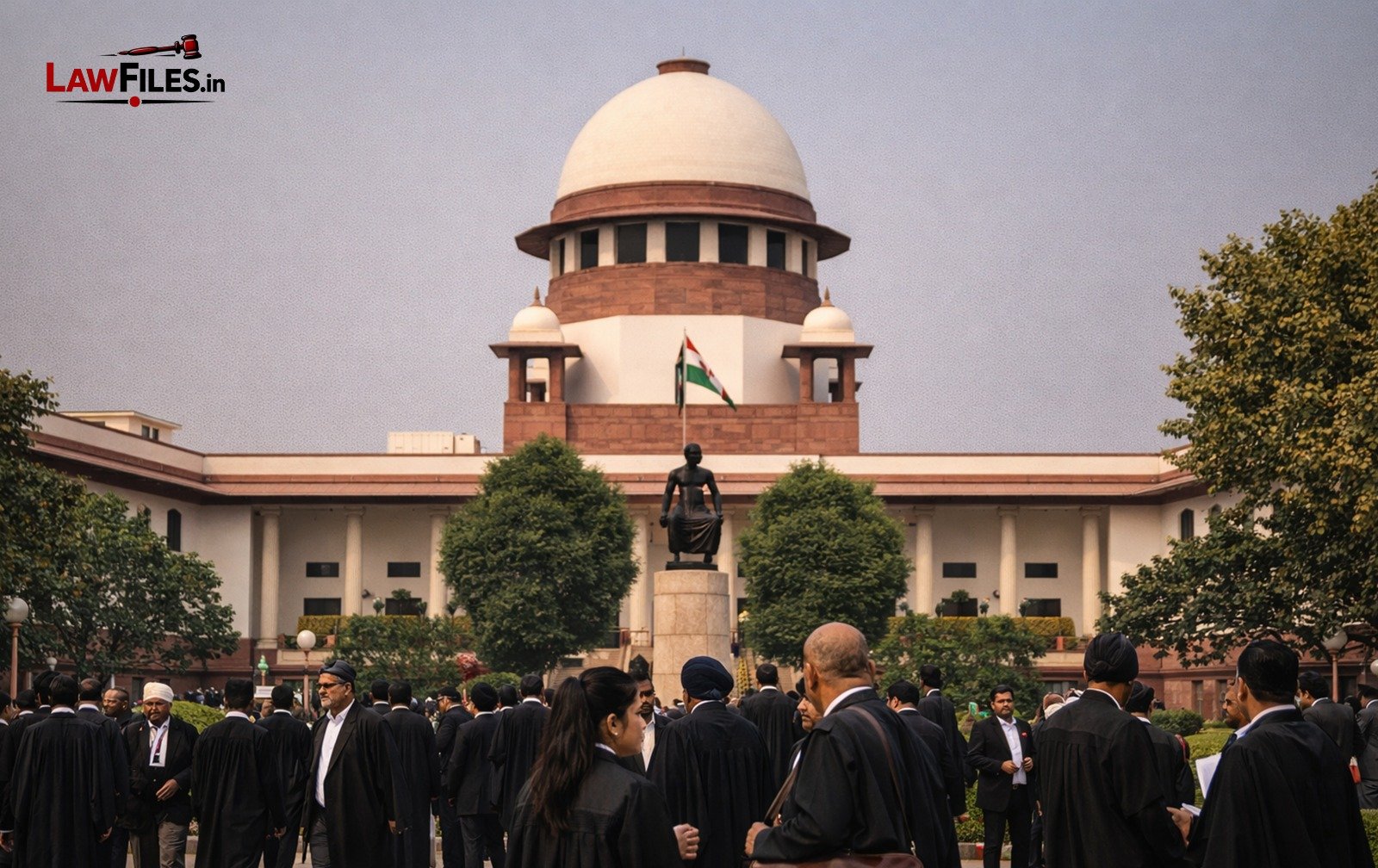
The lawns of the Supreme Court of India became the venue for an extraordinary constitutional moment when members of the legal fraternity gathered during the lunch recess to collectively recite the Preamble to the Constitution of India under the banner of the campaign “Save Democracy, Save Constitution.” The event was organised amidst widespread student protests across the country concerning alleged examination paper leaks and the subsequent police action in Delhi. Senior Advocate Indira Jaising, Justice (Retd.) S. Muralidhar, Supreme Court Bar Association President Senior Advocate Vikas Singh, several senior advocates, Advocates-on-Record and young members of the Bar participated in the programme. Carrying copies of the Constitution and the National Flag, the participants publicly reaffirmed the constitutional ideals of Justice, Liberty, Equality and Fraternity, transforming what appeared to be a symbolic gathering into an important constitutional conversation. Although the event was held outside formal court proceedings, it immediately drew national attention because it reflected the legal fraternity’s engagement with issues lying at the intersection of constitutional rights, democratic dissent and institutional accountability.
The gathering assumed greater significance because it followed a series of developments that had already placed the Supreme Court and the legal community at the centre of public discourse. In the days preceding the event, both the Supreme Court Bar Association (SCBA) and the Supreme Court Advocates-on-Record Association (SCAORA) had expressed concern over the alleged use of force against student protesters and members of the legal fraternity. The Bar bodies called for an independent inquiry into the incidents and urged that accountability be fixed if excessive police action was established. Around the same time, the Supreme Court itself had taken cognisance of the practical difficulties caused by the closure of the Supreme Court Metro Station due to the protests, with Chief Justice Surya Kant assuring the Bar that the Court would intervene if the issue remained unresolved. These developments provided the immediate background against which the public recitation of the Preamble acquired constitutional as well as symbolic importance.
From a constitutional perspective, however, the most important question is not why lawyers assembled, but why they chose to read the Preamble instead of raising political slogans or issuing a conventional protest statement. The answer lies in the unique constitutional status of the Preamble itself. While it does not create independently enforceable legal rights, the Preamble encapsulates the philosophy and objectives that animate the entire constitutional framework. It declares India’s commitment to justice, liberty, equality and fraternity and serves as the moral compass guiding constitutional interpretation. Therefore, when lawyers publicly recite the Preamble, they are not merely reading introductory words to a legal document; they are reaffirming the foundational principles upon which every institution of the Republic—including Parliament, the Executive and the Judiciary—is expected to function.
The constitutional significance of the Preamble has been repeatedly recognised by the Supreme Court, particularly in the landmark decision of Kesavananda Bharati v. State of Kerala (1973). In that judgment, the Court held that the Preamble forms an integral part of the Constitution and reflects the Basic Structure Doctrine, which limits Parliament’s power to amend the Constitution. Values such as democracy, republicanism, secularism, liberty, equality and the rule of law are therefore not merely aspirational ideals but constitutional commitments that cannot be destroyed even through constitutional amendment. Against this legal backdrop, the collective reading of the Preamble assumes far greater significance than an ordinary symbolic act. It represents an affirmation that constitutional values must remain the touchstone for evaluating public action, institutional conduct and democratic disagreements.
Equally significant is the role of the legal profession within India’s constitutional framework. Advocates are not merely representatives of individual litigants but are recognised as officers of the court, entrusted with duties that extend beyond client representation. Their professional obligations include assisting the administration of justice, protecting the integrity of judicial institutions and upholding constitutional values. Throughout India’s constitutional history, members of the Bar have frequently participated in debates concerning civil liberties, judicial independence and democratic governance. From the freedom movement to the Emergency and from constitutional reform debates to contemporary public interest litigation, lawyers have consistently occupied a central place in shaping constitutional discourse. The present gathering therefore continues a long institutional tradition in which the legal profession engages with constitutional issues while remaining committed to the independence of the judiciary.
The episode also revives an important discussion on the scope of Article 19 of the Constitution. The guarantees of freedom of speech and expression, peaceful assembly and association collectively recognise that democracy requires active civic participation rather than passive acceptance of governmental decisions. Peaceful symbolic acts such as reading the Constitution, carrying the National Flag or publicly affirming constitutional values constitute recognised forms of democratic expression, subject of course to the reasonable restrictions authorised under Articles 19(2) and 19(3). The lawyers’ gathering therefore illustrates that constitutional engagement need not always take the form of adversarial litigation. At times, the reaffirmation of constitutional ideals through peaceful public expression itself becomes an important contribution to democratic culture.
