


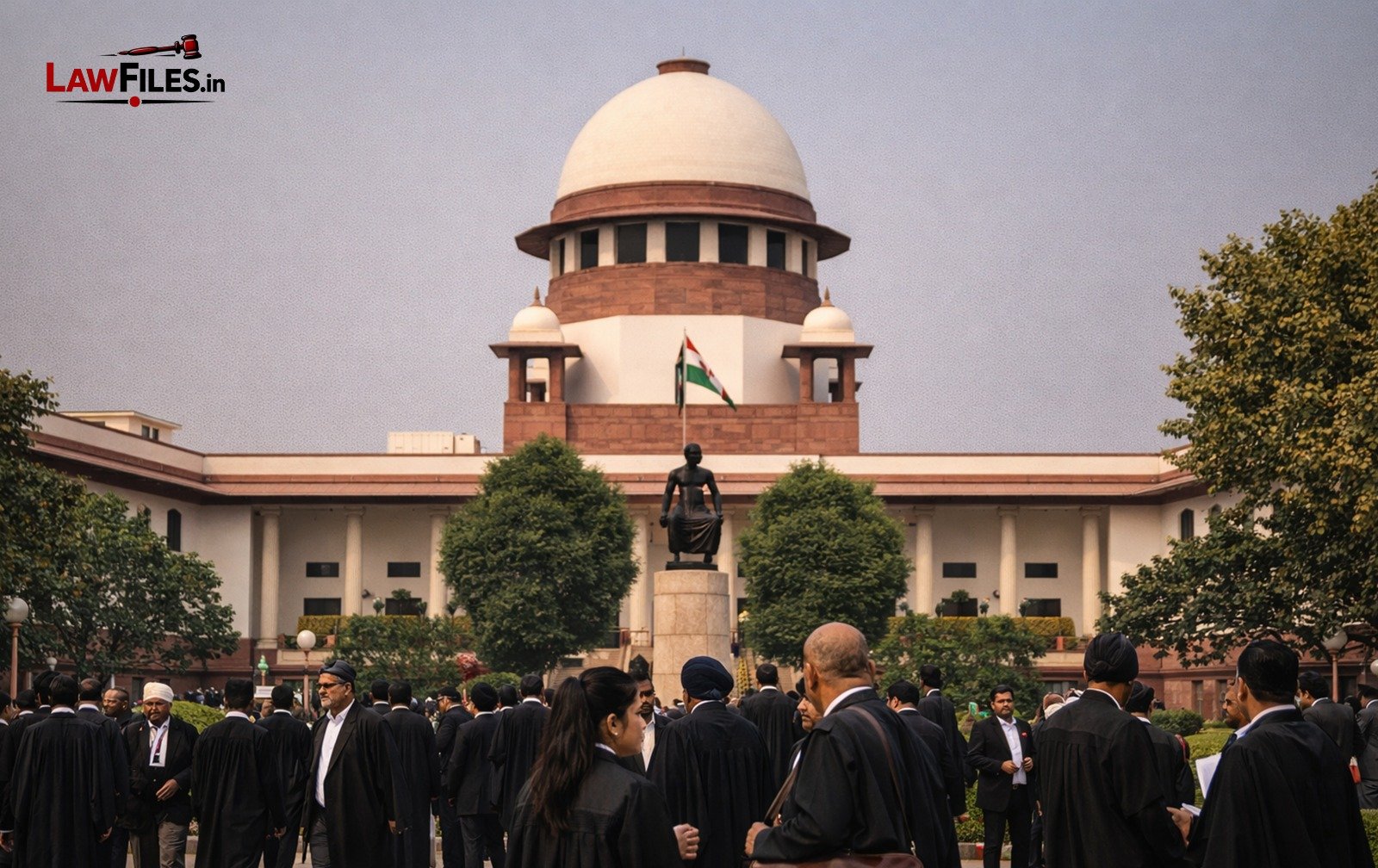
In a significant development touching upon the delicate intersection of criminal jurisprudence, political protest and judicial scrutiny of prosecutions, the Supreme Court has indicated that it is not inclined to interfere with the Punjab and Haryana High Court’s decision quashing criminal proceedings against Punjab Chief Minister Bhagwant Mann in a decades-old rioting case. While hearing a Special Leave Petition filed by the Chandigarh Administration, the Court observed that democratic politics inevitably involves public demonstrations and slogan-raising, remarking that “everyone does naarebaazi in a democracy.” At the same time, the Bench clarified that if the Administration intended to challenge the High Court’s judgment, it must do so on sound legal grounds rather than political rhetoric or generalised allegations. The Court’s observations, though made during preliminary hearing, reflect a broader constitutional principle that criminal law must remain an instrument of justice and not become a means of prolonging politically charged prosecutions in the absence of sustainable legal evidence.
The proceedings arose from a challenge to the Punjab and Haryana High Court’s order quashing criminal proceedings initiated against Bhagwant Mann in connection with an incident dating back several years, when he was an opposition political leader. The prosecution alleged that Mann and others had participated in an unlawful assembly, raised slogans, obstructed public officials and committed offences relating to rioting and obstruction of public servants during a political demonstration. After examining the record, however, the High Court concluded that continuation of the criminal proceedings would amount to an abuse of the judicial process and exercised its inherent jurisdiction to quash the FIR and all consequential proceedings.
Aggrieved by that decision, the Chandigarh Administration approached the Supreme Court contending that the High Court had prematurely terminated the prosecution without permitting a full-fledged criminal trial. It was argued that the allegations disclosed cognisable offences and that disputed factual issues ought to have been examined only after recording evidence before the trial court. The Administration therefore urged the Supreme Court to restore the criminal case and allow the prosecution to proceed in accordance with law.
During the hearing, however, the Supreme Court expressed reservations regarding the challenge. The Bench observed that it was not inclined to interfere with the High Court’s judgment unless the Administration could demonstrate specific legal errors in the reasoning adopted by the High Court. Referring to the allegations concerning slogan-raising during the protest, the Court remarked that raising slogans is not an uncommon feature of democratic political activity, observing that “everyone does naarebaazi in democracy.” The Court accordingly advised the Administration to argue the matter on legal merits, indicating that political overtones or general assertions could not justify revival of criminal proceedings once the High Court had exercised its quashing jurisdiction after evaluating the available material.
Although the Supreme Court has not finally dismissed the appeal, its observations are constitutionally significant because they reaffirm the settled limits governing judicial interference with orders quashing criminal proceedings. Once a High Court invokes its inherent powers after concluding that continuation of prosecution would constitute abuse of process, an appellate court ordinarily interferes only where the order suffers from manifest illegality, perversity or jurisdictional error. The Supreme Court’s preliminary observations therefore indicate judicial reluctance to reopen criminal litigation merely because another view may also be possible.
The controversy inevitably invites examination of the inherent powers of the High Court under Section 482 of the Code of Criminal Procedure, 1973, now substantially reflected in Section 528 of the Bharatiya Nagarik Suraksha Sanhita, 2023. These provisions preserve the inherent jurisdiction of constitutional courts to prevent abuse of judicial process and to secure the ends of justice. The power is extraordinary and is intended to be exercised sparingly. Nevertheless, where criminal proceedings appear manifestly unsustainable, malicious, legally deficient or instituted for collateral purposes, the High Court possesses authority to terminate the prosecution at the threshold rather than compel an accused to undergo a prolonged criminal trial.
The governing principles were authoritatively laid down in State of Haryana v. Bhajan Lal (1992), where the Supreme Court identified illustrative categories in which criminal proceedings may legitimately be quashed. These include situations where the allegations, even if accepted in their entirety, do not disclose any offence; where the prosecution is manifestly attended by mala fides; where the proceedings are instituted with an ulterior motive; or where continuation of the prosecution would amount to abuse of the judicial process. Although the categories are not exhaustive, Bhajan Lal remains the foundational precedent governing the exercise of inherent jurisdiction in criminal matters.
Subsequent decisions such as Neeharika Infrastructure Pvt. Ltd. v. State of Maharashtra (2021) have reaffirmed that while courts should ordinarily refrain from evaluating disputed evidence at the investigation stage, they remain duty-bound to intervene where prosecution itself becomes legally untenable. The present proceedings must therefore be understood within this well-established jurisprudential framework. The issue before the Supreme Court is not whether Bhagwant Mann is innocent or guilty of the allegations originally levelled against him; rather, the question is whether the High Court correctly concluded that the criminal proceedings were legally incapable of continuing.
Equally important is the constitutional backdrop against which the Court’s observations regarding slogan-raising assume significance. Article 19(1)(a) guarantees freedom of speech and expression, while Article 19(1)(b) protects the right to assemble peacefully without arms. Political demonstrations, public meetings and slogan-raising constitute recognised forms of democratic participation, though these freedoms remain subject to reasonable restrictions under Articles 19(2) and 19(3) in the interests of public order, sovereignty, security and other constitutionally recognised grounds. Consequently, every political protest does not automatically become criminal merely because it is loud, inconvenient or critical of the government. Criminal liability arises only where statutory ingredients of specific offences are independently established.
This distinction is particularly important in prosecutions alleging offences such as rioting under Sections 146 and 147 IPC (corresponding provisions now contained in the Bharatiya Nyaya Sanhita). Rioting requires proof of an unlawful assembly coupled with the use of force or violence in prosecution of the common object. Mere presence at a political gathering or participation in slogan-raising, without satisfying the statutory ingredients, cannot by itself constitute the offence. Similarly, allegations of obstruction of public servants or unlawful assembly must be supported by concrete evidence demonstrating the essential elements prescribed by the Penal Code rather than inferred from political participation alone.
The Supreme Court’s observations also reflect a broader institutional concern regarding criminalisation of political activity. Indian constitutional history contains numerous examples where criminal law has intersected with political protest. While unlawful conduct during demonstrations unquestionably attracts penal consequences, courts have consistently cautioned against employing criminal prosecution as a mechanism to discourage legitimate democratic dissent. Judicial scrutiny therefore becomes particularly important where prosecutions arise out of political agitations, ensuring that constitutional freedoms are not indirectly curtailed through prolonged criminal proceedings unsupported by adequate legal foundation.
From the standpoint of criminal procedure, the case illustrates the distinction between judicial review of prosecutorial decision-making and judicial determination of guilt. Quashing proceedings does not amount to a declaration that the accused never participated in the events alleged. Rather, it reflects the court’s conclusion that, assuming the prosecution materials to be true, continuation of criminal proceedings would nevertheless fail to satisfy the legal requirements necessary for a valid prosecution or would otherwise constitute abuse of process. This procedural distinction is central to understanding why High Courts possess inherent powers to terminate proceedings even before commencement of trial.
Another notable aspect of the hearing is the Supreme Court’s insistence that the Chandigarh Administration argue “on merits.” This observation underscores an important appellate principle. Once a High Court delivers a reasoned judgment quashing criminal proceedings, the burden shifts to the appellant to identify specific legal infirmities rather than rely upon the political sensitivity of the dispute or the public profile of the accused. Appellate review is directed towards the correctness of judicial reasoning, not the identity of the parties involved.
The proceedings also reinforce the constitutional expectation of institutional neutrality in criminal administration. Whether the accused occupies public office, belongs to the ruling party or the opposition, the governing legal standards remain identical. Criminal law derives its legitimacy from equal application rather than selective invocation. Consequently, courts must examine prosecutions involving political figures through the same objective legal principles that govern every other criminal case, neither extending special protection nor permitting exceptional severity because of political status.
Ultimately, the Supreme Court’s preliminary observations should not be understood as a final adjudication of the appeal. The Chandigarh Administration remains free to advance substantive legal arguments challenging the High Court’s exercise of inherent jurisdiction. Yet the hearing has already reaffirmed an important constitutional proposition: criminal prosecution cannot rest upon political symbolism alone. Democratic societies inevitably witness demonstrations, slogans and vigorous political contestation. Where such activity crosses into genuine criminality, prosecution is both lawful and necessary. But where statutory ingredients remain doubtful or proceedings appear disproportionate to the conduct alleged, constitutional courts are empowered to intervene to prevent misuse of the criminal process. By signalling that legal merit not political controversy must determine the fate of criminal litigation, the Supreme Court has reiterated a foundational principle of the rule of law: criminal justice must remain governed by evidence, statutory requirements and constitutional safeguards, not by the intensity of political disagreement.
