


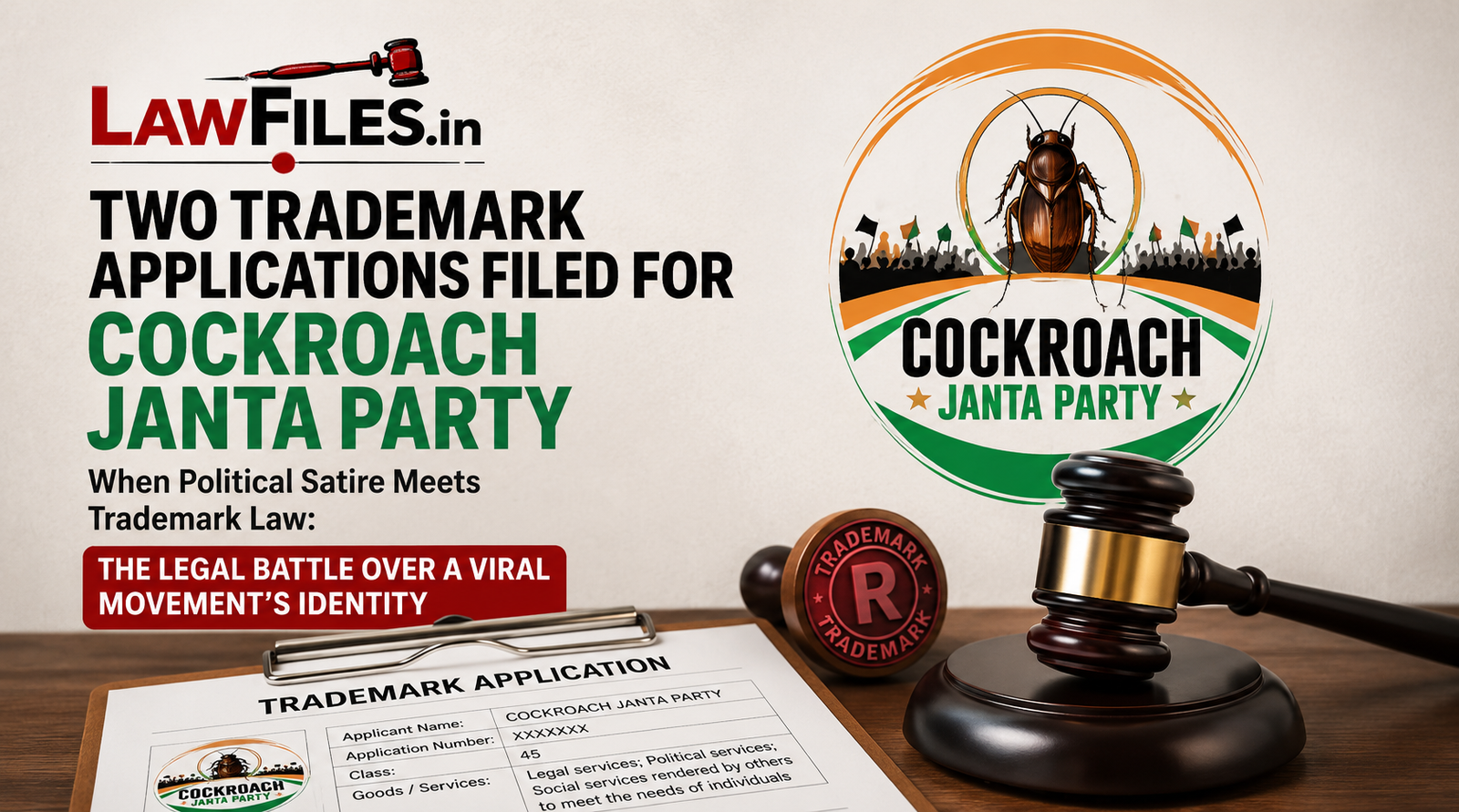
The filing of trademark applications for the phrase “Cockroach Janata Party” has transformed what began as a viral social media phenomenon into a fascinating case study at the intersection of intellectual property law, political expression, branding rights, and digital culture. What initially emerged as a satirical response to judicial remarks has now evolved into a legal controversy that raises important questions about ownership of political slogans, trademark protection of viral movements, and the commercialization of internet-driven public discourse. The development demonstrates how rapidly digital narratives can acquire legal and commercial significance in an age where political messaging and brand identity often overlap.
According to records available on the Trade Marks Registry, multiple applications have been filed seeking registration of the mark “Cockroach Janta Party” or “Cockroach Janata Party.” The applications were reportedly filed by private individuals rather than the individuals associated with the viral movement that popularized the phrase online. Both applications were filed under Class 45, which broadly relates to legal and certain personal services, and had cleared the preliminary formality stage at the time the issue attracted public attention.
The controversy traces its origins to remarks made during proceedings before the Supreme Court, after which the phrase “Cockroach Janata Party” rapidly gained traction across social media platforms. What began as an expression of political satire quickly transformed into an online movement attracting substantial public engagement, particularly among younger demographics. As media attention grew, the phrase evolved from a mere hashtag into a recognizable identifier associated with a broader political and social commentary movement.
From a trademark law perspective, the episode presents an intriguing legal question: can a phrase that emerges organically from public discourse and political satire become the exclusive property of a private individual through trademark registration? Under the Trade Marks Act, 1999, registration does not automatically flow from mere filing. An applicant must establish entitlement to registration and demonstrate that the proposed mark is capable of distinguishing their goods or services from those of others. The controversy therefore raises broader concerns regarding whether public expressions, political slogans, or socially generated movements should be capable of monopolization through trademark law.
The issue becomes even more complex because trademark law is fundamentally designed to protect commercial goodwill rather than political legitimacy. Traditionally, trademarks function as indicators of source, enabling consumers to identify the origin of goods and services. Political slogans and movement names occupy a different conceptual space. They often derive their value not from commercial activity but from collective participation, public engagement, and ideological association. The attempt to secure proprietary rights over such expressions therefore sits at the intersection of private intellectual property rights and public discourse.
Legal commentators have observed that courts and trademark authorities across jurisdictions frequently exercise caution when dealing with politically sensitive or socially significant expressions. A mark may face objections if it is found to lack distinctiveness, is descriptive in nature, or is likely to mislead the public regarding its association with a particular organization or movement. Consequently, the filing of an application does not necessarily guarantee registration, particularly where questions arise concerning ownership, prior association, or public interest considerations.
The controversy also highlights a broader transformation in the nature of political communication. Traditionally, political parties and social movements built recognition through years of grassroots engagement. In contrast, the digital age has enabled political identities to emerge almost overnight through viral content, memes, and online campaigns. The “Cockroach Janata Party” phenomenon illustrates how internet culture can rapidly generate symbols, slogans, and identities that acquire real-world political relevance. The subsequent trademark filings reveal how intellectual property law is increasingly being called upon to address disputes arising from these unconventional forms of social mobilization.
Newspaper analyses and public commentary surrounding the controversy have focused on another important dimension—the commercialization of virality. Several commentators have noted that viral expressions today often possess substantial economic value. Social media movements can generate merchandise, sponsorships, digital communities, and even political capital. In such circumstances, trademark registration may be viewed not merely as a legal formality but as an attempt to secure future commercial rights over a rapidly expanding public brand. This reflects a growing trend where intellectual property law becomes a battleground for ownership of digital narratives before formal organizations are even established.
The matter also raises questions about the distinction between political identity and brand identity. Modern political movements increasingly operate through sophisticated branding strategies similar to those employed by corporations. Logos, slogans, hashtags, and movement names often function as powerful tools for mobilization and public engagement. As a result, trademark law is becoming increasingly relevant to political communication. However, extending exclusive proprietary rights over politically significant expressions may create tensions with democratic values that depend upon open participation and public discourse.
Another noteworthy aspect of the controversy is the apparent disconnect between the individuals who popularized the movement and those who sought trademark registration. This situation highlights a recurring challenge in intellectual property law: determining ownership where a symbol, phrase, or expression emerges collectively rather than through a clearly identifiable creator. Unlike traditional commercial trademarks, which usually originate from a business entity, viral political expressions often emerge through decentralized participation across digital platforms. Such circumstances complicate conventional notions of proprietorship and goodwill.
The episode further underscores the growing importance of intellectual property awareness in political and social movements. Activists, content creators, advocacy groups, and emerging organizations increasingly find themselves confronting legal questions traditionally associated with corporate branding. Failure to secure legal protection at an early stage may create opportunities for third parties to claim rights over names, symbols, or slogans that acquire public recognition. The controversy therefore serves as a practical lesson in the strategic importance of intellectual property management in the digital era.
For law students and young practitioners, the dispute offers a compelling example of how intellectual property law continues to evolve in response to technological and social change. It illustrates the expanding relevance of trademark law beyond conventional commercial contexts and highlights the challenges of applying traditional legal doctrines to internet-generated phenomena. The matter also demonstrates the increasing convergence of constitutional law, political communication, media studies, and intellectual property rights.
The broader significance of the controversy extends beyond the fate of any particular trademark application. At its core, the dispute reflects a deeper question confronting modern legal systems: who owns a public idea once it captures the imagination of millions? As digital platforms continue to blur the boundaries between social movements, political expression, and commercial branding, courts and regulatory authorities will increasingly be called upon to determine where private ownership ends and public discourse begins.
Ultimately, the “Cockroach Janata Party” trademark controversy is more than a routine intellectual property dispute. It represents a glimpse into the future of legal regulation in the digital age, where memes can become movements, hashtags can become brands, and political satire can evolve into subjects of formal legal claims. Whether the applications ultimately succeed or fail, the episode has already emerged as a significant illustration of the challenges that arise when intellectual property law encounters the unpredictable dynamics of contemporary digital democracy.
