


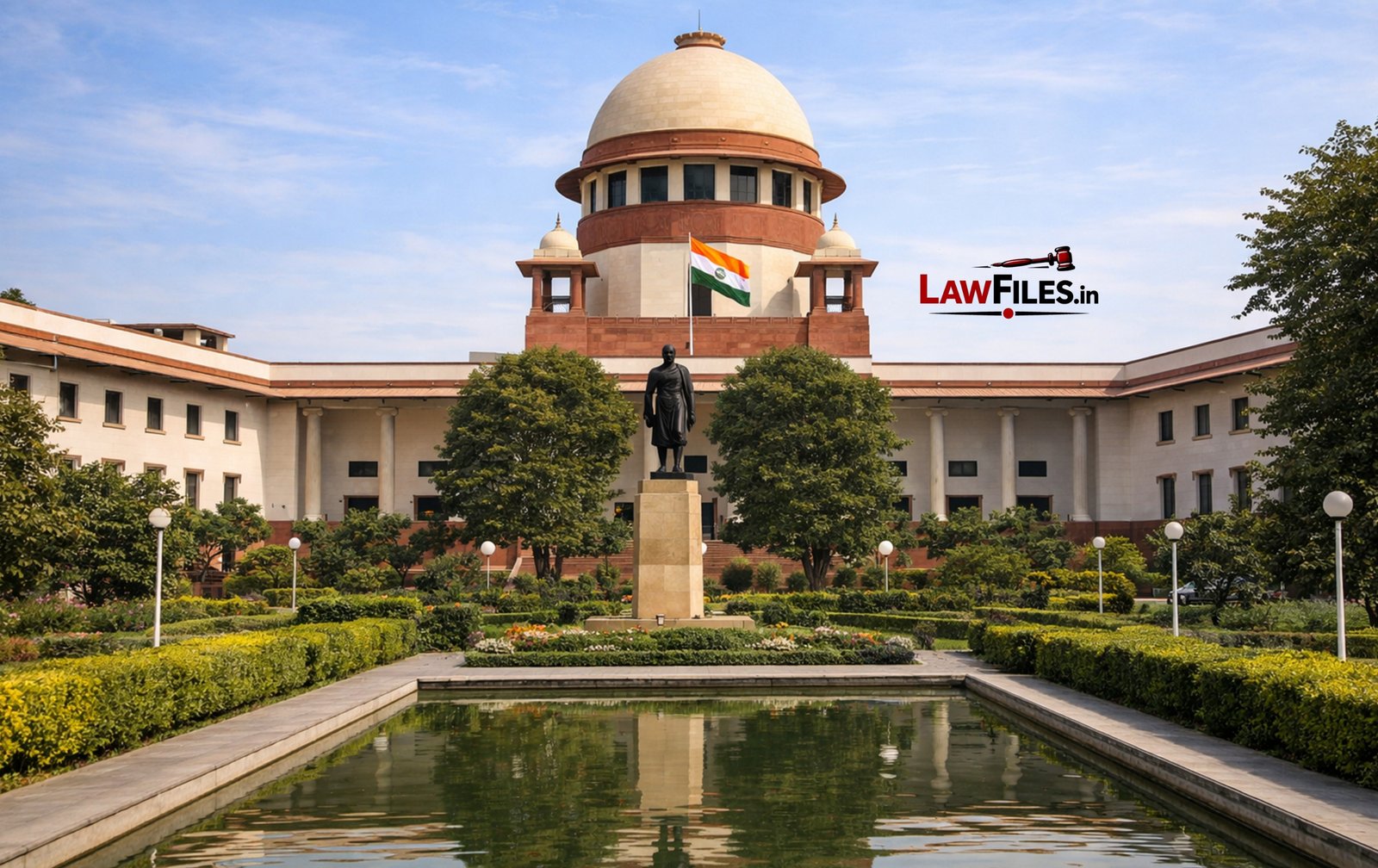
In a judgment that has reignited discussion on the constitutional status of Bar Associations and the limits of writ jurisdiction, the Supreme Court has upheld the Delhi High Court’s ruling that a Bar Association is not a “State” or an instrumentality of the State under Article 12 of the Constitution and, therefore, is generally not amenable to writ jurisdiction under Article 226. The decision, arising from a dispute involving the New Delhi Bar Association, carries implications that extend beyond the immediate controversy and touches upon the relationship between professional bodies, constitutional remedies, and self-governance within the legal profession.
A Bench comprising Justice P.S. Narasimha and Justice Aravind Kumar dismissed a Special Leave Petition filed against the Delhi High Court’s judgment in Sangita Rai v. New Delhi Bar Association. The Court refused to interfere with the High Court’s conclusion that a Bar Association, being a society of advocates formed primarily for the welfare and interests of its members, does not perform governmental or public functions that would bring it within the scope of Article 12. The Supreme Court also imposed costs of ₹25,000 on the petitioner, observing that the dispute essentially arose from occupation and use of a lawyers’ chamber and did not warrant invocation of extraordinary constitutional remedies.
The litigation originated from a dispute relating to a chamber situated within the Patiala House Courts complex. The petitioner claimed that she had been using the chamber for several years and alleged that certain advocates and office-bearers of the Bar Association had unlawfully interfered with her possession. She approached the High Court seeking directions against the New Delhi Bar Association and the Bar Council of Delhi. While some reliefs were subsequently abandoned, the principal question that survived was whether a writ could be issued against a Bar Association directing it to take action against certain advocates.
The Delhi High Court had answered this question in the negative. The Division Bench headed by Chief Justice Devendra Kumar Upadhyaya held that the New Delhi Bar Association is a society registered under the Societies Registration Act, 1860 and functions as a private association of lawyers. Its primary objective is the welfare of its members rather than the discharge of statutory or sovereign functions. Consequently, it could not be classified as a State authority or instrumentality of the State.
The Supreme Court’s endorsement of that reasoning is significant because it reinforces a long-standing constitutional principle: not every organisation connected with the justice delivery system automatically becomes subject to writ jurisdiction. Merely because a Bar Association functions within court premises or consists of officers of the court does not convert it into a public authority. Constitutional remedies under Articles 32 and 226 are ordinarily directed against the State, its instrumentalities, or bodies discharging public functions. The Court appears to have reaffirmed that professional associations must satisfy this threshold before writ jurisdiction can be invoked against them.
For law students and young practitioners, the judgment offers an important lesson regarding the distinction between Bar Associations and Bar Councils. These institutions are often discussed interchangeably, but legally they occupy very different positions. Bar Councils are statutory bodies established under the Advocates Act, 1961 and are entrusted with regulatory and disciplinary functions relating to the legal profession. Bar Associations, on the other hand, are generally voluntary associations or societies created for welfare, representation, and professional engagement of advocates. The present ruling highlights that this distinction is not merely organisational it has constitutional consequences.
The decision also contributes to a broader judicial conversation on the doctrine of “public function.” Indian courts have repeatedly held that even private bodies may be subject to writ jurisdiction if they perform functions of a public nature. Educational institutions, sporting bodies, and professional organisations have, in different contexts, been examined through this lens. The Delhi High Court concluded, and the Supreme Court declined to disturb the finding, that the routine functions of a Bar Association protecting members’ interests, conducting elections, and addressing welfare concerns do not amount to public functions sufficient to attract writ jurisdiction.
Interestingly, the ruling does not imply that Bar Associations are beyond legal scrutiny. Rather, it clarifies that constitutional writ proceedings may not be the appropriate forum for resolving certain disputes involving such bodies. The courts emphasised that civil remedies, criminal proceedings, or proceedings before competent statutory authorities may remain available depending upon the nature of the grievance. In the present case, the Supreme Court noted that criminal law had already been set in motion and that ordinary legal remedies were available to address the allegations made by the petitioner.
From a professional governance perspective, the judgment raises an interesting question about accountability within legal institutions. Bar Associations play an influential role in the functioning of courts. They represent lawyers, participate in policy discussions, organise professional activities, and often act as the collective voice of the Bar. Yet the Court’s ruling suggests that their accountability mechanisms primarily arise from their internal rules, governing statutes applicable to societies, and ordinary legal processes rather than constitutional writ jurisdiction. This reinforces the principle of institutional self-governance while simultaneously placing greater responsibility on Bar Associations to maintain transparent and fair internal processes.
The decision may also influence future litigation concerning elections, membership disputes, chamber allotments, and internal administration of Bar Associations. Advocates challenging decisions of such bodies may increasingly need to demonstrate either a statutory violation or the existence of a public law element before seeking constitutional remedies. This could encourage a more careful distinction between private professional disputes and issues genuinely involving public law principles.
For aspiring lawyers, the case provides a valuable illustration of constitutional concepts that frequently appear in litigation and competitive examinations. Questions surrounding Article 12, writ jurisdiction, public functions, and maintainability often arise in constitutional law, administrative law, and professional regulation. Understanding how courts apply these principles in practical disputes is essential for anyone seeking to build expertise in public law.
At a broader level, the judgment reflects judicial reluctance to constitutionalise every professional disagreement. Courts have repeatedly cautioned that extraordinary remedies are intended for extraordinary situations. By refusing to convert an internal professional dispute into a constitutional controversy, the Supreme Court has reaffirmed the importance of preserving the distinction between public law remedies and private disputes.
Ultimately, the ruling is not merely about the status of a Bar Association. It is about the architecture of constitutional governance itself. The judgment reinforces the principle that the availability of writ jurisdiction depends not on the identity of the parties alone but on the nature of the functions performed and the rights sought to be enforced. For the legal community, it serves as a reminder that professional autonomy and constitutional accountability must coexist within carefully defined boundaries.
As courts continue to refine the contours of Article 12 and Article 226, this decision is likely to be cited as an important precedent on the constitutional status of professional associations and the limits of judicial intervention in their internal affairs. For law students and young advocates, it is a judgment worth studying not only for what it says about Bar Associations, but for what it reveals about the evolving relationship between private bodies and public law in modern constitutional jurisprudence.
