

Close Menu
LawFilesLawFiles

    Subscribe to Updates

    Get the latest creative news from FooBar about art, design and business.

    What's Hot

    Advocacy Is Not Influencing, It Is a Public Trust: Bar Council of India Draws Ethical Boundaries for Lawyers in the Age of Social Media

    July 18, 2026

    ‘No Passenger Is Second-Class in a Constitutional Democracy’: Supreme Court Urges Railways to Curb Overcrowding, Reconsider Terminology and Strengthen Passenger Safety

    July 18, 2026

    Electoral Exclusion Is Not Citizenship Determination: Supreme Court Reaffirms Constitutional Limits on Election Commission’s Powers in West Bengal SIR Proceedings

    July 17, 2026
    Facebook X (Twitter) Instagram Threads
    Sunday, July 19
    LawFilesLawFiles
    Facebook X (Twitter)
    • Home
      • Who We Are
      • Our Mission
      • Advisory board
      • Contact US
    • Supreme Court
    • High Courts
      • Gujarat High Court
      • Jharkhand High Court
      • Rajasthan High Court
      • Karnataka High Court
      • Andhra Pradesh High Court
      • Allahabad High Court
      • Himachal Pradesh High Court
      • Chhattisgarh High Court
      • Jammu & Kashmir and Ladakh High Court
      • Kerala High Court
      • Punjab and Haryana High Court
      • Patna High Court
      • Madhya Pradesh High Court
      • Madras High Court
      • Bombay High Court
      • Orissa High Court
      • Calcutta High Court
      • Meghalaya High Court
      • Delhi High Court
      • Manipur High Court
      • Gauhati High Court
    • Corporate
    • Taxation Laws
      • Income Tax
      • GST
      • Customs & Excise
    • Global Affairs
    • Articles
      • Sitting Judge’s’ Views
      • Senior Advocate
      • Policy Analysis
      • Tax Expert
    • PILS
      • Free/Affordable Legal Aid
      • PIL Cell
      • Law student Volunteer Cell (research & Drafting)
      • NGO & Legal services Authority Tie-ups
      • Online Legal Formats
      • Online Legal Help Form
    Subscribe Premium
    LawFilesLawFiles
    Home»Supreme Court»A New Era for the Bar? Justices Vikram Nath and Sanjay Karol Push for Greater Space for Young Advocates
    Supreme Court

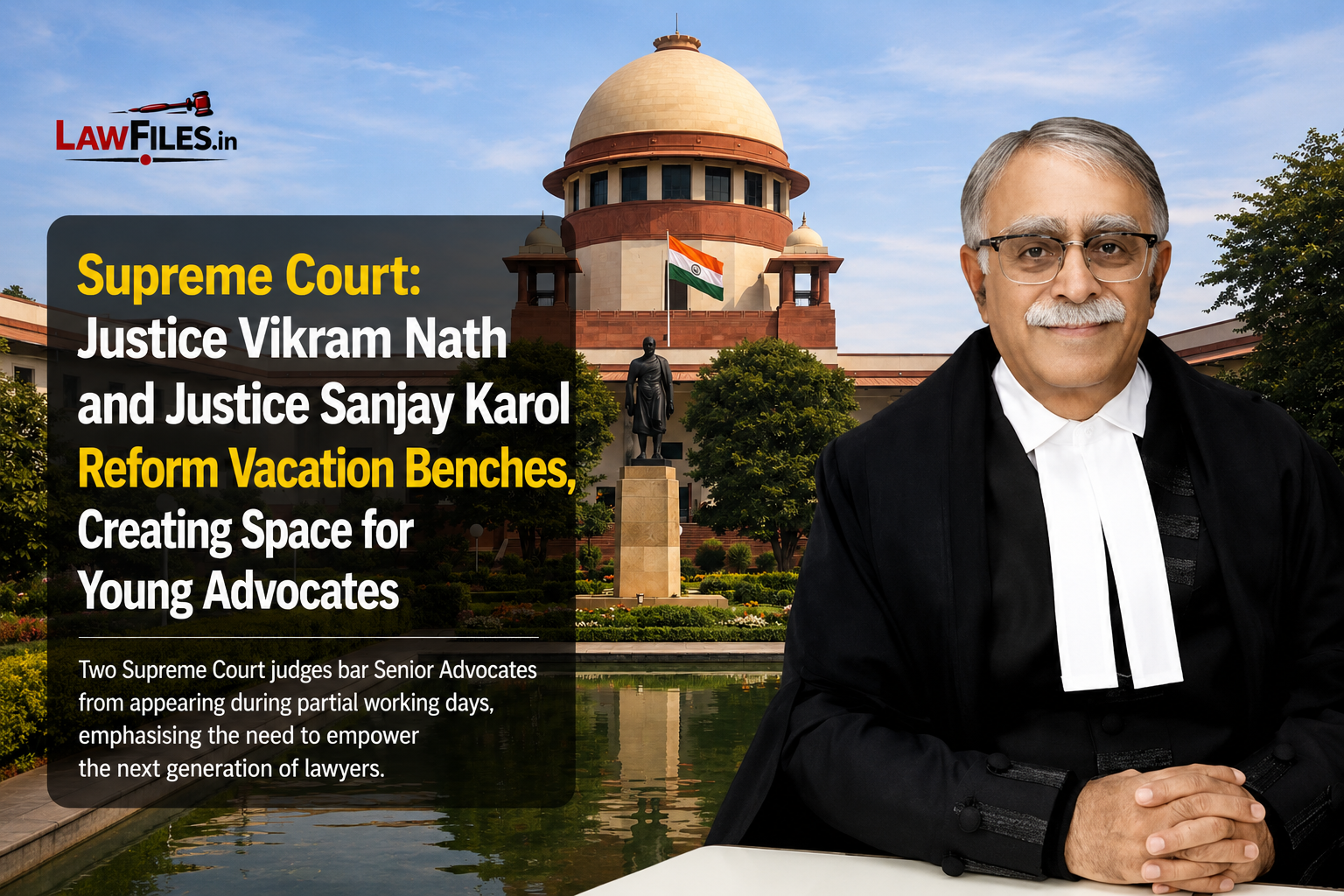
    A New Era for the Bar? Justices Vikram Nath and Sanjay Karol Push for Greater Space for Young Advocates

    Anvita DwivediBy Anvita DwivediJune 1, 2026No Comments6 Mins Read
    WhatsApp Facebook Twitter Copy Link
    Share
    Facebook Twitter Pinterest Copy Link WhatsApp

    A quiet but significant institutional shift appears to be unfolding within the Supreme Court during the newly introduced “partial court working days.” In a development that has sparked discussion across the legal fraternity, two sitting judges of the Supreme Court Justice Vikram Nath and Justice Sanjay Karol have made it clear that Senior Advocates will not be permitted to orally mention matters or argue cases before their vacation benches. While the immediate objective is to create opportunities for younger members of the Bar, the move has triggered a larger conversation about hierarchy, access, mentorship, and the future structure of advocacy before India’s highest court.

    The issue first gained attention when Justice Vikram Nath refused to allow Senior Advocates to appear before his bench during the partial working period of the Court. Reiterating a practice he has reportedly followed for several years, Justice Nath declared that no Senior Advocate would be permitted to mention or argue matters before him during vacations. Instead, Advocates-on-Record and junior counsel were encouraged to conduct proceedings themselves. The judge repeatedly emphasized that the purpose of the practice was to provide meaningful courtroom exposure to younger lawyers who otherwise remain in the shadows of India’s most prominent legal personalities.

    The significance of the development increased when Justice Sanjay Karol adopted a similar approach, effectively transforming what initially appeared to be an individual courtroom preference into a broader institutional trend. The convergence of two judges on the same issue has led many observers to ask whether the Supreme Court is gradually reimagining the role of vacation benches as spaces for professional development within the Bar rather than merely forums for urgent litigation. Reports indicate that Justice Karol’s court also declined appearances by designated Senior Advocates during the partial working period, insisting that younger counsel take responsibility for arguing their own cases. This has reinforced the perception that a conscious effort is underway to democratize courtroom participation.

    At first glance, the move may appear procedural. In reality, however, it touches the very architecture of legal practice in India. The institution of Senior Advocates occupies a unique constitutional and statutory position. Designated under Section 16 of the Advocates Act, Senior Advocates enjoy special professional recognition owing to their standing, expertise, and contribution to the law. Their presence often shapes the outcome of complex constitutional and commercial litigation. Yet their dominance has also generated criticism that younger lawyers frequently struggle to obtain meaningful opportunities before constitutional courts, particularly in high-stakes matters.

    The Supreme Court’s vacation benches have historically provided a limited but important platform where emerging lawyers could receive greater visibility. Several judges over the years have informally encouraged juniors to argue matters during vacation periods. Justice Vikram Nath’s position, however, represents a more structured and uncompromising approach. When Senior Advocate Siddharth Dave requested relaxation of the rule on the ground that many seniors had already been engaged in pending matters, Justice Nath declined, maintaining that the objective was to allow younger advocates to step forward. “Let young lawyers come,” the judge remarked while refusing to alter his position.

    The development is particularly noteworthy because it coincides with the Supreme Court’s transformation of the traditional summer vacation system into “partial court working days.” Under the revised arrangement, a significantly larger number of judges continue hearing cases during the summer months, and even the senior-most judges of the Court remain on the roster. The reform was intended to address concerns regarding pendency and judicial accessibility. Against this backdrop, the decision to prioritize younger lawyers assumes additional significance. If partial working days are designed to enhance judicial productivity, the exclusion of Senior Advocates can be viewed as a parallel effort to broaden professional participation within the legal system.

    From a policy perspective, the judges’ approach reflects a growing concern about concentration of advocacy opportunities in the hands of a relatively small group of elite practitioners. The Supreme Court Bar remains heavily influenced by a handful of Senior Advocates who appear in a substantial proportion of constitutionally significant cases. While this concentration often ensures high-quality advocacy, critics argue that it can limit courtroom exposure for younger lawyers and create structural barriers to professional advancement. By requiring junior counsel and Advocates-on-Record to argue matters themselves, the vacation benches appear to be addressing this concern directly.

    The move also resonates with broader debates about professional succession within the legal profession. Many of today’s leading Senior Advocates built their reputations by receiving opportunities to independently argue cases early in their careers. Yet the increasing complexity and commercialisation of litigation have arguably narrowed those opportunities for subsequent generations. In this context, the Supreme Court’s intervention may be understood as an attempt to preserve a culture of courtroom learning that is essential to the long-term health of the Bar.

    However, the policy is not without controversy. Critics contend that litigants have a right to engage counsel of their choice and that restrictions on appearances, even if temporary, may affect the quality of representation in urgent matters. Senior Advocates often possess specialised expertise acquired over decades of practice, particularly in complex constitutional, tax, arbitration, and commercial disputes. Some members of the Bar therefore argue that opportunities for younger lawyers should be expanded without entirely excluding senior practitioners.

    The debate also raises an important constitutional question about the balance between judicial control of courtroom procedure and litigants’ freedom to choose legal representation. Courts undoubtedly possess broad authority to regulate proceedings before them. Yet the exercise of that authority inevitably interacts with professional autonomy and litigant preference. Whether the present practice remains confined to vacation benches or influences regular court functioning in the future remains an open question.

    Nevertheless, the broader symbolism of the development cannot be ignored. The message emerging from Justices Vikram Nath and Sanjay Karol is not directed against Senior Advocates as an institution. Rather, it reflects a judicial recognition that the future strength of the Bar depends upon creating opportunities for the next generation. By compelling younger lawyers to step into the spotlight, the judges are effectively challenging long-standing professional hierarchies that have shaped Supreme Court practice for decades.

    Viewed in a wider context, the development reflects an evolving judicial philosophy that places institutional capacity-building alongside adjudication. Courts are not merely forums for deciding disputes; they are also spaces where future generations of lawyers are trained, tested, and refined. The refusal to permit Senior Advocates during partial working days is therefore more than a courtroom rule. It is an experiment in professional renewal—one that seeks to ensure that constitutional advocacy remains vibrant, diverse, and accessible to emerging talent.

    Whether the initiative becomes a permanent feature of Supreme Court practice remains uncertain. What is clear, however, is that it has reopened an important conversation about privilege, opportunity, and professional equality within India’s legal system. At a time when concerns regarding access to justice often dominate legal discourse, the Supreme Court appears to be asking a different but equally important question: who gets access to the courtroom itself?


    A New Era for the Bar? Justices Vikram Nath and Sanjay Karol Push for Greater Space for Young Advocates
    Share. WhatsApp Facebook Twitter Pinterest Email
    Anvita Dwivedi

    Related Posts

    Advocacy Is Not Influencing, It Is a Public Trust: Bar Council of India Draws Ethical Boundaries for Lawyers in the Age of Social Media

    July 18, 2026

    ‘No Passenger Is Second-Class in a Constitutional Democracy’: Supreme Court Urges Railways to Curb Overcrowding, Reconsider Terminology and Strengthen Passenger Safety

    July 18, 2026

    Electoral Exclusion Is Not Citizenship Determination: Supreme Court Reaffirms Constitutional Limits on Election Commission’s Powers in West Bengal SIR Proceedings

    July 17, 2026
    Add A Comment
    Leave A Reply Cancel Reply

    Demo
    Top Posts

    Digital Forensics Fail to convince Supreme Court: Bail Denied to Gagan Khanna in BNS Assault Case

    June 15, 2026246 Views

    Wrongful Claim Rejection Amounts to Deficiency in Service: Delhi Consumer Commission Holds Star Health Liable

    March 16, 202673 Views

    Banking Negligence and Consumer Accountability: Supreme Court Reinforces Duty of Care in Cheque Handling

    April 16, 202668 Views

    Bombay High Court Quashes POCSO Case, Directs Accused to Fund MacBook for Victim’s Education

    February 28, 202662 Views
    Don't Miss

    Advocacy Is Not Influencing, It Is a Public Trust: Bar Council of India Draws Ethical Boundaries for Lawyers in the Age of Social Media

    By Anvita DwivediJuly 18, 2026

    In one of the most significant regulatory interventions concerning the legal profession in the digital…

    ‘No Passenger Is Second-Class in a Constitutional Democracy’: Supreme Court Urges Railways to Curb Overcrowding, Reconsider Terminology and Strengthen Passenger Safety

    July 18, 2026

    Electoral Exclusion Is Not Citizenship Determination: Supreme Court Reaffirms Constitutional Limits on Election Commission’s Powers in West Bengal SIR Proceedings

    July 17, 2026

    Witness Protection, Fair Trial and Investigative Neutrality: Supreme Court Records UP Police Report Clearing Ashish Mishra and Ajay Mishra in Separate Witness Intimidation Probe

    July 16, 2026
    Stay In Touch
    • Facebook
    • Twitter

    Subscribe to Updates

    Get the latest creative news from SmartMag about art & design.

    Top Posts

    Digital Forensics Fail to convince Supreme Court: Bail Denied to Gagan Khanna in BNS Assault Case

    June 15, 2026246 Views

    Wrongful Claim Rejection Amounts to Deficiency in Service: Delhi Consumer Commission Holds Star Health Liable

    March 16, 202673 Views

    Banking Negligence and Consumer Accountability: Supreme Court Reinforces Duty of Care in Cheque Handling

    April 16, 202668 Views
    Don't Miss

    Advocacy Is Not Influencing, It Is a Public Trust: Bar Council of India Draws Ethical Boundaries for Lawyers in the Age of Social Media

    By Anvita DwivediJuly 18, 2026

    In one of the most significant regulatory interventions concerning the legal profession in the digital…

    ‘No Passenger Is Second-Class in a Constitutional Democracy’: Supreme Court Urges Railways to Curb Overcrowding, Reconsider Terminology and Strengthen Passenger Safety

    July 18, 2026

    Electoral Exclusion Is Not Citizenship Determination: Supreme Court Reaffirms Constitutional Limits on Election Commission’s Powers in West Bengal SIR Proceedings

    July 17, 2026

    Witness Protection, Fair Trial and Investigative Neutrality: Supreme Court Records UP Police Report Clearing Ashish Mishra and Ajay Mishra in Separate Witness Intimidation Probe

    July 16, 2026
    Stay In Touch
    • Facebook
    • YouTube
    • TikTok
    • Instagram
    Top Trending
    About Us
    About Us

    LawFiles.in is a comprehensive legal news platform delivering real-time updates from the Supreme Court, High Courts, Tribunals, Corporate and Tax law, Regulators, Politics, Crime, Consumer cases, and Global Affairs.

    Email Us: lawfilesoffical@gmail.com
    Contact: +91 8800026066

    Contact Us:
    India International Centre
    40, Max Mueller Marg
    Lodhi Estate, New Delhi-110003

    Facebook X (Twitter)
    Our Picks

    Advocacy Is Not Influencing, It Is a Public Trust: Bar Council of India Draws Ethical Boundaries for Lawyers in the Age of Social Media

    July 18, 2026

    ‘No Passenger Is Second-Class in a Constitutional Democracy’: Supreme Court Urges Railways to Curb Overcrowding, Reconsider Terminology and Strengthen Passenger Safety

    July 18, 2026

    Electoral Exclusion Is Not Citizenship Determination: Supreme Court Reaffirms Constitutional Limits on Election Commission’s Powers in West Bengal SIR Proceedings

    July 17, 2026

    Witness Protection, Fair Trial and Investigative Neutrality: Supreme Court Records UP Police Report Clearing Ashish Mishra and Ajay Mishra in Separate Witness Intimidation Probe

    July 16, 2026

    Remission Is a Constitutional Process, Not an Automatic Right: Supreme Court Directs Odisha Government to Decide Dara Singh’s Premature Release Plea in Graham Staines Murder Case

    July 15, 2026
    Most Popular

    Supreme Court Rules Limitation Period Under CrPC Starts When Offender’s Identity Is Known, Not From First Complaint

    February 27, 20260 Views

    Maharashtra State Consumer Commission Slams HP Employees’ Co-operative Credit Society for Enforcing Undisclosed Restriction, Orders Refund with Interest and Compensation

    March 2, 20260 Views

    Repeated Vehicle Defects Amount to Deficiency in Service: Chandigarh Consumer Commission Awards ₹4 Lakh Compensation to Ford Owner

    March 9, 20260 Views

    Order VI Rule 17 Proviso Not Applicable to Pre-2002 Suits: Allahabad High Court Allows Amendment in 1997 Plaint

    March 9, 20260 Views

    India’s Tribunal Crisis: Supreme Court Questions Who Guards the Guardians

    March 10, 20260 Views
    © 2026 LawFiles. Owned by Varta24 Media.
    • Articles
    • Careers
    • Corporate
    • Global Affairs
    • Law Firms & Lawyers
    • PILS
    • Regulatory

    Type above and press Enter to search. Press Esc to cancel.