


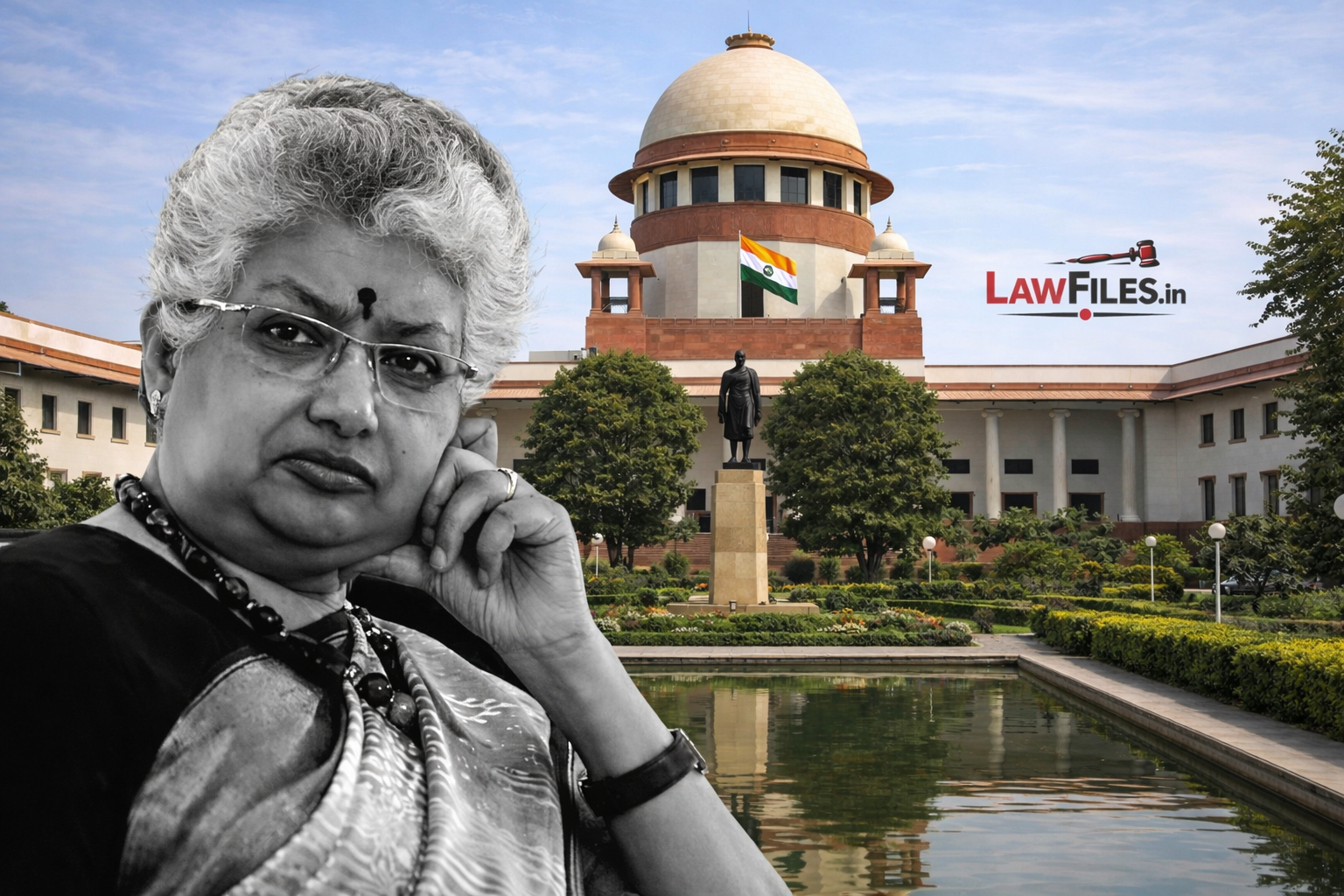
In a development carrying major constitutional and legal implications, the Supreme Court recently expressed serious reservations about the judgment that denied bail to former student activist Umar Khalid in the Delhi riots larger conspiracy case under the Unlawful Activities (Prevention) Act, 1967 (UAPA). The Court observed that the earlier two-judge bench ruling appeared to have disregarded the binding precedent laid down by a larger three-judge bench in Union of India v. K.A. Najeeb, which recognised prolonged incarceration and delay in trial as valid constitutional grounds for granting bail even under stringent anti-terror legislation.
The observations were made by a Bench comprising Justice B.V. Nagarathna and Justice Ujjal Bhuyan while granting bail to a Jammu and Kashmir accused in a narco-terror case under the UAPA who had remained incarcerated for more than six years without conclusion of trial. In the course of the judgment, the Bench openly disapproved of recent judicial approaches that diluted the principles laid down in K.A. Najeeb, particularly referring to the decision in Gulfisha Fatima v. State, which had denied bail to Umar Khalid and Sharjeel Imam earlier this year.
The Court underscored that judicial discipline requires smaller benches to follow precedents established by larger benches. Justice Ujjal Bhuyan, writing for the Bench, observed that a coordinate or smaller bench cannot circumvent, dilute, or effectively override principles already settled by a larger bench without referring the matter for reconsideration. The judgment stated that the earlier bail denial appeared difficult to reconcile with the constitutional reasoning adopted in K.A. Najeeb, where the Supreme Court had held that excessive pre-trial incarceration could justify bail notwithstanding the restrictive provisions contained in Section 43D(5) of the UAPA.
The significance of these observations extends far beyond Umar Khalid’s individual case. They reopen one of the most contentious constitutional debates in contemporary India: whether anti-terror laws can effectively convert prolonged incarceration into punishment without trial. Under ordinary criminal jurisprudence, bail is traditionally considered the rule and jail the exception. However, the UAPA reverses this framework by imposing severe restrictions on grant of bail once courts conclude that accusations appear prima facie true.
Over time, this stringent statutory structure has resulted in a growing pattern where accused persons remain imprisoned for years before trials even begin meaningfully. In several UAPA prosecutions, especially those involving alleged conspiracies, investigations generate voluminous chargesheets, hundreds of witnesses, and extraordinarily delayed trials. Consequently, incarceration often extends for half a decade or more without judicial determination of guilt.
It was precisely this constitutional danger that the Supreme Court sought to address in K.A. Najeeb in 2021. In that landmark judgment, a three-judge Bench held that constitutional courts retain the authority to grant bail where prolonged detention and delayed trial threaten the accused’s fundamental right to personal liberty under Article 21 of the Constitution. The Court clarified that statutory restrictions under the UAPA cannot completely extinguish constitutional protections relating to speedy trial and human liberty.
The recent observations by Justice Nagarathna and Justice Bhuyan suggest judicial concern that subsequent decisions may have narrowed or undermined the constitutional balance established in K.A. Najeeb. The Bench specifically criticised attempts to create rigid “two-pronged tests” for bail under the UAPA that effectively make release impossible irrespective of the duration of incarceration. According to the Court, such interpretations risk transforming anti-terror detention into indefinite imprisonment without adjudication.
Critically analysed, the controversy reveals a growing doctrinal conflict within Indian anti-terror jurisprudence. One line of judicial reasoning prioritises national security considerations and defers heavily to prosecutorial allegations at the pre-trial stage. Another constitutional approach insists that even anti-terror legislation must remain subject to Article 21 protections against arbitrary deprivation of liberty. The Supreme Court’s latest observations indicate that the judiciary itself is increasingly grappling with the consequences of excessively prolonged incarceration under stringent security laws.
The Umar Khalid case has become emblematic of this constitutional conflict. Khalid, arrested in September 2020 in connection with the alleged larger conspiracy behind the 2020 Delhi riots, has remained incarcerated for years while trial proceedings continue at a slow pace. The prosecution alleges his involvement in a broader conspiracy linked to communal violence in northeast Delhi, accusations he has consistently denied. His bail applications before trial courts, the Delhi High Court, and eventually the Supreme Court repeatedly generated intense legal and political debate.
In January 2026, the Supreme Court denied bail to Umar Khalid and Sharjeel Imam while granting relief to several co-accused. The Court then distinguished their alleged role from other accused persons by describing them as central conspirators in the prosecution narrative. However, the recent remarks suggest that another Bench of the Court now views aspects of that reasoning with considerable caution, especially regarding treatment of prolonged incarceration and precedent.
The issue also intersects with the broader problem of low conviction rates under the UAPA. In the same judgment, the Supreme Court referred to official NCRB statistics placed before Parliament showing that national conviction rates under the anti-terror law range between approximately 1.5% and 6%, while conviction rates in Jammu and Kashmir reportedly remain below 1%. The Court observed that such figures indicate a very high probability of eventual acquittal despite prolonged detention.
These observations fundamentally challenge the operational logic of preventive anti-terror detention. If acquittals constitute the overwhelming majority of outcomes, prolonged incarceration before conviction raises serious constitutional concerns regarding fairness, proportionality, and abuse of process. The Court’s remarks implicitly recognise that the criminal process itself may become punitive when trials remain indefinitely delayed.
Historically, India’s experience with extraordinary security legislation has repeatedly produced similar tensions. The Terrorist and Disruptive Activities (Prevention) Act (TADA) and the Prevention of Terrorism Act (POTA) both faced severe criticism over allegations of misuse, prolonged detention, and negligible conviction rates before eventually being repealed or allowed to lapse. The UAPA, though structurally different, inherited several features associated with preventive detention and restrictive bail regimes.
Another important dimension of the present controversy concerns judicial hierarchy and precedent. The Court’s observations strongly reaffirm the doctrine that smaller benches are constitutionally bound by judgments delivered by benches of greater numerical strength. This principle forms the backbone of judicial consistency and institutional coherence within constitutional courts. By emphasising that smaller benches cannot disregard larger bench precedents, the Supreme Court has also indirectly addressed concerns regarding fragmentation in constitutional interpretation.
The controversy further reveals how bail jurisprudence itself has become one of the most contested arenas of constitutional law in India. Questions concerning liberty, dissent, national security, and preventive detention increasingly converge in bail hearings under statutes such as the UAPA. Courts are therefore no longer deciding merely procedural applications but balancing competing visions of constitutional governance itself.
The timing of the observations is also institutionally significant. Recently, the sanctioned strength of the Supreme Court was increased from 34 to 38 judges through a presidential ordinance aimed at addressing growing pendency and constitutional workload. Historically, the Supreme Court began in 1950 with only eight judges, gradually expanding through legislative amendments in response to increasing litigation and expanding constitutional responsibilities. Over the decades, the Court evolved from a relatively compact appellate body into one of the world’s busiest constitutional courts adjudicating issues involving national security, civil liberties, technology, federalism, and democratic governance.
Yet despite this expansion in numerical strength, constitutional courts today confront increasingly complex dilemmas where legal doctrine intersects with political conflict and public anxiety. The Umar Khalid controversy illustrates how questions of bail under anti-terror laws now carry implications extending beyond individual liberty into broader debates concerning dissent, State power, and constitutional morality.
The Supreme Court’s latest observations may therefore reshape future UAPA litigation. Defence lawyers are likely to increasingly invoke K.A. Najeeb while challenging prolonged incarceration, whereas courts may face renewed pressure to ensure that stringent statutory provisions do not effectively eliminate meaningful constitutional scrutiny.
Ultimately, the Court’s criticism of the judgment denying bail to Umar Khalid represents more than a technical disagreement over precedent. It reflects a deeper judicial struggle over the constitutional limits of preventive detention, the meaning of liberty under Article 21, and the role of courts in ensuring that anti-terror laws do not transform accusation into punishment through endless incarceration without trial
