


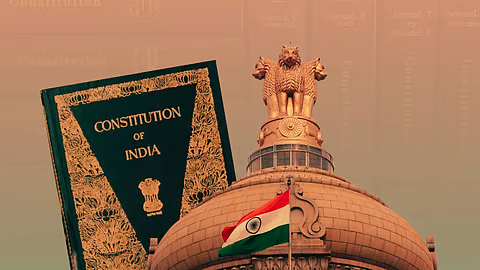
⚖️ A Constitutional Flashpoint
The week that has just gone by witnessed an extraordinary constitutional impropriety by the Governors of Tamil Nadu, Kerala, and Karnataka—States governed by parties different from the ruling party at the Union level. By refusing to deliver the Opening Address at the commencement of the legislative session, these constitutional heads openly defied a clear constitutional mandate, almost triggering a constitutional crisis.
This conduct is not a matter of political disagreement or personal discretion. It strikes at the very architecture of constitutional governance.
📜 What the Constitution Mandates
The Constitution speaks in unambiguous and mandatory terms.
Relevant Provisions
-
Article 87(1) – Mandates that the President shall address both Houses of Parliament
-
Article 176(1) – Mandates that the Governor shall address the State Legislature
These provisions apply:
-
At the first session after every general election, and
-
At the first session of every year
The language is mandatory, not discretionary.
The words “shall address” admit of no constitutional choice, preference, or political veto.
🏛️ Historical Context: From Every Session to Annual Session
Originally, the Constitution required the President/Governor to address the legislature at the commencement of every session.
This was modified by the Constitution (First Amendment) Act, 1951, which rationalised the requirement to:
-
The first session after elections, and
-
The first session of each year
However, what changed was frequency, not obligation.
The constitutional duty remained absolute.
🚨 Why This Refusal Is Constitutionally Dangerous
The Opening Address is not a personal speech of the Governor. It is:
-
A constitutional communication
-
Made on the aid and advice of the Council of Ministers
-
Reflecting the policy priorities of the elected government
By refusing to deliver it, the Governor:
-
Disrupts legislative functioning
-
Undermines the authority of the elected government
-
Oversteps constitutional boundaries
-
Transforms a ceremonial head into a political actor
This conduct directly violates the principle that:
The Governor is bound by constitutional duty, not political alignment.
⚠️ From Neutral Arbiter to Political Obstruction
The Constitution envisages the Governor as:
-
A neutral constitutional sentinel
-
Not an agent of the Union executive
-
Not an opposition authority to an elected State government
When Governors selectively comply with constitutional mandates depending on political convenience, it:
-
Erodes federalism
-
Distorts separation of powers
-
Weaponises constitutional offices
Such actions reduce constitutional morality to partisan expediency.
🧠 Constitutional Morality at Stake
Dr. B.R. Ambedkar repeatedly emphasised that:
The Constitution can only work if those in authority respect its spirit.
The refusal to deliver the Opening Address is not a procedural lapse—it is a deliberate constitutional transgression.
If constitutional heads can pick and choose which duties to perform, the Constitution becomes:
-
A suggestion, not a command
-
A political instrument, not a legal framework
🏁 Conclusion: A Warning Signal
What transpired in these States is a grim reminder that constitutional breakdowns often begin not with dramatic coups, but with quiet defiance of mandatory provisions.
The Constitution is not desecrated only by its suspension—but also by its selective obedience.
If such conduct is normalised, the office of the Governor risks becoming a site of constitutional sabotage rather than constitutional stability.
